Opinion
The true worth of an Indian passport
…and the glories India’s first citizen is earning the nation on his many foreign trips
Even as the ministry of external affairs tries to make up its mind about the Indian passport, what it is and isn’t, whether it is proof of Indian citizenship or not, the 2026 edition of the Global Passport Index (GPI) published in early July ranks India 125 among 197 countries. Not terribly flattering, whichever way you count, especially for a country that fancies itself as ‘Vishwaguru’ with the most widely travelled Indian prime minister ever, not out on a century-plus foreign trips since assuming office in 2014.
Unlike the highly cited Henley Passport Index, which ranks passports based on the number of destinations their holders can access visa-free, the GPI, brought out by citizenship advisory firm Global Citizen Solutions headquartered in London, uses a scoring system that measures the strength of passports on three parameters — global mobility or visa-free travel, which is assigned 50 per cent weightage; how friendly a country is to foreign investors, including tax regimes and business environment (25 per cent); and living conditions, personal freedoms and global reputation (25 per cent).
In mid-May, Prime Minister Narendra Modi exhorted Indians to avoid foreign travel on account of the multiple economic crises buffeting India because of the West Asia war. He was presumably worried about India’s low oil reserves and dwindling foreign exchange reserves. The concerns weren’t entirely misplaced but his list of don’ts for citizens, with or without passports, was frankly laughable.
Soon after he’d lectured Indians on the need for austerity, he set off on more foreign jaunts. As temperatures soared in Delhi, he hit the cooler climes of Europe. But another kind of heat lay in store. In the Netherlands, Dutch Prime Minister Rob Jetten voiced concerns about the erosion of press freedom and minority rights in India. In Norway, journalist Helle Lyng Svendsen asked Modi why he doesn’t take questions from the media.
At a presser later, Lyng asked an Indian diplomat, “Why should we trust you (India)? Can you try to stop the human rights violations that go on in your country?” Sibi George, India’s MEA secretary (West), tied himself in knots fielding the question, and soon became the butt of jokes on social media.
Modi’s inability to handle Q&A sessions with journalists — de rigueur in a democracy — has become a pathology and is a national embarrassment. He is not even willing to use an inter-preter and reply in Hindi, the language in which he is easily more fluent, also the language his government wants all Indians to embrace without question.
India’s pliant and beholden mainstream media may be content with dictations, set pieces and third-party material from social media handles, but the fourth estate in still-functioning democracies is calling out Modi’s evasion of questions, especially since the assault on citizen freedoms and minorities in India is now an open secret abroad.
Foreign governments have assessed that he does not really understand international affairs. What he craves is publicity and a sure way to extract concessions is to pander to his vanity.
In Italy, which followed the bruising stops in the Netherlands and Norway, Italian prime minister Giorgia Meloni waltzed him around Rome, hosted a dinner at the Colosseum, clicked selfies and received the Indian candy ‘Melody’ (which Meloni coyly interpreted as a blend of Meloni and Modi). And guess what? When Modi met Meloni at the G7 summit in France a month later, he couldn’t resist mentioning that photos of them together had gone ‘viral’ on Instagram! Diplomacy 101.
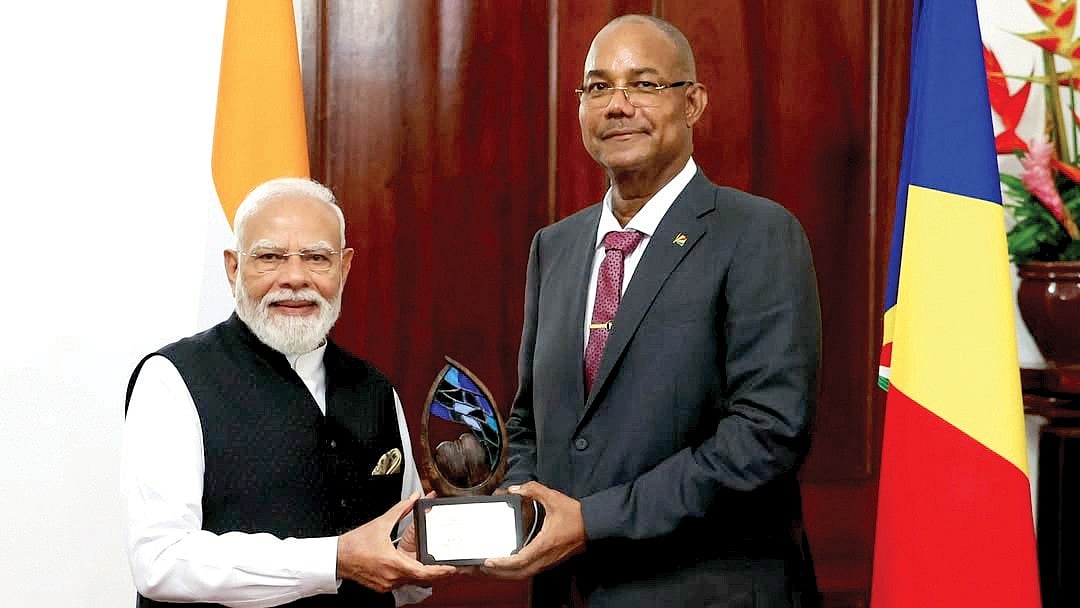
Our prime minister also has a penchant for collecting international awards, which is getting attention in foreign media. Following his visit to Seychelles in late June to collect the newly minted ‘Guardian of the Blue Horizon’ award, Britain’s Guardian newspaper ran a report headlined: ‘Give him any award, and he’ll come running.’ It wrote: ‘The award, it transpired, had only been created three days before Modi’s arrival and he was the first and only recipient.’
The hurriedly produced certificate even misspelled ‘republic’ as ‘repubblic’ and ‘Seychelles’ as ‘Seycheeles’. [...] A red-faced Seychelles foreign ministry claimed that a ‘working draft’ had accidentally been circulated and that an ‘authentic and duly approved’ version had now been issued.’ But our broadminded prime minister collected it with pride nevertheless.
The importance of heads of government meetings should not be underestimated. But what has Modi achieved in his 12 years of frequent flying that an Indian ambassador or foreign minister couldn’t have accomplished? How is a prime minister who is so happy to preach frugality to citizens so unconcerned about throwing crores of taxpayer rupees on foreign photo-ops?
An utter lack of substance seems to define his overseas engagements. Almost every departure from time-tested Indian policies — the foundations of which were laid by India’s first Prime Minister Jawaharlal Nehru and tweaked for post-Cold War circumstances by Prime Minister P.V. Narasimha Rao — has been a disaster.
Jumping into America’s lap without obtaining any concessions or guarantees from Washington and making a trip to Israel and hugging its Prime Minister Benjamin Netanyahu on the eve of the US–Israel airstrikes on Iran have done India no favours.
Not a single country in the world, other than Israel, endorsed his government’s military action — codenamed Operation Sindoor — against Pakistan last year. In contrast, Pakistan won active support from China, Turkey and Azerbaijan, with Saudi Arabia standing by. And this, despite India’s desperate efforts to have it named and shamed and treated as a pariah state. This was the same Saudi Arabia whose crown prince was wooed by Modi and which now has a Strategic Mutual Defence Agreement with Pakistan.
Then came trips to Indonesia, Australia and New Zealand. At his first halt, Modi was forced to listen to the Indonesian president extol Nehru’s role in enabling his country’s independence and as the ‘Father of Non-alignment’.
In Australia, Amnesty International urged the Australian govern-ment to raise India’s human rights record, while Alliance Against Islamophobia protested against ‘bigotry and persecution’ of Muslims and backward castes.
A reporter with 7News, Australia’s most watched news service, said in a piece-to-camera as Modi walked by in the distance behind him, “This is about as close as you’ll get to Narendra Modi on his trip to Melbourne. He famously avoids unscripted news conferences, preferring instead more stage-managed appearances.”
Incidentally, the announcement that Australia had agreed to supply uranium to India was old news repackaged as new. Canberra did this in 2011 when Dr Manmohan Singh was prime minister.
Stuff, a news platform in New Zealand, revealed that Modi’s advance security and logistics team had asked the organisers to ‘allow for nap times’ and select ‘venues without stairs’. But that worry aside, we learnt from Rudrendra Tandon, MEA secretary (East), why Modi doesn’t do press meets: apparently because he is a “quintessential Indian politician” who “has perfected the art of direct contact with his electorate”.
Ashis Ray was editor-at-large of CNN, and is the author of The Trial that Shook Britain. More of his writing here
Join our official telegram channel (@nationalherald) and stay updated with the latest headlines