Opinion
One-sided, humiliating and unacceptable
Instead of leveraging India’s strengths to extract concessions, Modi’s negotiators capitulated, even accepting bullying terms like ‘monitoring’ by the US
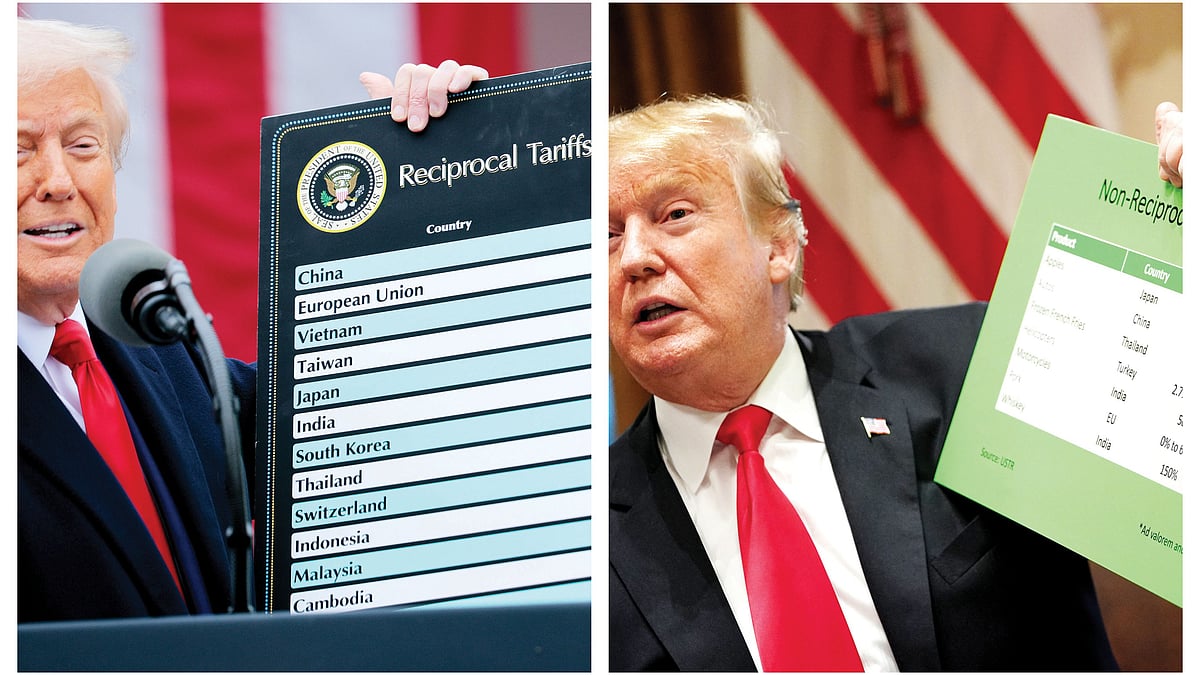
He had heard of ‘frameworks’ for an agreement. And he’d heard of ‘interim agreements’. But would someone please explain what a ‘framework to an interim agreement’ was? Economist Rathin Roy’s scathing reaction to the India-US joint statement summed up the absurdities of the ‘major deal’ hailed by Prime Minister Narendra Modi and tom-tommed by his underlings in government.
The announcement, the timing and the language used left no doubt that India had, as former finance secretary Subhash Chandra Garg put it, capitulated.
On 2 February, four days before the joint statement was issued, US President Donald Trump posted on Truth Social that the Indian prime minister had agreed to the long-awaited trade deal, that India had agreed to stop buying Russian oil, that India would buy American products ‘at a much higher level’ and purchase much more from the US and Venezuela. In return, the US would reduce ‘reciprocal tariffs’ from 25 to 18 per cent.
This was followed by PM Modi’s tweet welcoming the tariff reduction, stressing his friendship with Trump and declaring that the partnership would unlock ‘immense potential’ for both countries.
The euphoria lasted all of four days. On 6 February, the one-page joint statement (a.k.a. ‘framework to an interim agreement’) was issued from Washington D.C. while India was still asleep. This was most unusual. The Press Information Bureau (PIB) released the statement at 4.20 am IST. Bereft of details as it was, there was enough there to shock trade experts.
While the final trade agreement — a legal document — would take up several thousand pages, the one-pager clearly stated that India had agreed to stop buying Russian oil, had agreed to the US monitoring (emphasis added) its oil purchases and had agreed to reduce import duty on most US products to zero.
‘This disastrous deal will hurt and haunt India for decades to come,’ wrote Garg in the Deccan Herald. There was nothing ‘reciprocal’ about the US imposing 18 per cent tariff on imports from India and India imposing zero tariff on US imports.
Ajay Srivastava, international trade negotiator and founder of the Global Trade Research Initiative, New Delhi, wonders what India could import from the US — it produces little of the industrial and consumer goods India needs. The wording of the joint statement, he says, is worrying. While India has committed to ease non-tariff barriers, the US has made no commitment to dilute laws and regulations to facilitate the entry of goods from India.
While India has surrendered to monitoring by the US, the 18 per cent tariff is conditional — on India not buying Russian oil directly or indirectly. The asymmetry in the joint statement was glaring enough for author and commentator Dr Bramha Chellaney to underline that “India’s obligations are immediate, quantified and subject to formal monitoring, while American ‘concessions’ are largely conditional, reversible or simply corrective… the US Trade Representative and the White House frame India as a ‘market’ to be unlocked rather than a strategic partner, emphasising gains for American workers and exporters by opening a massive consumer base for [the] US”.
Most Indians saw the statement for the bullying it was. A cartoon by Sorit in Down to Earth shows a farmer asking why the trade deal is being called ‘historic’. A worker carrying a loaded basket replies: ‘Because Indian farming will become history after the deal’.
A wit posted on social media: ‘Did a historic trade deal with my bar. According to the deal, I will drink only from that bar and not buy drinks from any other bar. In return, he will continue to sell me highly priced drinks.’
Another commentator said: “The US has done to India what the Indian government is used to doing to its citizens — taken away rights and imposed penalties, only to ease them as a great favour.”
****
The Indian government, argues Srivastava, might like to think that the war in Ukraine will end soon and sanctions on Russia will be lifted; that the US Supreme Court will strike down President Trump’s reciprocal tariffs as illegal and that the US president will become a lame duck after mid-term elections in November.
Nothing else can explain India’s acceptance of such humiliating terms. “Are you not ashamed of what you have done?” asked Leader of the Opposition in the Lok Sabha, Rahul Gandhi, while addressing the treasury bench on the Union budget.
Within hours of Union commerce minister Piyush Goyal gloating that the US tariff of 18 per cent gave India an advantage over countries like Bangladesh and Vietnam, the US signed a trade deal with Bangladesh.
Bangladesh — which does not grow any cotton but is a major exporter of textile and garments — agreed to import cotton from the US. In return, the US offered to impose zero tariff on textile and garments manufactured in Bangladesh using US-produced cotton or man-made fibres. Which may be curtains for textiles and garments made in India, which is also the second largest grower of cotton after China.
Contrary to Goyal’s brag, the US trade deals with India and Bangladesh have left Indian textiles facing the grim prospect of losing dominant market share in the US.
India has agreed to ‘eliminate or reduce tariffs on all US industrial goods and to cut duties on a wide range of US farm and food products, including DDGS (distillers dried grains with solubles ) and red sorghum for feed, tree nuts and fruits, soyabean oil, wine and spirits… to provide preferential market access in agreed sectors, address discriminatory or burdensome digital trade practices and to work towards digital trade rules’.
The joint statement also recorded that ‘India intends to purchase $500 billion worth of US goods over five years, including energy products, aircraft and parts, precious metals, technology products and coking coal’.
What worries Srivastava even more are those parts of the statement that are vague and open to interpretation. For instance, in the phrase ‘both sides to align on economic security and supply chain resilience’ what does ‘alignment’ mean? Speaking to Karan Thapar in an interview for The Wire, Srivastava said he was alarmed to find a provision in the US-Malaysia deal that trade relations with third countries would also be vetted by the US. Indian negotiators must avoid such draconian provisions while working out the final deal, he cautioned.
For Indian farmers, the new Indo-US interim trade deal is a worrying case of history repeating itself. Nearly six years after the Union government attempted to push through the three farm laws — legislation that farmers rightly believed would leave them at the mercy of market forces — Indian agriculture is once again confronting what many see as an existential threat. The core concern is that Indian farmers, mostly small and marginal, are being asked to compete with some of the most heavily subsidised agricultural producers in the world.
The average landholding in India is around 1–1.5 hectares (roughly 2–3 acres). In contrast, the average farm size in the United States exceeds 170 hectares (over 400 acres). American agriculture operates on a massive scale with mechanisation, advanced storage, insurance coverage and direct income support.
According to US agricultural data, American farmers receive substantial government support. Direct and indirect subsidies, crop insurance, disaster payments and federal farm programmes together provide tens of billions of dollars annually. Reports suggest that average support per farm in the US runs into tens of thousands of dollars each year. An additional multi-billion-dollar farm assistance programme has been proposed for 2026 alone.
The deal allows tariff reduction or elimination on a range of products like soyabean oil, DDGS and red sorghum used for animal feed. Soyabean farmers in Madhya Pradesh, Maharashtra, Telangana and Rajasthan are already facing a crisis. Market prices often hover 20-30 per cent below the minimum support price (MSP). Imports of cheaper soyabean oil — particularly from a country where over 90 per cent of soya production is genetically modified and highly mechanised — could further depress domestic prices.
Similarly, red sorghum and maize imports for animal feed can reduce demand for Indian-grown maize and soyabean meal. DDGS imports are being described as ‘limited’ under a quota system. But once a channel is opened, the long-term direction becomes difficult to reverse.
Nowhere is the anxiety more visible than in India’s apple belt — in Himachal Pradesh and Jammu & Kashmir. The minimum import price (MIP) for imported apples is fixed at Rs 80 per kg. With a 25 per cent tariff it costs importers around Rs 100 per kg. In contrast, in 2025, the Adani Group procured apples from HP farmers at Rs 85 per kg. Adding packaging, transportation and other costs (approx. Rs 35) brings the total to Rs 120 per kg. This makes importing apples cheaper for Adani.
Lokinder Singh Bisht of the Progressive Growers Association says, “Our interest has been surrendered.” He told National Herald that the immediate impact will be on premium quality Indian government eventually withdrew the laws. Critics argue that through this trade deal, farmers may once again be exposed — not to domestic corporations alone but to global agribusinesses backed by powerful governments.
Indian agriculture contributes roughly 16-18 per cent of GDP but supports nearly 45 per cent of the population. Trade decisions affecting agriculture do not just impact the economy but affects social and political conditions as well. Indian agriculture is already under strain from rising input costs, climate volatility, stagnant real incomes and indebtedness.
Opening up segments of the market to subsidised imports without comprehensive domestic reforms — irrigation, storage, procurement, processing and farmer income support — risks deepening the rural distress.
India’s trade negotiators failed to leverage the country’s strengths to secure meaningful concessions. Instead, they appear to have bowed to US bullying. They meekly accepted monitoring by the US, sacrificed autonomy and exposed large swathes of Indian agriculture to US imports.
Join our official telegram channel (@nationalherald) and stay updated with the latest headlines