Opinion
What ‘activating’ the Makkah pact really means
Saudi Arabia has compelling reasons to advertise that it is not alone, writes Ashok Swain
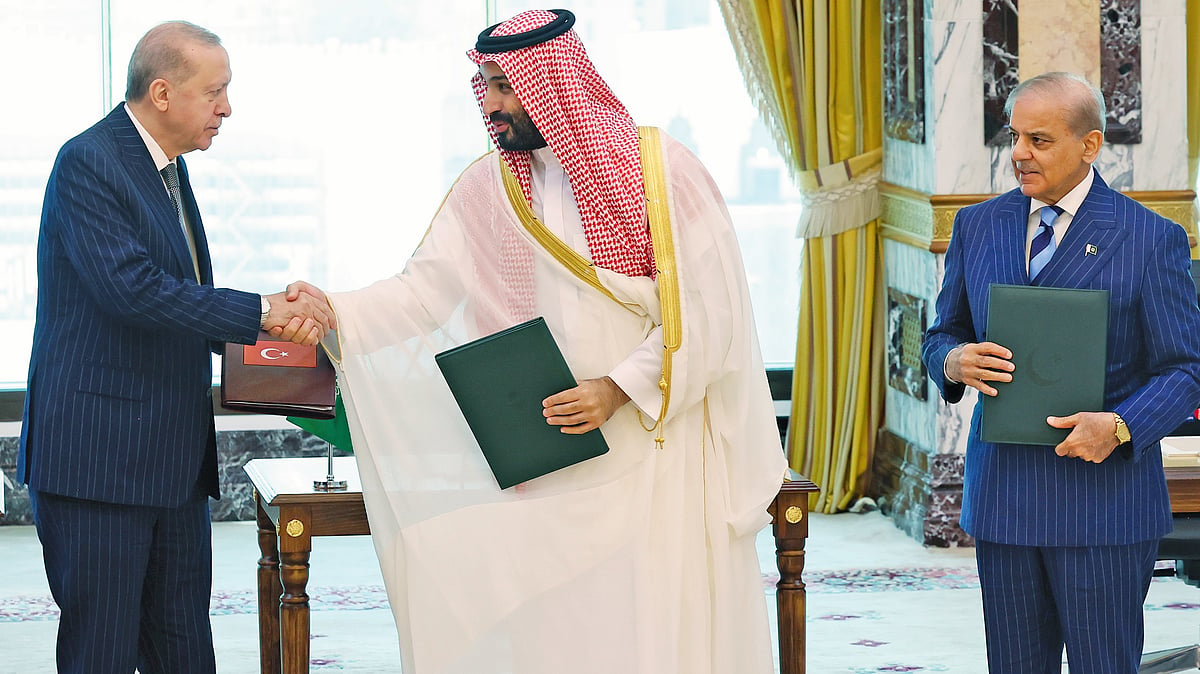
Saudi Arabia’s decision on 5 October to activate the Makkah defence pact reveals how precarious its security has become. In the Houthis, it faces an enemy capable of threatening its cities, disrupting its energy infrastructure and challenging its access to the Red Sea. This, even after spending heavily on sophisticated US weapons and cultivating powerful Western partners. Bringing Turkey and Pakistan into the response may bolster its sense of security but it could also widen a war that none of the three governments can control.
The emergency meeting in Riyadh on 5 October committed the three countries to implementing their collective defence obligations and rapidly deploying agreed forces and capabilities to Saudi Arabia. Signed on 7 August this year, the agreement treats an armed attack against one member as an attack against all. Its activation gives political substance to that promise. Riyadh wants the Houthis and their Iranian backers to understand that continued attacks could bring them into confrontation with a broader coalition.
However, ‘activation’ does not mean that Turkish and Pakistani soldiers have entered combat against the Houthis. Pakistan’s defence minister has described their current role as supportive. Any deployment announcement is also subject to national legislation, and Turkey’s parliament has yet to ratify the agreement. These qualifications place limits on what the announcement immediately delivers. The pact has acquired greater political weight, but its operational contours are still fuzzy.
That distinction matters because military assistance takes different forms. Intelligence sharing, training and air defence could help protect Saudi territory without sending allied troops into Yemen. Yet defensive support can also facilitate offensive operations by freeing Saudi forces for other assignments. The danger lies in the gradual expansion of a mission.
Saudi Arabia has compelling reasons to advertise that it is not alone. Repeated Houthi missile and drone attacks have exposed the limits of its territorial defence. Even successful interceptions consume scarce ammunition and require continuous readiness across a vast country.
Reports of dwindling interceptor supplies from the US underline the problem. The Houthis need only occasional breakthroughs to cause disruption, whereas Saudi Arabia must protect airports, cities, military installations, oil facilities and sea routes simultaneously. Its superior military resources have not removed this costly imbalance.
The Houthis are striking Riyadh’s airport and oil infrastructure with disconcerting regularity. Pressure on its airports and energy infrastructure undermine the desert kingdom’s economic ambitions. Crown Prince Mohammed bin Salman’s Vision 2030 blueprint for Saudi Arabia’s economic diversification and growth will hinge critically on investor and tourist perception of its political stability. An adversary able to sustain attacks from across its southern border challenges that promise, regardless of how many incoming weapons are intercepted.
The struggle extends well beyond Saudi territory. With shipping through the Strait of Hormuz constrained by the Iran war, the kingdom’s western export routes through Bab al-Mandab have become more important. Moving crude across the peninsula towards the Red Sea offers an alternative, but pipelines, ports and tankers remain vulnerable. The Houthis’ ability to threaten Bab al-Mandab gives them leverage over international trade, affecting countries even beyond the Arabian Peninsula.
Saudi-backed Yemeni forces have launched an offensive seeking to recover Houthi-held territory, but determining Yemen’s political future and protecting Saudi cities are very different objectives. The Mecca pact has no answers for the first. Who will govern recovered areas? How will competing Yemeni factions share power? What settlement will communities accept?
Without credible answers to those questions, military advances will only create new fronts and fresh grievances rather than a durable end to the war.
The Houthis’ hostility towards Saudi Arabia has deep roots in Riyadh’s influence over Yemen’s political and religious life. The Houthis do have Iranian support, but to see them solely as Tehran’s instrument is to miss their independent ambitions and local roots. Saudi Arabia’s interventions since 2015 have failed to restore a friendly government with unchallenged authority in Yemen and enlisting more allies will not change this.
Pakistan has particularly strong reasons to avoid any direct involvement. While Saudi financial support and defence cooperation encourage Islamabad to demonstrate loyalty, Pakistan also shares a border with Iran and has sought a diplomatic role in the wider conflict.
Fighting the Houthis could strain its relations with Tehran. Sectarian tensions at home, existing security burdens and growing internal political opposition from Imran Khan’s supporters further complicate the choice. An alliance that raises Pakistan’s international standing may also reduce its freedom to refuse a costly foreign commitment.
Turkey faces a related calculation. Supporting Saudi defence strengthens Ankara’s influence in Gulf affairs and creates opportunities for military cooperation. Entering Yemen’s war would expose it to retaliation and another potentially prolonged deployment. NATO membership does not automatically extend alliance protection to every operation Turkey undertakes. Nor does Pakistan’s nuclear status establish an automatic nuclear guarantee for Saudi Arabia. Inflated assumptions about these relationships can encourage risks that underlying commitments do not justify.
Another big danger is that the pact connects conflicts already spreading across the region. American and Israeli attacks on Iran in February 2026 unleashed a war whose consequences now reach both sides of the Arabian Peninsula. Turkish or Pakistani casualties in combat could generate pressure for retaliation. Retaliation could provoke further attacks on their forces or interests. Governments might then escalate to defend the credibility of the alliance, defeating its original purpose of providing limited protection.
India must take this development seriously. Pakistan’s external security relationships can no longer be assessed primarily through its partnership with China. The Makkah pact introduces Saudi Arabia and Turkey into calculations surrounding future Indian military action against Pakistan.
Their intervention would not be automatic; the circumstances of an attack, treaty interpretation and national decisions would matter. Nevertheless, New Delhi cannot assume that punitive actions or what Modi markets as surgical strikes would remain confined to a bilateral exchange. Political backing, intelligence and military supplies could alter the confrontation without allied troops appearing on the battlefield.
Ashok Swain is a professor of peace and conflict research at Uppsala University, Sweden. More by the author here
Join our official telegram channel (@nationalherald) and stay updated with the latest headlines