Opinion
Where India stands after the BRICS dance
Ashok Swain on why non-alignment by another name does not carry conviction
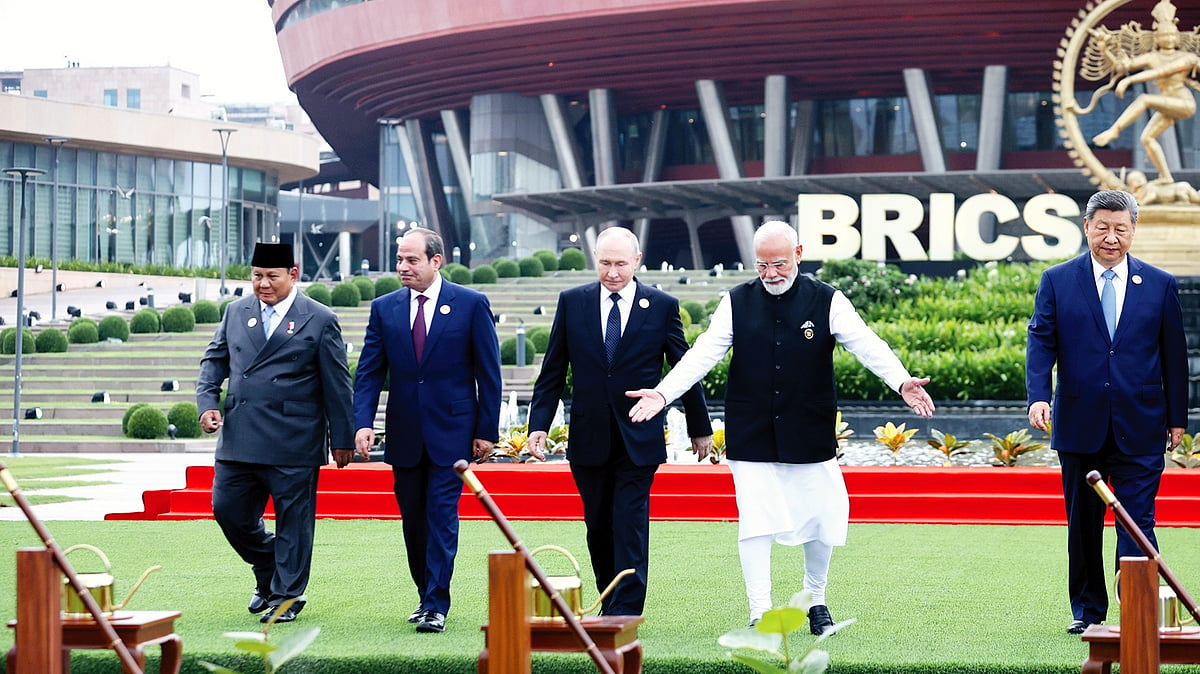
Sensing that geopolitical winds may once again be changing direction, the Modi government executed some nifty U-turns at the New Delhi BRICS summit on 12-13 September. For the nonce, China and Iran seem to have replaced US and Israel as the seasonal flavours of our foreign policy.
Judging by photo-ops featuring Modi, Xi Jinping, Vladimir Putin, Masoud Pezeshkian et al, BRICS is still alive and kicking and India and China can be friends with benefits, so to speak. Iran has noted that Modi is keen to mend ties, and even though these words do not appear in the summit joint statement, in his opening remarks, Modi said we are “not against anyone; we try to take everyone along”.
For Modi’s propaganda machinery, this was a validation of his government’s policy of ‘strategic autonomy’ in foreign relations. The posture is: India talks to everyone, joins no camp and maximises its options. But to go whichever way the wind blows is not the same as ‘non-alignment’ even if you call it ‘strategic autonomy’.
And while the latest manoeuvres of India’s external affairs establishment may seem adroit, and big media sound gung-ho about the joint statement, the summit has once again exposed that India’s foreign policy is driven by short-term opportunism rather than a clear understanding of India’s long-term national interests.
In any case, strategic autonomy or non-alignment never meant equidistance from competing big powers. Rather it meant retaining the political, economic and military independence to take decisions in India’s sovereign interests rather than yielding to the demands of a big power. Multi-alignment can be a modern expression of that tradition, but successful multi-alignment requires consistency of objectives even when relationships change.
India’s relations with China in the Modi years are a good illustration.
Six years after the Galwan clash, in which 20 Indian soldiers were killed, the territorial capture by China of over 2,000 sq. km of territory is still unresolved. Significant military deployments continue along the contested Himalayan frontier and China continues to make inroads into Indian territory.
Also, China remains Pakistan’s principal military supplier and India’s most formidable security threat. Yet Xi received a red-carpet welcome in Delhi on his first visit to India in seven years. Modi and Xi promised an expansion of business ties, of transportation and people-to-people links and again committed themselves to seeking a mutually acceptable boundary settlement.
Dialogue with China is sensible, no doubt — to not engage with the world’s second-largest economy, also India’s most powerful neighbour, would be foolhardy. But what did India secure in the current rapprochement? What reciprocal concessions did the two sides make?
China’s foreign ministry declared this week that Modi had told Xi that India ‘will not allow any force to engage in anti-China activities on its territory’. The asymmetry is striking. Where is the equivalent Chinese assurance that its territory, military-industrial complex and intelligence capabilities will not be used to strengthen activities that threaten India? Where is Beijing’s commitment to restrain material and military assistance to Pakistan in a confrontation with India?
The reconciliation with Beijing also exposes India’s economic dependence. After years of ‘Atmanirbhar Bharat’ sloganeering, India’s reliance on Chinese imports has in fact grown dramatically. The balance of trade is hopelessly askew and imports from China reached $132 billion in the last financial year.
What’s the reconciliation based on when there is no credible move to settle the border dispute or any assurance from China vis-à-vis Pakistan or a fundamental convergence of geopolitical interests?
Other than India’s dependence on Chinese machinery, electronics, components and industrial inputs — which is a compelling reason to make nice with China — what is India able to command in this relationship with its much-vaunted ‘strategic autonomy’? Is the recent lack of joy in trade talks with the Trump administration and the ensuing desperation to find alternatives ‘strategic autonomy’?
****
The sudden show of great warmth for Pezeshkian would have been equally befuddling had people not come to expect Modi to put on a show for the cameras.
For much of his time as prime minister, India and Israel have had an interdependent relationship and Modi’s personal ties with Netanyahu have been well known. The two leaders have both made public declarations about their friendship and grown defence and intelligence cooperation between their countries. India has landed on Israel’s side in the genocidal war it has been waging in Palestine, supporting it diplomatically and militarily, a far cry from India’s balanced stand vis-à-vis Israel/Palestine since the creation of the Israeli state in 1948.
But Netanyahu faces an election in October that he may well lose. Trump too faces midterm elections in November and his prospects are far from rosy; his authority may be seriously weakened in the aftermath. Suddenly, for Modi, to be seen in the corner of these embattled leaders in Washington and Jerusalem is not looking so good.
Is that, then, the secret of the fussy attention Pezeshkian received in Delhi? Modi held extensive discussions with him while emphasising freedom of navigation, commerce and the safety of shipping amid the Gulf conflict. Is that the reason to invoke ‘a longstanding civilisational relationship’ with Iran and to speak of ‘a long-term win-win strategy’? Once again, engaging Iran is not a mistake, but do the overtures carry conviction?
Iran has always mattered to India’s long-term interests. It controls crucial energy routes. The Chabahar port project, where India has wound down operations under US pressure, granted India access to Afghanistan and Central Asia bypassing Pakistan. Stability around the Strait of Hormuz directly affects Indian energy security. These realities did not suddenly emerge in 2026; they were in play even when Modi was enthusiastically courting Netanyahu. What has changed is the geopolitical price of ignoring them.
It couldn’t have been easy to hammer out an agreement between Iran, the UAE, Saudi Arabia, China, Russia and others despite profound divisions, but consensus was also possible because the New Delhi Declaration artfully skirted the questions on which an agreement would have faltered. It called for ‘maximum restraint’ in West Asia but avoided direct references to the perpetrators of the attacks on civilian and nuclear infrastructure; it criticised tariffs and unilateral sanctions without naming the United States.
That may be good summit diplomacy but it doesn’t constitute a shared geopolitical vision any more than hosting BRICS makes Modi the voice of the Global South. The US and Israel have no doubt taken notes. China and Iran, too, are unlikely to mistake India’s show of warmth for loyalty or even a firm commitment. Beijing understands India’s continuing partnership with Washington and its participation in the Quad. Tehran won’t forget India’s support of aggressor Israel or its decision to soft-pedal economic ties when Trump turned the screws during the war.
Everyone will deal with India because its market is not an inconsiderable attraction. But they will do so transactionally because they know that India’s foreign policy under Modi is not anchored in a geopolitical vision, that ‘strategic autonomy’ is really about what seems expedient in the short term.
Ashok Swain is a professor of peace and conflict research at Uppsala University, Sweden. More by the author here
Join our official telegram channel (@nationalherald) and stay updated with the latest headlines