POLITICS
Compromised robot is PM of India: Cong alleges ‘Epstein hand’ behind India’s Israel shift
Pawan Khera links defence deals, diplomatic pivots to alleged backchannel influence exerted by late sex offender
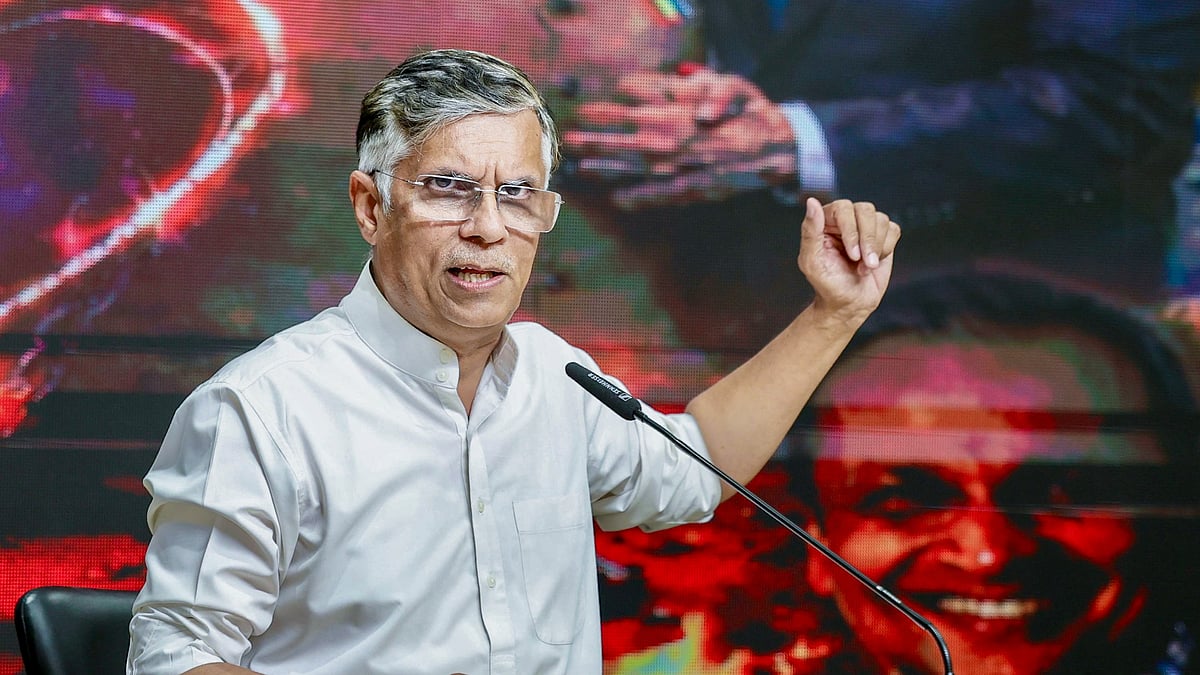
As tensions between the United States and Iran escalate amid speculation about a possible military confrontation, and Prime Minister Narendra Modi goes on a visit to Israel, the Congress on Wednesday launched a sweeping attack on the government’s foreign policy, with party spokesperson Pawan Khera alleging that India’s diplomatic and defence alignment with Israel and the United States was shaped not by sovereign decision-making but by the shadowy influence of late financier and convicted sex offender Jeffrey Epstein and his international network.
Addressing a press conference at the Congress headquarters in Delhi, the party's media and publicity department chief framed Prime Minister Narendra Modi’s ongoing visit to Israel as unfolding in a volatile geopolitical moment, warning that the United States could strike Iran at any time. He argued that New Delhi had already shown vulnerability to American pressure by cutting oil purchases from Iran and Russia in the past, and suggested that the prime minister’s current diplomatic posture reflects a deeper strategic drift.
Khera said India’s long-standing commitment to a two-state solution on Israel and Palestine had been altered under the present regime. He alleged that a powerful US-Israel lobby had reshaped the “direction and character” of India’s foreign policy, breaking with decades of balance.
Invoking Epstein — convicted for sexual crimes against minors — Khera claimed that while he may be seen by the public as a criminal, he functioned as a decisive influence on the Modi government’s external strategy. In a provocative formulation, Khera alleged that even after his death, Epstein’s imprint continued to guide key policy choices.
Central to Khera’s claims were alleged email exchanges dating back to early 2017. He cited purported correspondence involving former diplomat and current Union minister Hardeep Singh Puri, industrialist Anil Ambani, former Israeli Prime Minister Ehud Barak, and others.
According to Khera, emails from January to March 2017 suggest Epstein facilitated introductions and discussions relating to India’s defence ties, including references to the White House and defence procurement. He alleged that Epstein sought to position himself as an intermediary capable of delivering “inside information” in exchange for strategic access.
At one point during the briefing, Khera said, “Jeffrey Epstein is a notorious sex offender for common people, but a hero for the Modi government's foreign policy. Even after death, Jeffrey Epstein lives on in the Modi government's decisions and policies. It wouldn't be wrong to say that 'Epstein' is Narendra Modi's ideology.”
Khera further pointed to a 6 July 2017 email allegedly sent by Epstein to a Qatari businessman, claiming that Modi had “took advice and danced and sang in Israel for the benefit of the US President… IT WORKED!” — a line Khera used to question the autonomy of India’s diplomacy.
He also cited references to interactions between Epstein and former White House strategist Steve Bannon, suggesting discussions about engaging India politically and strategically.
Khera sought to link these alleged exchanges to a series of high-value defence and strategic deals between India and Israel from 2017 onwards. Among them, he listed:
A 2017 missile system agreement reportedly valued at $2 billion
A major naval LR-SAM procurement
The 2017 Pegasus spyware controversy
The 2018 Adani–Elbit Systems drone joint venture
A Rs 880 crore Negev Light Machine Guns deal in March 2020
The 2022 acquisition of Haifa Port by the Adani Group
Subsequent collaborations in drone production, defence supply chain integration and anti-submarine warfare through 2025 and 2026
Khera argued that between 2020 and 2024, India accounted for roughly 34 per cent of Israel’s defence exports, making it Israel’s largest defence market. He claimed these commercial and military ties were not merely bilateral outcomes but the product of private backchannel negotiations allegedly facilitated from Epstein’s residence.
He also referenced the 2022 investigative report by the New York Times, which described Pegasus spyware and missile systems as centre pieces of a broader $2 billion India–Israel defence package agreed during that period.
“All of this happened over the past several years, and the man who orchestrated it was Epstein, with help from Hardeep Puri and Anil Ambani,” he said.
In a sharply worded rhetorical flourish, Khera mocked recent claims attributed to the prime minister about building a robot in childhood, alleging instead that foreign actors had “built a robot” in India’s leadership. The metaphor, he said, reflected concerns that decisions were being externally steered.
He went further, citing an FBI statement describing Epstein as having intelligence links, and warned that it was “deeply alarming” if individuals with alleged espionage connections influenced India’s sovereign decisions.
The Congress leader accused the government of attempting to divert public attention to suppress scrutiny of the alleged emails and linkages. “The country is paying a heavy price to hide these mails,” he said, suggesting that the implications extend beyond foreign policy into national security and democratic accountability.
The government has not responded publicly to the specific allegations raised in the press conference.
Join our official telegram channel (@nationalherald) and stay updated with the latest headlines