POLITICS
Students are on the warpath
…and not only for student rights. Nandlal Sharma reports on the Jantar Mantar effect
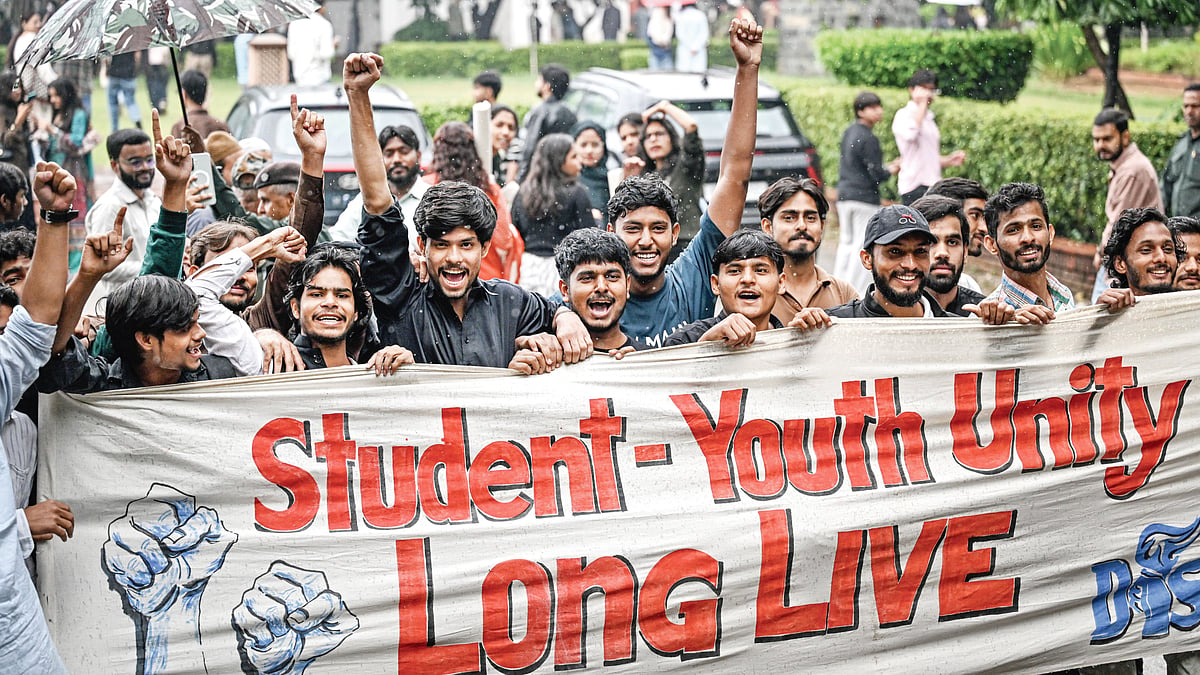
The Modi government may have succeeded in turning Jantar Mantar into a fortress, but they couldn’t stop the energy sparked by the student-youth movement of July 2026 from spreading across the country, turning varsity campuses into powerful sites of protest.
At Delhi’s Ambedkar University (Kashmere Gate), students staged a 17-day hunger strike demanding basic facilities. We pay lakhs in annual fees, they said, but: why are we not allowed to enter and exit through the university’s main gate? Why are roads leading to the campus unsafe for women students? Why are there no teachers? Why is there no playground on campus? Why is the park reserved exclusively for the vice-chancellor? Why are PhD students required to mark biometric attendance? Why must students obtain written permission four days in advance to hold any meeting or protest?
The administration responded by turning the campus into a prison. A three-tier security cordon was set up to confine students. Security guards were forbidden to bring in food, students could not order meals, even ambulances were denied entry.
On 13 October, security personnel forcibly stopped a public screening of Anand Patwardhan’s 2011 documentary Jai Bhim Comrade. They tore down protest posters, injured several students and ripped the clothes of women protesters. The following day, police evicted all students from the protest site and the university suspended 11 students on charges of vandalism and clashes with security personnel. The students approached Delhi High Court, which quashed the order.
Blessy, an MA student of gender studies, was among those suspended. She summed it up: “This isn’t Ambedkar University, it’s Tihar Jail. In jail, at least you get your meals on time. In a university, if a student asks questions, you won’t even get food.”
At Aligarh Muslim University (AMU), on 21 September, MA (Urdu) student Yasir Fahad began an indefinite hunger strike at the historic Duck Point. His demand: immediate restoration of student union elections, suspended for eight years.
On 9 October, the administration announced elections and voting took place on 5 November. Their success inspired students at Jamia Millia Islamia in Delhi, where the fight centred on alleged opacity in spot admissions and the restoration of student union elections (suspended for two decades).
The Jamia demonstration began on 12 October. On 24 October, the protest site was vandalised during negotiations, personal belongings damaged, and attempts made to take hunger-strikers into custody under the pretext of hospitalisation.
According to the Students’ Federation of India (SFI), the police imposed Section 163, erected barricades and detained students. The administration shifted classes online, restricted access to libraries and reading rooms, and ordered students to vacate hostels. The students held firm. After 18 days of hunger strike, the administration was forced to back down and agree to the restoration of the student union elections.
At Jawaharlal Nehru University (JNU), too, student satyagraha prevailed. On Day 17 of an indefinite hunger strike launched by the students’ union, the administration was forced to yield. Alongside basic demands, they agreed to revoke the unjust expulsion of union office-bearers and the former president, and withdraw proctorial inquiries and FIRs related to the protests.
Students are not fighting for students’ rights only. They have since rallied behind more than 700 campus workers employed in sanitation, mess, security, gardening and maintenance services who are protesting wage cuts, unpaid statutory bonuses, arbitrary suspensions and other violations of labour rights.
Women students have been leading the charge. At Delhi University, they organised ‘Hum Auratein Azaad Hain’ (We Women Are Free) marches across campuses, demanding safety, freedom and the right to occupy public spaces without fear. Their slogans — “Tear down the society that keeps women shackled” and “We have a right to the night too” — captured the anger of a generation unwilling to accept the domination of patriarchy.
From the night march at JNU’s Sabarmati dhaba to the ‘Pinjra Tod’ (Break the Cage) slogan at Delhi University, the message was unmistakable: “We want safety, not restrictions that treat us like prisoners.” With Neha, Mudita and Nadia showing the way, students have been uninhibited in their dissent and united in their fight, without necessarily organising under any particular flag.
In West Bengal, the struggle has taken on a broader political dimension. Students of Satyajit Ray Film and Television Institute (SRFTI), Jadavpur University and Presidency University are resisting what they see as saffron thuggery.
On 27 September, SRFTI students protested an event organised by the RSS-affiliated Akhil Bharatiya Grahak Panchayat, questioning the presence of politically aligned organisations on a publicly funded campus. The protest escalated into a violent confrontation. On 4 October, members of the Bangiya Hindu Jagran Manch were accused of throwing bricks and bottles at students. When the administration expelled six students in mid-October, protesters demanded their reinstatement, the vice-chancellor’s resignation and better campus security.
At Jadavpur University, Left- and ABVP-affiliated students clashed over a general body meeting on 20 August. At Presidency, an ABVP poster featuring Swami Vivekananda triggered controversy. Ever since the BJP ‘took’ Bengal, students are on the warpath against the RSS’s attempts to gain control of the state’s educational institutions.
The resistance extends well beyond Bengal and Delhi. At Allahabad University, protests against fee hikes and a cut of 6,000 seats began in July and intensified in October. On 6 October, students organised a mass mobilisation and blocked the university’s main gate, while women students took out a ‘Freedom March’ demanding safety and autonomy. Students of IISER Pune boycotted classes over stringent hostel rules.
At Banaras Hindu University, women students organised a candlelight march and indefinite sit-in opposing the 10.00 pm hostel curfew and discriminatory rules. At Lucknow University, students protested for more than 50 days (from 2 June) against fee hikes and the ‘dictatorial’ expulsion of three student leaders — Prem Prakash Yadav, Prince Prakash and Harshit Shukla — on charges of indiscipline.
“If the Jantar Mantar movement had not happened (forcing Dharmendra Pradhan’s resignation), our suspensions would never have been revoked,” says Vishal Singh, a PhD scholar at Lucknow University.
The footprint extends from Gorakhpur to Patna, from Pune’s Savitribai Phule University to Mumbai University’s Kalina campus, from Kalady’s Sree Sankaracharya University of Sanskrit to Mewat Engineering University (where protests ended after assurances from the Waqf Board (Haryana) and authorities).
The movement has also exposed institutional failures around mental health. The suicide of 31-year-old IIT Delhi student Rishikesh Kumar on 24 August rallied over 2,000 students. It took eight suicides in 30 months, an indefinite sit-in and an emotional appeal by Rishikesh’s mother for the administration to constitute an inquiry committee headed by a former high court judge.
At IIT Bombay, the suicide of BTech student Sahil Wakode on 18 September sparked a three-day ‘Students’ Lives Matter’ protest, with an 18-point demands’ charter.
The country’s top law schools have also been touched by the spirit of rebellion. In August, more than 400 students at Hyderabad’s National Academy of Legal Studies and Research opposed inviting Chief Justice Surya Kant to their convocation. The controversy deepened when Bar Council of India chairman and BJP MP Manan Mishra wrote to put the enrolment of the 2026 graduating batch on hold. At Bengaluru’s National Law School of India University, hundreds of students and alumni similarly opposed the presence of senior judicial officials.
SFI national president Adarsh M. Shaji believes the Jantar Mantar movement has given students the confidence to fight back. “They are no longer afraid of repression by RSS-backed vice-chancellors or the ruling establishment. Students are fighting to protect the very foundations of education.”
The resistance across campuses makes one thing clear: the battle is far from over. Jantar Mantar is everywhere. Victory is infectious. Dissent is unstoppable.
Join our official telegram channel (@nationalherald) and stay updated with the latest headlines