POLITICS
JNU’s fight to reclaim the right to dissent
What have the students lost over the past 10 years? Nandlal Sharma reports
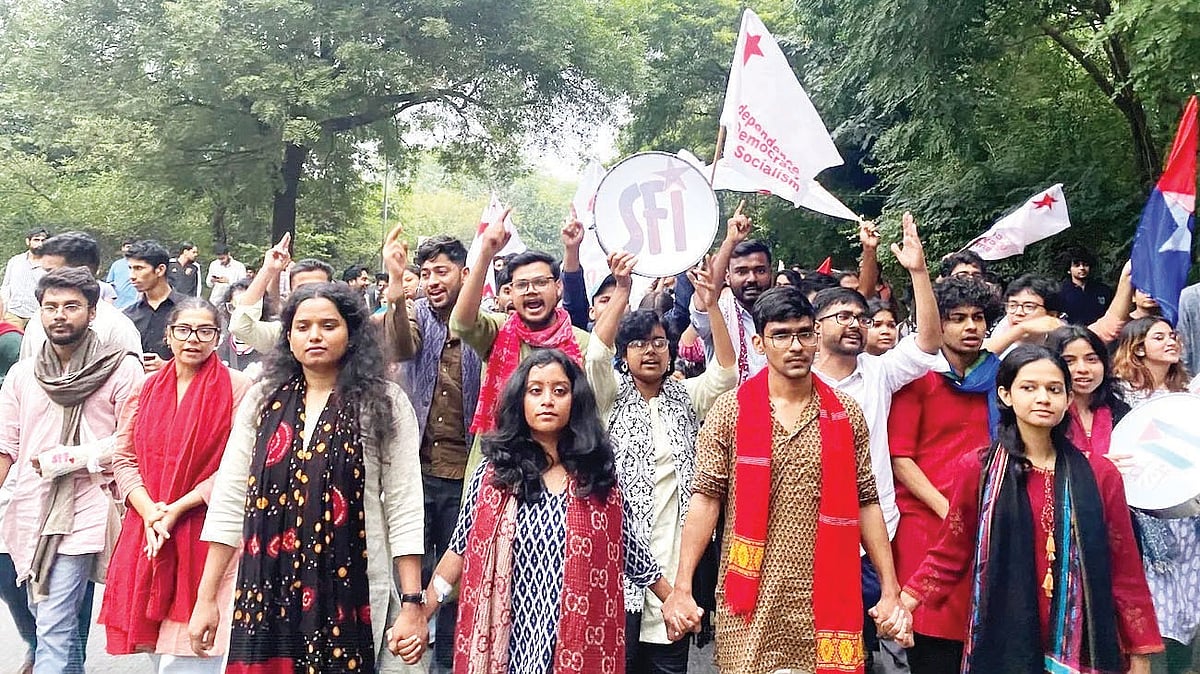
A banner attached to the pillars of the School of International Studies (SIS) building flutters in the wind: ‘SIS is on strike against the CPO Manual’. On the lawns between the School of Languages and SIS, a tent has been pitched — mattresses and quilts have been laid out, there’s a pot on a stove next to a gas cylinder. The daflis of different student unions, long identified with JNU Students’ Union (JNUSU) protests, can also be seen.
It’s 22 February. ‘Out of Bounds – Classroom’, a lecture by former professor Anand Kumar (JNUSU president, 1974) is about to begin. Students are milling around, busy preparing for their samta juloos (equality march) that evening, one of several protests against JNU vice-chancellor Santishree Dhulipadi Pandit’s remark accusing Dalits of permanently “playing the victim card” in a 16 February podcast (where she also compared affirmative action for Dalits and Blacks to a “temporary type of drug”).
I manage to speak to a few students before a security guard comes up and asks: Do you have permission to record? Who has called you? What have you come to do? Go to the control room near the main gate to get permission for taking photos.
At the control room, I am told to bring the student who can get permission on my behalf, and come back the next day (permission needs to be taken 24 hours in advance). The guards tell me, “If you cannot do this, leave. If you don’t leave on your own, we will have to evict you.”
Not sure what to do, I ask the students. They say, ignore. That’s what they do. And that’s what they pay the price for.
I have no choice but to leave the premises. Late that night, there are clashes between the Akhil Bharatiya Vidyarthi Parishad (ABVP), the JNUSU and other participating left student body unions. On 23 February, the JNU administration issues a statement of ‘strict action under University’s rules & regulations and under BNS’. It has subsequently filed cases of rioting and criminal conspiracy against the student leaders.
****
A proctorial inquiry into a November 2025 protest against what students described as the beginning of mass surveillance led to the suspension of students’ union president Aditi Mishra, vice-president K. Gopika, general-secretary Sunil Yadav, joint-secretary Danish Ali and former president Nitish Kumar for their alleged role in protests against the installation of Facial Recognition Technology (FRT) on campus. They were accused of damaging FRT-based access gates and CCTV cameras installed at Dr B.R. Ambedkar Central Library.
According to the chief proctor’s order on 2 February, Nitish Kumar was found guilty of destroying FRT-based gates worth around Rs 20 lakh and vandalising the system, along with the others. Each was fined Rs 20,000. Eight additional students were fined Rs 19,000 each for clapping and raising slogans.
Joint-secretary Danish Ali tells me all this is happening because JNU still has a strong students’ union. “Our fight is not just against suspensions. It’s about defending the right to unionise. A strong students’ union that questions authority is uncomfortable for those in power. We object to the CPO (Chief Proctor Office) manual being used as a tool to crush dissent.”
The 15-page 2023 Manual bars hunger strikes, sit-ins, group bargaining and blocking access. Protests within 100 metres of academic or administrative buildings were already banned as per a 2017 Delhi High court order.
Penalties include fines up to Rs 20,000, eviction from hostels, rustication and expulsion from campus for two semesters. Posters deemed religious, communal, casteist or ‘anti-national’ attract fines. Security staff are authorised to record students on mobile phones and cameras for evidence.
Vice-chancellor Pandit says the manual has existed since 1969 and has not fundamentally changed. But even before the latest manual, dissenters were punished. Old cases were reopened.
Students were suspended or fined for demanding basic rights like water in hostels. A disabled hostel resident was declared ‘Out of Bounds’. ‘Out of Bounds’ suspension requires students to vacate their hostel rooms and technically bars them from campus. Yet they remain, preparing for a larger struggle: to reclaim what JNU has lost over the past decade.
While Anand Kumar says he has never heard of a more draconian CPO, Nitish Kumar says it all started in 2016, when M. Jagadesh Kumar was appointed vice-chancellor to “destroy JNU.” That was the year the administration filed FIRs against its own students for the first time.
Then came the big changes. Faculty linked to the RSS and BJP were appointed. The entrance exam pattern was changed and handed to the National Test Agency. The Gender Sensitisation Committee Against Sexual Harassment (GS-CASH) was scrapped and replaced by an Internal Complaints Committee. M.Phil. was first delinked, then abolished. Student representation in the Academic Council and other bodies was withdrawn. Union funds were stopped. Promotions of key faculty were stalled.
The present union has listed over 15 demands, including the resignation of the vice-chancellor; the revocation of student suspensions; the implementation of UGC guidelines and the proposed Rohith Act; faculty promotions; filling vacant posts; the removal of librarian Manorama Tripathi and the Siddhant Foundation.
The union alleges that in the School of Languages, the Siddhant Foundation is teaching through recorded videos. This, they say, is a clear example of privatisation despite the availability of faculty at JNU.
****
The pivotal point was 9 February 2016, when an event marking the anniversary of Afzal Guru’s execution led to allegations of ‘anti-national’ sloganeering. Student leaders Kanhaiya Kumar and Umar Khalid were arrested. Television studios branded JNU the ‘tukde-tukde gang’.
On 5 January 2020, masked mobs attacked students protesting fee hikes and the Citizenship Amendment Act. Internet and electricity were cut. Students and teachers were assaulted. The police stood by. Till date, no one has been conclusively punished. The disappearance of student Najeeb remains unresolved. Umar Khalid remains in jail.
Whether it was the institutional killing of Rohith Vemula or Payal Tadvi, or the deaths of Darshan Solanki, Muthu or Senthil — all these students fell victim to systemic oppression. Their dreams were crushed, and they did not receive justice on campus. There was no committee to hear their grievances.
Despite this, vice-chancellor Pandit says the UGC regulations are not needed, even though those guidelines were prepared following the Supreme Court’s directions. Even today, there is no body in JNU where students can report caste-based harassment. Besides, even if someone complains, will they get justice? These are the questions being raised.
Danish asks: doesn’t the V-C see the casteist abuses scrawled on library desks and walls in JNU? Isn’t she disrespecting the struggles of the mothers of Rohith Vemula and Payal Tadvi, who campaigned long and hard for UGC guidelines after the death of their children? Didn’t her statement make a mockery of their struggle?
Casteism is evident not only in campus graffiti but discriminatory viva assessments and ‘Not Found Suitable’ rejections that affect Dalits, Adivasis and OBCs alike. Nitish gives his own example: “During elections, GBMs (general body meetings) are held to form committees. At the GBM of the School of Social Sciences, ABVP people surrounded me and abused me for an hour, saying things like you are an Ahir, we’ll show you the way we did Lalu… we’ll take you back to the 90s… you are ruining merit, you have come through reservation.”
Nitish adds that there are many OBC-majority villages where atrocities are committed against Dalits, but that does not mean that atrocities don’t happen against them on the university campus.
The JNUSU is now mobilising for the Rohith Vemula Act. The casteist views of Santishree Dhulipudi Pandit do not represent JNU, it is the students who represent JNU. “Jawaharlal Nehru University stands for public education and social justice,” they say. “Our fight begins here.”
Join our official telegram channel (@nationalherald) and stay updated with the latest headlines