POLITICS
Odisha: Herculean on paper, not impossible on the ground
By all accounts, the Congress was all but dormant in Odisha; however, recent events have lit a spark of hope
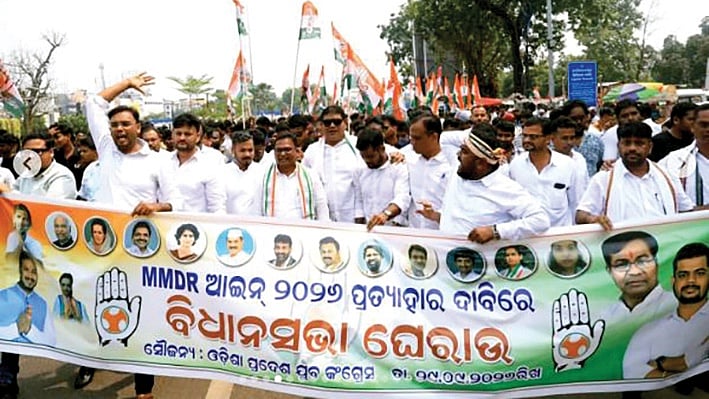
On 8 October, a 12-hour bandh disrupted transport, mining and normal activity in parts of Odisha. The INDIA bloc held a large ‘Parivartan Rally’ in Bhubaneswar and activists attempted to march toward the residence of chief minister Mohan Charan Majhi.
With tribals restive in several mineral-rich districts of Koraput, Rayagada, Keonjhar, Sundargarh, Mayurbhanj and Nabarangpur, both the BJP and INDIA bloc are coming out for and against the Mines and Minerals (Development and Regulation) Amendment Act 2026.
Rushed through Parliament despite the Supreme Court ruling in favour of the states, the amendment prevents state governments from independently levying fresh taxes, cesses or local duties on mineral rights and mineral-bearing lands, bringing them under the Centre’s direct regulatory framework.
As the Congress — which has been out of power in Odisha for the last 26 years — shows signs of life, the question being asked is: can it make a successful bid for power in 2029?
It’s a Herculean task on paper. In the 2024 Assembly election, the BJP and BJD had each garnered a little over 40 per cent of the vote share. Congress was a distant third with just about 13 per cent. The GOP will need to treble its vote share to come anywhere close to victory.
The Naveen Patnaik-led BJD government in the state was non-confrontational and believed in ‘live and let live’. It extended the olive branch to all top Opposition party leaders. The Congress, then the main Opposition, became a victim of the ruling party’s politics of accommodation. The BJD’s outreach effectively blunted its aggression.
The BJP, a BJD-ally from 2000 to 2009, escaped the treatment partly because it was a partner-in-power and partly because it did not need BJD patronage after Naveen Patnaik broke the alliance in 2009. Contesting alone, the BJD won 103 out of 147 seats (39 per cent of the vote share). The Congress came second, with 27 seats (29 per cent). BJP managed six seats (15 per cent).
In 2014, the BJD improved its tally to 117 and increased its vote share to 44 per cent. The Congress imploded, tumbling from 27 to 16 seats; but its vote share decreased only marginally, from 29 to 26 per cent. The BJP increased its seats from six to 10 and its vote share from 15 to 18 per cent.
The most dramatic turnaround came in the 2019 Assembly election. The BJD maintained its stranglehold with 112 seats and 45 per cent vote share. The BJP, backed by the Modi government at the Centre, galloped to second position. It increased its seat tally from 10 to 23 and vote share from 18 to 33 per cent. The Congress was down to nine seats, and its vote share fell from 26 to 16 per cent.
In 2024, the BJP finally succeeded in toppling the BJD. Its seats shot up from 23 to 78 while the BJD’s dropped from 112 to 51. The BJP’s vote share, however, was merely a notch below the BJD’s: 40.1 per cent versus 40.2 per cent. The Congress improved its seat tally from 9 to 14, but its vote share plummeted from 16 to 13 per cent.
Ahead of 2029, the Congress faces twin challenges in Odisha. In the ruling space, the electoral machinery (and machinations) of the BJP and the RSS. In the opposition space, the formidable organisational structure the BJD has built over 24 years of being in power. Both the BJP and BJD are cash rich, in contrast to the cash-starved Congress. Barring its core supporters, many Congressmen have switched sides, making it weak both organisationally and financially.
The current situation is, however, extraordinary and holds out hope for the Congress. There is a groundswell of resentment against the BJP in general and Narendra Modi in particular. Anger is also brewing because Majhi has remained a mute spectator while his ministers are on a looting spree, with Gujarati contractors allegedly having taken control of all government projects.
Neither Naveen Patnaik nor the other top brass of his party are in a position to speak openly against the Modi-Shah regime because of ED-CBI-Income Tax threats. With the BJD on the backfoot, there is room for a more assertive Congress.
Current Odisha Congress president Bhakta Charan Das, who highlighted the Kalahandi famine and became an MLA at the age of 27, took charge in February 2025. He has been touring across the state to revive the party. Milestones to his credit include the Nuapada by-election in which the Congress came second, pushing the BJD to third position.
It has taken a little over two years for the Congress to get its act together. It remains to be seen how it will take advantage of the space that has now opened up.
Join our official telegram channel (@nationalherald) and stay updated with the latest headlines