POLITICS
AAP delivers a lesson in censorship
In Delhi, Kejriwal cries censorship, in Chandigarh he enforces it, writes Harjeshwar Pal Singh
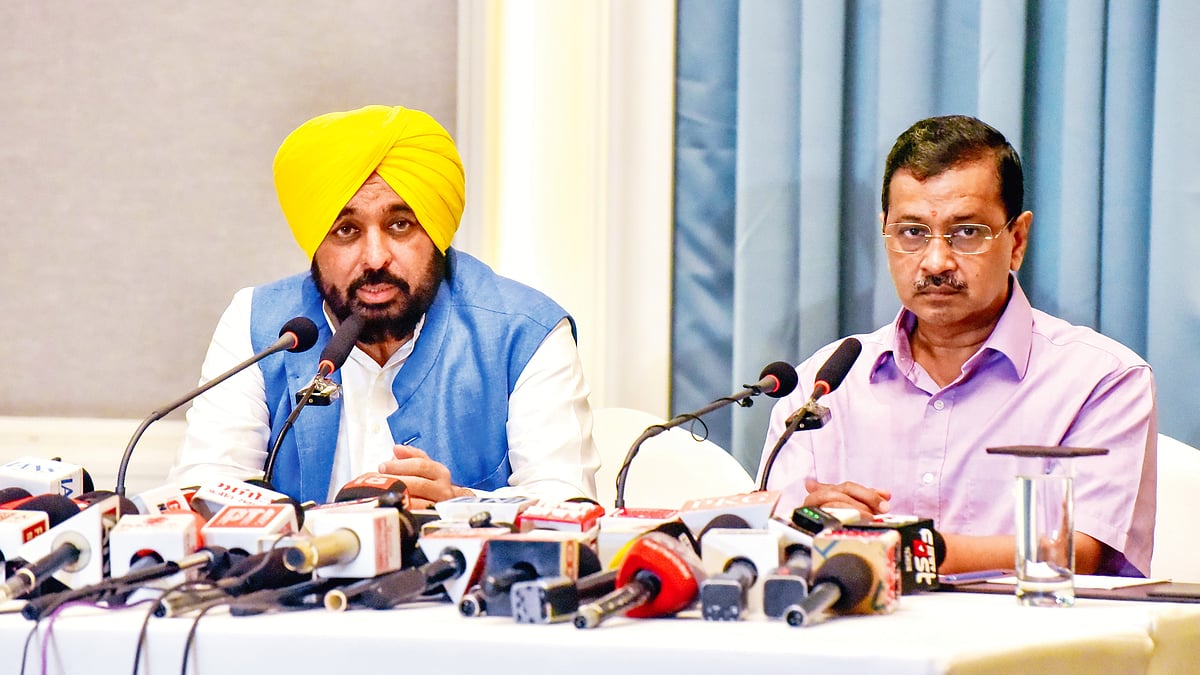
"In Delhi, Kejriwal keeps talking about ‘Godi media’. The reality is that press freedom is worse in Punjab than in Delhi. In Delhi, you have Godi media, here we have Keji media… If you speak up, you are choked,” Jass Grewal, a digital journalist in Bathinda told The Reporters’ Collective.
Grewal lost his Facebook page, with 1.4 million followers, after three AAP copyright claims. Nikhil Pahwa, digital rights activist and editor of MediaNama, told the Collective, “I have not come across any instance where a political party has used copyright strikes as a mechanism for censorship.”
Another chilling incident was reported by the Collective on 18 August. Police from six districts reached Bathinda-based journalist Rattandeep Singh Dhaliwal’s house over a video in which he claimed around 32 sitting AAP MLAs may not be fielded in the upcoming Punjab elections.
Several AAP MLAs filed pre-filled police complaints alleging that the video spread “false, fabricated and misleading” information likely to create “unrest and disturb the peace”. In short, anti-national.
In 2022, when Bhagwant Mann took oath as chief minister at Khatkar Kalan — Bhagat Singh’s village, a location chosen for maximum symbolism — the AAP sold Punjab a single, seductive word: badlaav (change). It was supposed to signal the end of elitist durbaari politics, the culture of fear and favours that had defined half a century of governments alternating between the Akalis and the Congress.
Four-and-a-half years into that badlaav, Punjab’s journalists — those digital foot-soldiers who carried AAP’s anti-establishment message to every Dhaani and Dera during the Kisan Andolan — are discovering that the durbar has simply changed its liveried guards.
This is not incidental irony. It is structural to what AAP has always been: a party born of the India Against Corruption movement’s moral theatre, a self-styled conscience-keeper that rules with the same instinct for narrative capture that it claims to despise in Delhi.
After his own Instagram handle was briefly restricted, Arvind Kejriwal spent 7 August complaining on X that the Modi government had throttled social media users during the Gen Z protests. True. But barely 200 km north, in Punjab, the AAP machine had already claimed copyright ownership of at least 48 videos and posts by independent Punjabi journalists — including photographs from inside the Vidhan Sabha and even Mann’s own tweets — solely to have Facebook take them down. In Delhi, Kejriwal cries censorship. In Chandigarh, he practises it.
The charge sheet, laid out plainly by The Reporters’ Collective, is long enough to embarrass any party that once marched under Anna Hazare’s banner.
Digital-rights lawyers say that the copyright strike is a genuinely novel weapon in the annals of press suppression in India. Faridkot’s Maninderjeet Singh Sidhu of Lok Awaz TV absorbed 20 strikes; his own page was pulled down under the IT Act after he reported on police action against farmers in Bathinda.
Later, he was named in a fresh FIR over alleged abetment of suicide, stemming from his investigative reporting on the drug trade in Muktsar district. Dhaliwal took 19 strikes before his page — with its modest 3.24 lakh followers — vanished for sharing, among other things, a Sri Akal Takht press release AAP had no claim to.
The FIR has become an instrument of first resort. RTI activist Manik Goyal was denied information on the CM’s helicopter use and questioned it publicly. He found himself named in a police case for spreading ‘misinformation’, along with journalists Maninderjit Sidhu and Mintu Gurusariya. The Punjab and Haryana High Court had to step in and stay the investigation.
According to Goyal, “The RTI Act is almost dead now. PIOs and appellate authorities routinely deny information. Thousands of appeals are pending. The state’s information commission is running on half-strength and takes up to two years to decide cases.”
The first warning signs came in 2023, when the state hunted Amritpal Singh. Well over a hundred Twitter accounts — including journalists, a Canadian poet, a sitting MP — were withheld across India at AAP’s request. Internet and SMS services were suspended for 27 million Punjabis. The government that today denounces the Centre’s surveillance ran, in its own backyard, a near-identical playbook.
Political commentators and politicians haven’t been spared either. Malvinder Singh Mali (Navjot Sidhu’s old adviser-turned-relentless AAP critic) was arrested from his own home in September 2024 under the IT Act over a Facebook post, and sent to judicial custody.
Bikram Majithia, who routinely hauls the government over the coals, has been jailed twice already, most recently in a Rs 540-crore money-laundering case. Sukhpal Khaira, another inveterate critic — once AAP’s own Leader of Opposition before he switched parties — was arrested in a decade-old drugs case the moment he became politically inconvenient.
The legacy press was leaned on through the oldest instrument of all: money. Punjab Kesari editors wrote to the governor alleging their advertisements were cut off within days of publishing an unflattering piece on Kejriwal’s Delhi residence; Ajit editor-in-chief Barjinder Singh Hamdard was summoned by the Vigilance Bureau; Indian Express delivery vans were stopped and searched. According to senior journalist Shiv Inder Singh, “AAP is behaving in Punjab just like the BJP at the Centre.”
He points to the massive increase in AAP’s media budget — almost 10-fold over previous regimes — being used to silence media and reward pliant news outlets. “Websites and news outlets are being paid for producing pro-government content.”
This is what Kautilya’s ‘saam, daam, dand, bhed’ looks like when deployed by a party of the smartphone generation: saam is the flattery of pliant channels showered with government advertising; daam is the buying of silence, with editors quietly shunted out and accreditations cancelled; dand is the FIR, the copyright strike, the IT Act notice, the midnight police visit; bhed is the subtler work of dividing the field.
AAP’s media in-charge Baltej Pannu dismissed the targeted Facebook journalists as men without “proper degrees or qualifications”, an old bureaucratic trick for redefining who counts as press.
The result is the humiliating choreography of self-censorship — or subversion. Parmeet Singh Bidowali of Punjab Inside TV now blacks out Mann’s face in every video, or swaps it with an AI sketch — an echo, he says, of newspapers that ran blank editorial columns during the Emergency, offered as “a mark of protest”.
Has Kejriwal forgotten that Punjab’s digital press was born of the Kisan Andolan, when farmers, frustrated with a supine national media, built their own YouTube newsrooms from tractor trolleys and dhabas along the Delhi border? The deeper tragedy is not merely that Punjab was promised change and handed censorship. It is that the party doing the gagging is the one party that built its entire mythology on having once been gagged.
Harjeshwar Pal Singh teaches history in SGGS College, Chandigarh. More of his writing here
Join our official telegram channel (@nationalherald) and stay updated with the latest headlines