POLITICS
Selective outrage in Bengal
From student safety and Annapurna backlash to hawker demolitions, issues stirring online anger struggle for public and media attention
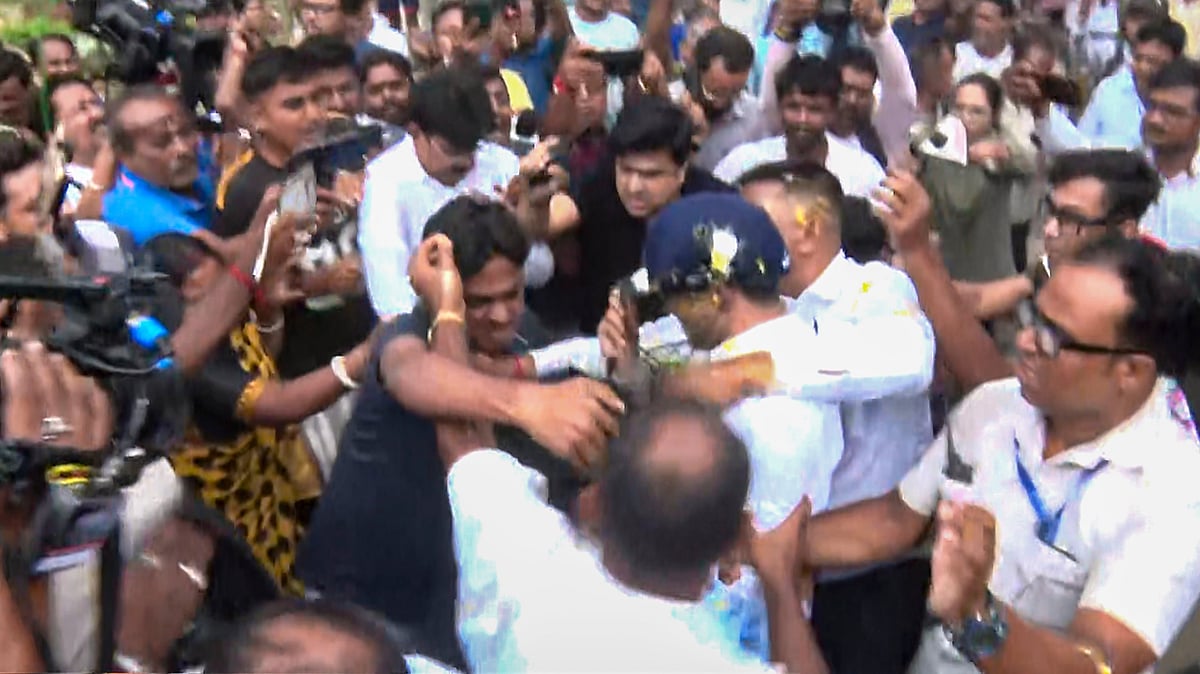
The 27 May attack on Trinamool Congress (TMC) MP and national general-secretary Abhishek Banerjee has quickly become Bengal’s dominant political story, consuming television debates, political messaging and public discussion.
Yet, before the incident seized headlines, a series of controversies had been steadily building around West Bengal’s new BJP government — from allegations of sexual violence and questions over student safety to backlash over a flagship welfare scheme and anger over bulldozer drives targeting hawkers and small traders.
Many of these issues generated intense discussion on social media, including among voters who had initially supported the BJP. But they struggled to command the kind of sustained television coverage, political mobilisation or public outrage associated with earlier flashpoints such as the R.G. Kar case, to cite one major example.
Critics of the government argue that the focus on the Abhishek Banerjee attack did more than dominate the news cycle — it conveniently reordered the public conversation, pushing other uncomfortable debates to the margins.
TMC leader Pratikur Rehman accused sections of the mainstream media of selectively amplifying issues that suited the ruling establishment. "We have all heard terms such as 'godi media' and yellow journalism. It is quite evident that many media houses choose to focus only on what is convenient for the BJP, especially now that West Bengal has a so-called 'double-engine' government. Several important issues affecting ordinary people are not receiving the attention they deserve," he said."
CPI(M) leader Sujan Chakraborty echoed concerns about selective media attention. "For nearly a decade, large sections of the media have not performed the role expected of the fourth pillar of democracy. They often show only what is convenient for those in power. Instead of reporting news, they are increasingly promoting particular viewpoints and failing to represent the concerns of ordinary citizens," he said.
Among the most disturbing incidents discussed across social media was the alleged rape of a school student in Behala, which triggered outrage over the age of the victim and allegations of a slow official response.
The case quickly evolved into a wider debate about women's safety in Bengal. Activists, local residents and opposition figures questioned whether adequate protection mechanisms existed for school-going girls and whether the investigation was moving with sufficient urgency.
Social media users repeatedly asked why such a serious allegation was not receiving sustained attention from major television networks. Many posts expressed frustration that political narratives appeared to be overshadowing discussion about the victim and her family.
Women's rights groups argued that cases involving minors should attract greater institutional attention irrespective of political circumstances. The incident led to calls for faster investigations, stronger accountability and tighter safety mechanisms in educational institutions.
Another controversy that generated widespread anger online was the death of Class III student Ayush Kumar Nath of Maharishi Vidya Mandir in Bansdroni, south Kolkata.
According to the family's allegations, the child fell ill during school hours but did not receive timely medical attention. His father claimed the boy was allegedly made to remain in class despite feeling unwell and was later asked to carry his school bag. The family further alleged that the school delayed informing them about his deteriorating condition. Ayush later collapsed, suffered a brain haemorrhage and died after spending days in a coma.
The tragedy sparked protests by parents, students and local residents demanding accountability from the school administration. Police launched an investigation and registered a case under provisions of the Juvenile Justice Act.
The school denied negligence. But the emotional force of the case transformed it into a broader debate about student safety, institutional accountability and parental trust.
For many observers, the question was not only about the facts of the case but also about visibility: why did allegations involving a schoolgirl and the death of a child fail to trigger the scale of sustained outrage and saturation coverage seen in some earlier controversies?
Questions over welfare delivery also emerged as an early challenge for the new government. The BJP had campaigned heavily on the Annapurna Bhandar scheme, presenting it as a flagship programme for women and promising monthly financial assistance of Rs 3,000.
But public sentiment shifted sharply after the application form was released. Instead of the straightforward process many beneficiaries expected, applicants encountered a 12-page document demanding extensive household information — including Aadhaar-linked bank details, voter information, occupations, addresses and records relating to multiple family members.
The backlash was notable because it included criticism from women who had publicly supported the BJP online. One social media user wrote, "How are we calling this a women empowerment scheme? Also isn't this a type of data breach given the fact that we will have to enter all the account details of all family members?"
Another remarked, "This looks more like a UPSC question paper than Annapurna form."
Others questioned why details relating to entire households were being sought for a scheme marketed as direct support for women. A particularly pointed criticism stated: "Annapurna Bhandar was never marketed as a poor relief scheme. It was presented as a women empowerment scheme."
Many women argued that the administrative reality of the scheme looked very different from expectations created during the election campaign.
The backlash grew strong enough for state minister Agnimitra Paul to publicly defend the lengthy paperwork, arguing that the government wanted to ensure that only eligible Indian citizens benefited from welfare schemes. "We will not allow non-Indians to benefit from public welfare schemes," she said.
The defence, however, did little to calm criticism. Social workers warned that elderly women, poor women and those with limited education could struggle to navigate such extensive paperwork. Reports indicated that many applicants were seeking paid assistance simply to complete the forms.
Another major controversy centred on bulldozer drives targeting hawkers and roadside traders across parts of Bengal.
Reports emerged of demolition operations against stalls, temporary structures and informal businesses. One of the most discussed incidents involved allegations that bulldozers were used against meat shops near Kolkata's New Market area during post-election celebrations. Opposition parties described the episode as an example of "bulldozer politics".
A PTI report quoted the TMC as saying, "BJP's poriborton (change) has arrived, and it has arrived with a bulldozer."
Further criticism followed reports of hawker evictions in areas including Howrah, where traders allegedly arrived to find their stalls demolished overnight.
Accounts from the ground described vegetable sellers, tea vendors, repair workers and garment traders discovering that their workplaces had been reduced to rubble during late-night operations. The issue quickly became politically sensitive because many of those affected belonged to economically vulnerable groups.
Former chief minister Mamata Banerjee sharply criticised the demolitions, arguing that hawkers were an essential part of Bengal's economy and accusing the government of carrying out evictions without considering the livelihoods of poor families.
The debate widened into a broader question: was Bengal beginning to adopt the kind of "bulldozer governance" associated with some BJP-ruled states?
Against this backdrop, the attack on Abhishek Banerjee rapidly became the state’s central political flashpoint.
Rehman rejected suggestions that the incident would permanently displace the other issues that had been widely discussed online. "When people saw that their leader was allegedly being targeted through a stone-pelting attack, it was natural for them to react and speak about it. A large number of those raising concerns on social media are supporters of the TMC. However, that does not mean that the other issues will be forgotten. We will continue to raise those matters, and discussions around them will regain momentum very soon," he said.
Chakraborty argued that the extensive focus on the Abhishek Banerjee attack politically benefited both the BJP and the TMC. "We said immediately after the incident that the BJP was inadvertently giving fresh political space to the Trinamool Congress by bringing the spotlight back onto its leadership. The result is that both parties remain at the centre of public attention while discussions on other pressing issues are pushed into the background. In that sense, the social media narrative has also begun to shift," he said.
Regardless of political interpretation, the episode altered the public conversation. Controversies that had generated sustained online debate over student safety, welfare implementation and livelihoods found themselves overtaken by a familiar Bengal political script centred on violence, confrontation and partisan conflict.
Join our official telegram channel (@nationalherald) and stay updated with the latest headlines