POLITICS
SC is only neutral space left to Opposition, and Mamata proved it
The West Bengal CM's appearance in court was a strategic move to emphasise that the EC and BJP are on the same side
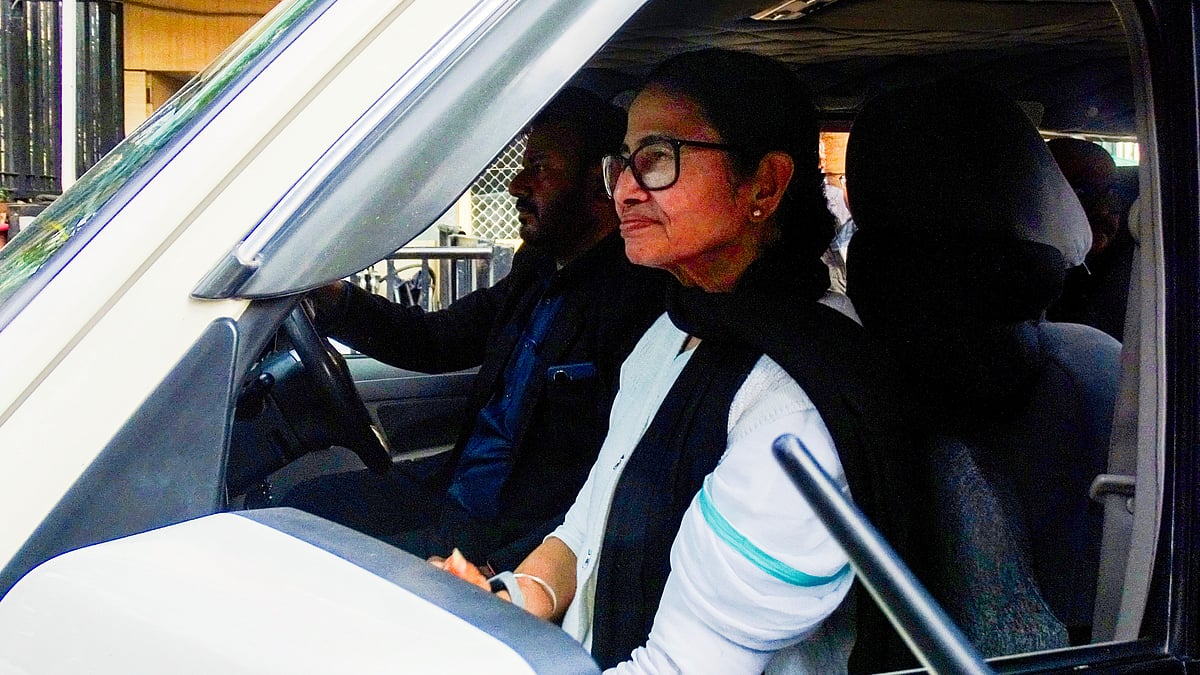
For 15 minutes on 4 February, a three-judge bench headed by Chief Justice of India Surya Kant heard a submission by West Bengal chief minister Mamata Banerjee on the Election Commission-mandated Special Intensive Revision (SIR) of electoral rolls that must be completed before the dates for the state Assembly elections are announced, weeks from now.
It was certainly an unprecedented — actually exceptional — occasion.
The reasons why it was exceptional are two; first, no chief minister in Independent India has done this; second, because the political Opposition to the ruling BJP — albeit in a coalition in the Lok Sabha because it did not win a majority — has no neutral space currently available to make its points at the national level.
The Lok Sabha speaker, shockingly, advised the Leader of the House, that is India’s duly elected prime minister, to forgo his prerogative to speak on the President’s address, because Om Birla claimed he had “credible information” that the Congress would organise an "untoward incident" directed at the prime minister.
When Banerjee spoke about logical discrepancies, micro observers, exclusions on the basis of misspelt names and more, it was not just the Supreme Court that heard her, so did the rest of the country.
The Court also heard and responded to the Election Commission's insensitivity in calling in eminent — even beloved — citizens like poet Joy Goswami (who had complained to the apex court) for 'hearings' to verify their identities as citizens. It may have been pertinent for the Supreme Court to name Nobel laureate economist and philosopher Amartya Sen and ex-MP Chandra Bose, a grand-nephew of Netaji Subhash Chandra Bose.
Before coming to the political impact of Banerjee’s appearance in the Supreme Court as a lawyer, it is necessary to understand the effect her appearance has had on the Election Commission’s credibility as a neutral institution committed to holding free and fair elections on behalf of India’s roughly 96.88 crore voters.
Having so far got away with bulldozing complaints lodged by various political parties — albeit all in opposition to the BJP — about the continuously changing rules for the SIR process, the Commission is being pinned down to give answers that are legally satisfactory to the Supreme Court.
By ordering that Class II officers of the West Bengal government must be used to correct errors in how names are spelled when translated into English, the Supreme Court has recognised that voters were being unnecessarily harassed to prove their identities. And that's only for starters; a second hearing is scheduled for 9 February before the apex court delivers its decision. That does not leave the Election Commission with much wriggle room.
By giving Banerjee 15 uninterrupted minutes to have her say on behalf of harassed and anxious voters fearful of being deleted from the voters' list for no fault of theirs, the Supreme Court provided a space and an opportunity to the political Opposition to the BJP, to have its say in a forum that must be respected by all political parties.
The hearing drew a line between the petitioners — namely Banerjee and others, including the CPI(M)’s Mustari Bano, a voter from Murshidabad — and the BJP.
As with the ruling BJP at the Centre, its counterpart in West Bengal has found nothing wrong with the SIR process as the state's principal opposition party; on the contrary, it has defended SIR with all its logical/ illogical discrepancies and continuous rectifications.
In other words, the BJP has defended the indefensible, which has not made it trustworthy for even its staunchest core voters — such as the hapless community of Matuas, who came to India from East Pakistan/ Bangladesh in waves and constitute over 2 crore of the state’s population as its second largest Schedule Caste group. In contrast, Banerjee has become the champion of the marginalised and defenceless.
By allowing her to speak, the Supreme Court recognised her role as the representative of West Bengal’s voters; those who have been called for the dreaded hearings and those who have escaped the summons. This is political capital in vast amounts earned by Banerjee at the cost of the BJP, and perhaps the Left as well as the Congress, both of whom have attacked her over her opposition to the SIR process.
The chief minister’s appearance in court was a strategic move; it was shrewd and calculated to emphasise that the Election Commission and the BJP, at the national and state levels, were on the same side.
The apex court certainly did not take sides, but by giving her time and opportunity, it produced unintended consequences. It is now up to Banerjee to build on the political capital she earned, and for the BJP to try and erode the value of that capital.
The balance of political advantage has sharply tilted in Banerjee’s favour, confirming that when she takes the fight to the streets, that is a larger arena, she is a formidable force, flawed but not flimsy.
Join our official telegram channel (@nationalherald) and stay updated with the latest headlines