POLITICS
Vijay: From ‘Thalapathy’ to ‘Muthalvan’ in debut electoral leap
Actor-turned-politician scripts unconventional rise, blending cinema charisma with grassroots strategy
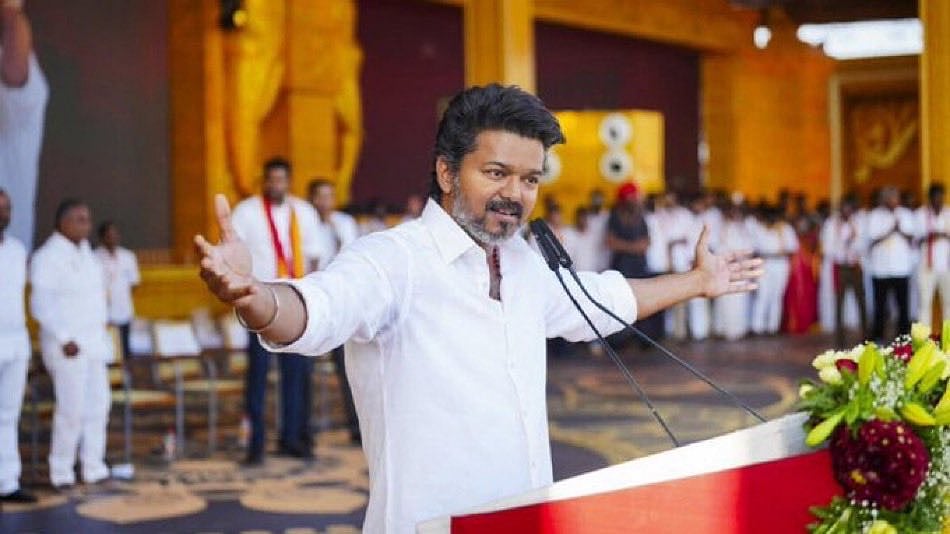
When Vijay declared that the 2026 Tamil Nadu Assembly election was a direct contest between his Tamilaga Vettri Kazhagam (TVK) and the ruling Dravida Munnetra Kazhagam (DMK), many dismissed it as political overreach. Yet, his campaign — unconventional, low on traditional rallies and high on digital mobilisation — has reshaped the contours of electoral politics in the state.
A campaign unlike any other
Rejecting standard campaign playbooks, Vijay avoided large-scale rallies, skipped extensive constituency tours, and largely stayed away from media interviews. Instead, he communicated directly with voters through social media and word-of-mouth amplification by his fan base.
In a strikingly novel approach, he targeted younger audiences — even children — urging them to influence family voting decisions. After polling crossed 85 per cent, he addressed them as “Vijay Mama” and thanked “Kutti, Nanba, Nanbees” for mobilising support.
Crafting a political identity
Vijay’s messaging fused elements of Dravidian ideology with Tamil nationalism, creating a hybrid political narrative distinct from established parties. His public appearances — often spontaneous and symbolic — reinforced his connection with ordinary voters, whether cycling through neighbourhoods or delivering layered speeches at film events.
Over decades, the actor had carefully shaped his public persona. From being introduced as “Ilaya Thalapathy” in the 1990s, he evolved into “Thalapathy” — a title synonymous with mass appeal — before transitioning into a political “Thalaivan” (leader) and ultimately “Muthalvar” (Chief Minister).
Cinema as a political springboard
Vijay’s films increasingly carried political undertones, reflecting social issues and governance concerns. Movies like Kaththi highlighted farmers’ distress, while Mersal stirred controversy over criticism of GST. Sarkar further amplified themes of electoral integrity and political accountability.
Earlier, his film Thalaiva, with the tagline “Born to Lead”, was widely seen as an early signal of his political ambitions.
From fan base to political machinery
The groundwork for Vijay’s political rise had been laid years earlier through the Vijay Makkal Iyakkam, whose members won local body elections in 2021 using his image, hinting at a latent political base.
Many of these grassroots organisers later transitioned into the organisational structure of TVK, providing Vijay with a ready cadre network ahead of his electoral debut.
Influences and early signals
Observers trace his political trajectory to moments such as his public support for Anna Hazare during anti-corruption protests and his adoption of signature phrases to connect with supporters, echoing styles used by leaders like J. Jayalalithaa and M. Karunanidhi.
His visits to victims of the Thoothukudi police firing and his increasing engagement with social issues further cemented his transition from screen icon to political figure.
A carefully engineered transformation
From a child artiste debut in the 1984 film Vetri to becoming one of Tamil cinema’s biggest stars, Vijay’s journey reflects a long-term strategy that blended branding, mass appeal and calculated political signalling.
His rise underscores a rare transformation — where cinematic charisma has been successfully converted into political capital — positioning him as a formidable force in Tamil Nadu’s evolving political landscape.
Join our official telegram channel (@nationalherald) and stay updated with the latest headlines