POLITICS
The importance of being Gurinder Singh Dhillon
Is the head of the influential Radha Soami Satsang Beas transitioning to a political role?
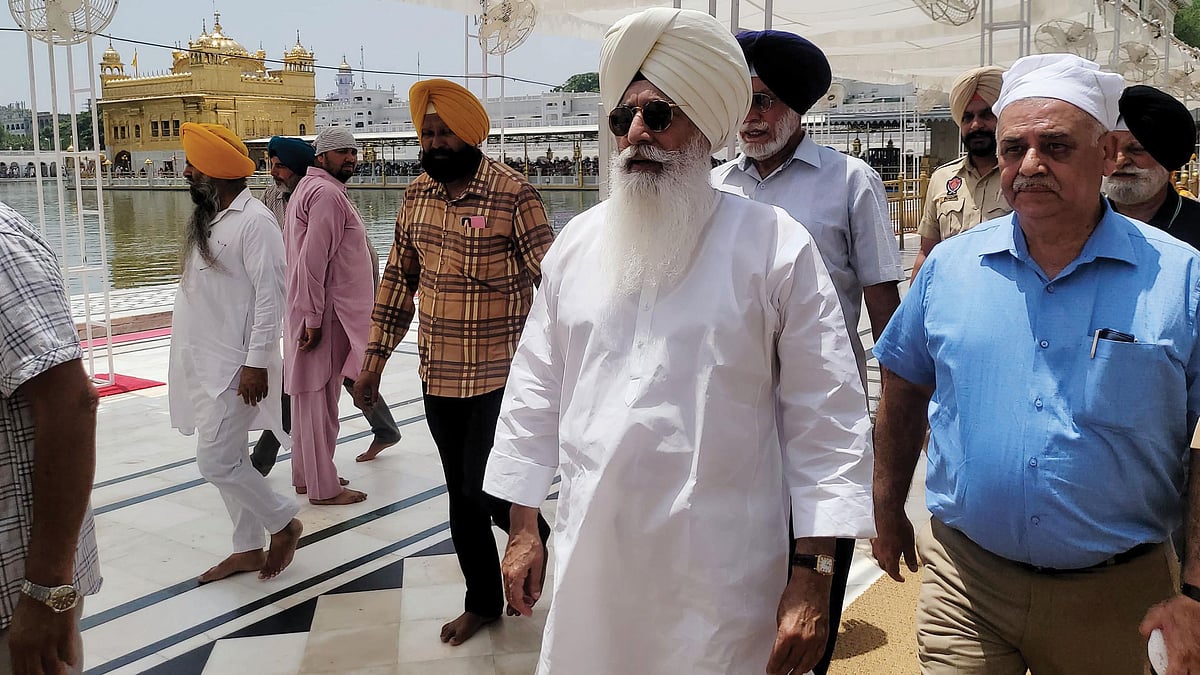
In a state where religion and politics have long shared a porous boundary, recent developments around Gurinder Singh Dhillon have sparked intense debate. The spiritual head of the influential Radha Soami Satsang Beas — widely known to his followers simply as ‘Baba’ — appears to have stepped into Punjab’s political theatre in a manner unprecedented for a dera chief.
The immediate trigger was Dhillon’s visit to meet jailed senior Shiromani Akali Dal (SAD) leader Bikram Singh Majithia, who has been embroiled in legal battles over a disproportionate assets case (he is also facing drug-related charges).
After the meeting (on 1 February), Dhillon publicly declared Majithia to be innocent. Whether that assessment was legally sound or not is beside the point. In a politically charged Punjab, such a statement from the head of the state’s largest dera amounted to a clear political signal — one widely interpreted as a rebuke to the ruling Aam Aadmi Party (AAP) government.
Dhillon’s political visibility did not end there. On 10 February, he joined state governor Gulab Chand Kataria at an anti-drug awareness foot march in Ferozepur. Sharing the stage were SAD president Sukhbir Singh Badal and Punjab BJP’s acting chief Ashwani Sharma. The optics were striking: a spiritual leader walking alongside leaders of rival political parties united in their opposition to the AAP.
A closed-door meeting during the event fuelled further speculation. Political circles buzzed with rumours that Dhillon was playing facilitator in reviving a potential SAD-BJP alliance to counter AAP and Congress. Observers described his role as that of a ‘bridge’ — someone capable of fostering cross-party cooperation on ostensibly social issues such as drug de-addiction, but with unmistakable political undertones.
Some went further, suggesting that the BJP, which is still struggling to find its feet in Punjab’s complex political terrain, may see Dhillon as a possible chief ministerial face. While there is no formal indication of such a plan, the conjecture underscores the dramatical shift in conversation around the dera chief.
Visits by political heavyweights to Dera Beas are not new. Prime Minister Narendra Modi, home minister Amit Shah and RSS chief Mohan Bhagwat have all been to the dera in recent years. Such visits are part of the state’s longstanding political culture, where religious and spiritual institutions are courted before elections.
What is new, however, is the apparent reversal of roles. Traditionally, it’s the politicians who seek blessings; rarely does a dera chief step so visibly into what seems like active political engagement.
Amritsar-based political observer Jagrup Singh Sekhon argues that the BJP is leaving no stone unturned to become a relevant player in Punjab. According to him, the party is attempting to disrupt established political equations and carve out space in a state where it has historically struggled. In that context, Dhillon’s increased public activity acquires added significance.
Radha Soami Satsang Beas is arguably the most influential dera in Punjab, with millions of followers in India and abroad. Its vast network and disciplined structure give it formidable social capital. Yet, despite the perception of deras as vote banks, there is little empirical data to conclusively prove that dera endorsements directly translate into electoral outcomes. Political parties continue to seek their support and the actual impact on voting patterns remains largely anecdotal.
Dhillon’s own public image has also been shaped by controversy. He was named in proceedings linked to the Ranbaxy scandal involving former promoters Malvinder and Shivinder Singh. Malvinder Singh alleged in court that a part of the proceeds from the sale of Ranbaxy Laboratories stake was diverted to Dhillon and his family.
In 2019, the Delhi High Court issued garnishee orders — a directive requiring a third party to pay funds directly to a creditor to satisfy a debt — against Dhillon, his family members and dozens of other entities.
Initially, the Dhillon family filed affidavits stating they did not owe money to Ranbaxy. Later that year, Dhillon acknowledged certain financial transactions dating back to 2006, though he disputed the scale of liability claimed and maintained that a full and clear account of transactions had not been presented. This dented the dera chief’s otherwise low-profile public persona.
Some analysts suggest that Dhillon’s visible proximity to national leaders in the years following the Ranbaxy controversy may have been strategic — a way to consolidate influence or ensure institutional protection during turbulent times. While such claims remain speculative, they contribute to the broader narrative now unfolding.
In a significant and somewhat rare organisational decision, Dhillon named Jasdeep Singh Gill as his successor in September 2024. Gill’s profile is markedly different: an alumnus of prestigious institutions including IIT, MIT and Cambridge, he has corporate experience that includes serving as a senior official at Ranbaxy. The move was seen as an attempt to institutionalise succession and insulate the dera from future turbulence.
Against this backdrop, Dhillon’s recent political engagements appear more consequential. Is he gradually transitioning from spiritual leadership to a political role?
Join our official telegram channel (@nationalherald) and stay updated with the latest headlines