POLITICS
Bengal ministers still await portfolios as questions grow over who's running govt
Delay in assigning departments fuels speculation over Delhi's role, while Tollygunge controversy highlights accountability vacuum
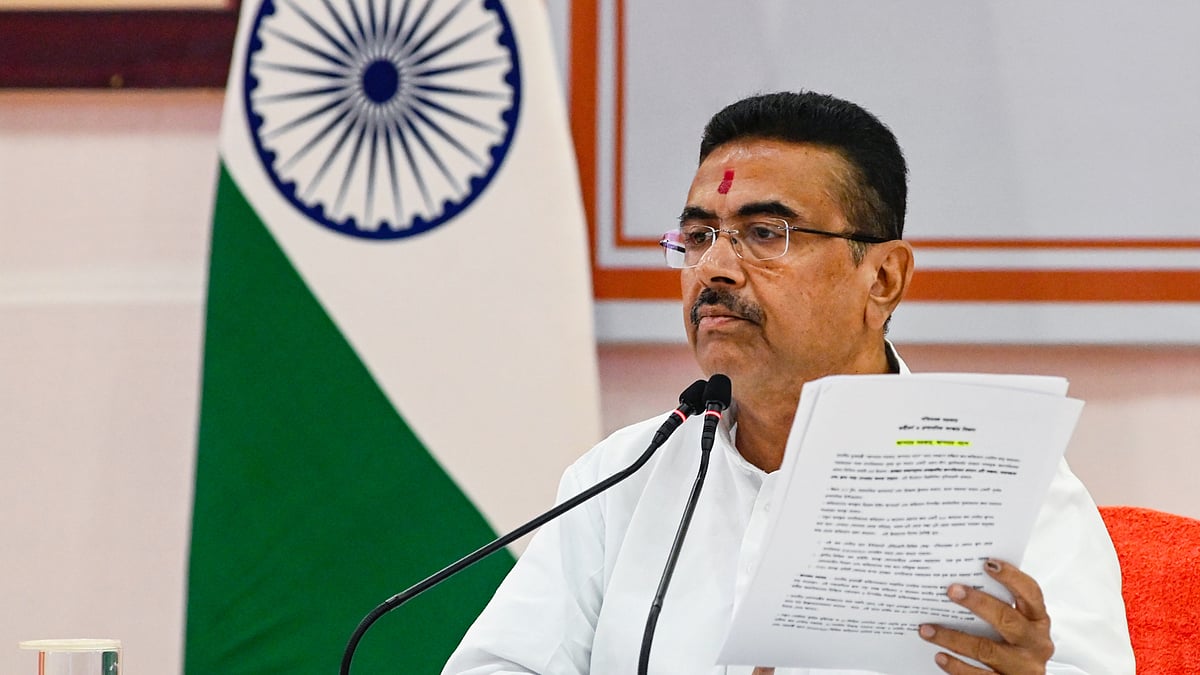
What is holding West Bengal chief minister Suvendu Adhikari back from allocating portfolios to his ministers?
That question is being asked with increasing frequency in political circles as West Bengal enters its fourth day with a fully expanded cabinet but no clarity on who is responsible for what.
Adhikari, who was sworn in on 9 May along with five ministers, expanded his ministry substantially on 1 June by inducting 35 more ministers. Yet four days later, portfolios have still not been allocated.
Under the Constitution, assigning departments is the chief minister's prerogative. The delay has therefore triggered speculation over whether Adhikari is struggling to balance competing interests within the BJP, facing pressure from ministers seeking influential departments, or awaiting guidance from New Delhi, the RSS (Rashtriya Swayamsevak Sangh), or the party's national leadership.
In the meantime, governance appears to be functioning in a peculiar state of suspension. Major announcements continue to come directly from the chief minister's office. A steady stream of government notifications is also being issued. What remains unclear, however, is whether these decisions are being deliberated by the cabinet, discussed within ministries, or simply being pushed through administrative channels while ministers wait for actual responsibilities.
The controversy surrounding the Bengali film industry's technicians is one example of that uncertainty.
Thousands of technicians gathered in Tollygunge on Thursday, 4 June to protest a proposal to dissolve 26 technicians' guilds and replace them with four umbrella bodies.
Protesters alleged that the decision had been taken without consultation and that they were subsequently attacked with bricks and eggs after being prevented from holding a press conference. Several technicians claimed some of the attackers identified themselves as supporters of BJP MLA and Eastern India Motion Pictures Cultural Confederation (EIMPCC) president Papiya Adhikari. She has denied any involvement.
The episode has raised an uncomfortable question: who authorised such a significant restructuring of an industry employing thousands of workers?
In a functioning government, such matters would ordinarily fall within the domain of designated ministers. But with portfolios yet to be allocated, critics argue that politically influential individuals and party functionaries are increasingly assuming responsibilities that would normally rest with accountable ministers.
National Award-winning make-up artist Somnath Kundu voiced the concerns of many protesters. "How can 26 guilds be dissolved without any discussion with anyone? These are long-standing guilds. Do they hold no importance? Where are we supposed to lodge our complaints?" he asked.
The incident has consequently evolved into something larger than a dispute within the film industry. It has become a case study in the confusion surrounding authority and accountability within the new administration.
Several BJP insiders admit privately that the delay in finalising portfolios has less to do with governance and more to do with internal power balancing. According to party sources, discussions are continuing over how cabinet positions and key responsibilities should be distributed among leaders aligned with different factions within the party, including those associated with Adhikari himself, Dilip Ghosh and sections of the RSS.
"The BJP is trying to strike a balance between various power centres within the organisation. Nobody wants to feel sidelined at the very beginning of a new government," a senior party functionary said on condition of anonymity.
Trinamool Congress leader Pratikur Rehman pointed to another sensitive factor. "Over the years, several BJP leaders and workers were involved in fierce political battles against leaders such as Suvendu Adhikari, Arjun Singh and Tapas Roy when they (the latter) were associated with Trinamool. The induction or elevation of former Trinamool leaders continues to generate resentment among sections of the BJP's old guard," he said.
A BJP leader familiar with the discussions acknowledged the challenge. "There are workers who suffered politically and physically during the Trinamool years. The leadership has to ensure that loyal BJP cadres are not ignored while accommodating leaders who joined the party later," he said.
Opposition parties have seized on the delay to question the authority of the state leadership. "If every major decision requires clearance from Delhi, then people are bound to ask who is actually running the government," Rehman remarked.
The CPI(M) has raised similar concerns. "A state government should be accountable to the people of the state, not be seen as waiting for instructions from elsewhere," CPI(M) leader Shatarup Ghosh said.
The Left has also linked the technicians' controversy to broader questions of governance. "Technicians are stakeholders in the industry. Their voices cannot simply be ignored," Ghosh said.
Political observers note that the dispute comes at a time when questions are already being raised about how authority is exercised within both the government and the ruling party. Critics allege that important decisions are increasingly being centralised, while supporters of the administration argue that reforms are necessary to improve efficiency and address corruption. The continued delay in allocating portfolios has only intensified scrutiny.
Trinamool leaders argue that the uncertainty reflects a government unable to take independent decisions and dependent on instructions from the BJP's central leadership.
A senior TMC leader claimed, "If ministers cannot be assigned departments promptly, it suggests that decisions are being taken elsewhere rather than in Kolkata."
The CPI(M) has similarly argued that governance inevitably suffers when administrative and political responsibilities remain undefined.
The BJP, however, insists the delay is administrative rather than political and says departments must be distributed carefully to ensure effective governance and coordination.
For now, however, West Bengal finds itself in an unusual position: a government with 41 ministers, but no public indication of what most of them are actually meant to do.
Join our official telegram channel (@nationalherald) and stay updated with the latest headlines