POLITICS
Yellow survey stones and a project called SilverLine
A rare victory for sustained public resistance against a mega infrastructure project backed by the full might of the state
When the yellow survey stone appeared one morning inside K. Thankamma’s kitchen courtyard in Alappuzha’s Kozhuvallur village, the 68-year-old widow felt as if somebody had quietly marked her family for eviction. The stone looked innocuous enough, but its message was terrifying.
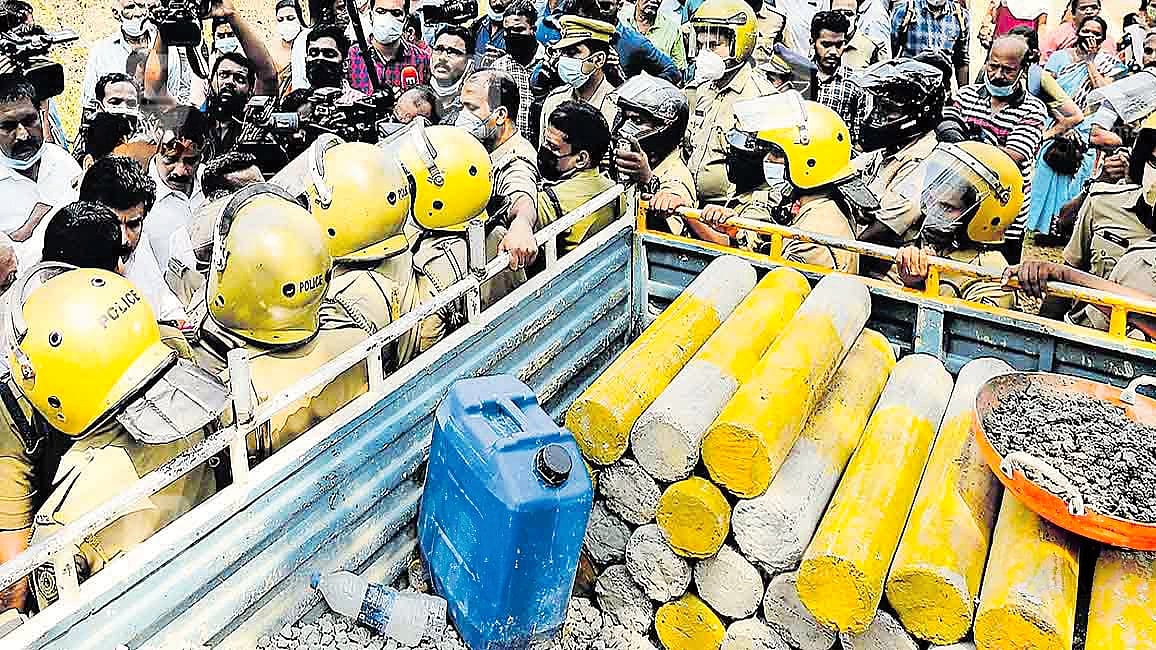
These stones were used to mark the proposed alignment of the controversial SilverLine high-speed railway corridor, projected by the then Pinarayi Vijayan-led LDF government as Kerala’s biggest infrastructure dream.
For Thankamma and thousands of others across the state, the yellow stones became symbols of fear, humiliation and uncertainty. Homes that had been around for generations faced demolition. Land prices crashed. Banks hesitated to grant new home loans. Families postponed weddings, house repairs and investments because nobody knew when the eviction notices or bulldozers might arrive.
With the new Congress-led UDF government led by chief minister V.D. Satheesan officially scrapping the project, relief has swept across villages that spent years living in a state of fear. “I used to wake up every day wondering whether this house would survive,” Thankamma told this reporter, standing beside the now fading yellow mark near her kitchen compound. “My husband built this home after years of hard work in the Gulf. After the yellow stone came, peace left this house. Even cooking in this kitchen became painful.”
From Kasaragod in the north to Thiruvananthapuram in the south, the yellow survey stones had entered courtyards, wells, paddy fields, kitchens and bedrooms. They had transformed ordinary homes into sites of anxiety.
Their removal now marks one of the most dramatic political reversals in Kerala’s recent history and a rare victory for sustained public resistance against a mega infrastructure project backed by the full might of the state.
****
In Thottolithazham near Kozhikode city, P.V. Shashindran spent years watching debt slowly consume his family. He had borrowed heavily to build a modest house and get his three daughters married. His liabilities crossed Rs 15 lakh. The only way out was to sell a portion of his ancestral property. Then the yellow stones arrived.
Potential buyers disappeared overnight. Nobody wanted land that could soon be acquired for SilverLine. Financial institutions too were reluctant to touch it. For Shashindran, this was worse than a nightmare — he had legal title of the land but couldn’t mortgage it or sell it. “The project destroyed our peace even before it had taken an inch of land,” he said.
****
In Meenchanda near Kozhikode, Abdul Razak had just finished construction of his new house when officials arrived with police escorts to place survey stones near the property. Panic entered the household at a time when his son was about to get married.
K.V. Razak, also a native of Meenchanda and a heart patient who actively joined the protests, collapsed during demonstrations against the survey. Images of elderly residents crying before police personnel travelled across Kerala.
Families felt abandoned by the state. Nobody would even say if their homes would survive. Even after the authorities hinted at possible alignment changes, the uncertainty continued.
For many affected families, this uncertainty was worse than displacement. People stopped renovating homes. Property transactions froze. Young couples postponed life decisions. Elderly residents were heard saying they would probably be gone before there was clarity.
Rebellion and relief
Madappally near Changanassery in Kottayam district emerged as a hotbed of resistance. Nearly 400 houses here were expected to be affected by the project.
Villagers turned into full-time protesters. Women slept inside makeshift tents. Elderly residents guarded roads at night fearing sudden survey operations. Families organised marches, sit-ins and human chains for years.
The movement shook Kerala after visuals emerged of grassroots activist Roselin Philip being dragged away by the police during a protest while her young daughter stood by and cried.
****
When authorities planted a survey stone in front of Thankamma’s kitchen in Kozhuvallur, villagers felt the state had crossed an invisible line. Protests intensified when the police reinstalled the survey stone after activists had once removed it. Sindhu James, a homemaker, was jailed and later alleged physical and mental harassment in custody.
The incident transformed the anti-SilverLine agitation into a larger statewide movement against what was seen and commonly described as authoritarian governance in Pinarayi Vijayan’s second term.
Environmental activist K.V. Ravishankar said the project failed because it ignored Kerala’s ecological and social realities. “SilverLine represented a dangerous development model imposed without listening to people or understanding Kerala’s fragile environment. The protests showed that ordinary people were no longer willing to sacrifice their homes and livelihoods or the wetlands for projects that mainly benefit contractors and politicians.”
SilverLine, a.k.a. K-Rail, became a moral and political question about whether ‘development’ could justify uprooting thousands of families in one of India’s most densely populated states.
When the new government announced the decision to scrap the project, residents burst crackers and distributed sweets. Many described the moment as liberation from a prolonged psychological siege.
The project that made Kerala see red
The Pinarayi Vijayan government had tried to sell SilverLine to the people as an infrastructure dream. The estimated cost: Rs 63,941 crore. The benefit: a speedy rail link (<4 hours) connecting the length of the state, from state capital Thiruvananthapuram in the south to Kasaragod in the north.
The proposed route cut through densely populated settlements, wetlands, paddy fields, rivers, backwaters and ecologically fragile regions including Madayippara, Kadalundi estuary and Kole wetlands.
It required acquisition of nearly 1,383 hectares of land across Kerala. Environmentalists warned that the corridor could trigger severe hydrological consequences in a state already battered by floods, landslides and coastal erosion. Experts argued that enormous quantities of granite, soil and sand required for embankments and elevated corridors would intensify pressure on the fragile Western Ghats ecosystem.
The financial implications were also controversial. Critics questioned how debt-stressed Kerala could support the cost of the project when it was already struggling with welfare commitments, climate disasters and fiscal instability.
Many experts argued that upgrading the existing railway network with electronic signalling, track doubling and modernisation could substantially reduce travel time without triggering mass displacement and ecological destruction.
Resistance to the project united an unusual coalition of environmentalists, church groups, scientists, civil society organisations and ordinary residents, including sections traditionally sympathetic to the Left.
SilverLine became a referendum on Kerala’s development politics.
Not just SilverLine
SilverLine was possibly the most emblematic of the governance trajectory but not the only infrastructure project under the Pinarayi Vijayan government that drew sharp criticism. The EMCC deep sea fishing project, which threatened the livelihoods of traditional fisher communities, the Vizhinjam port project, the extensive quarrying in ecologically fragile regions, disputes over buffer zones surrounding protected forests and allegations related to coastal mineral sand (black sand) mining had put the erstwhile LDF government on the defensive in the run-up to the recent elections.
While announcing the cancellation of the SilverLine project, just days after taking the oath of office, chief minister V.D. Satheesan said: “We cannot impose development by destroying people’s lives and the ecology. ... Kerala needs modern infrastructure. But every project must [consider] environmental sustainability and respect democratic consultation and the dignity of ordinary citizens.”
Join our official telegram channel (@nationalherald) and stay updated with the latest headlines