Science Tech
Discarded SpaceX rocket stage to crash into moon in rare accidental impact
Scientists expect collision to create a fresh crater and offer insights into space debris and future lunar missions
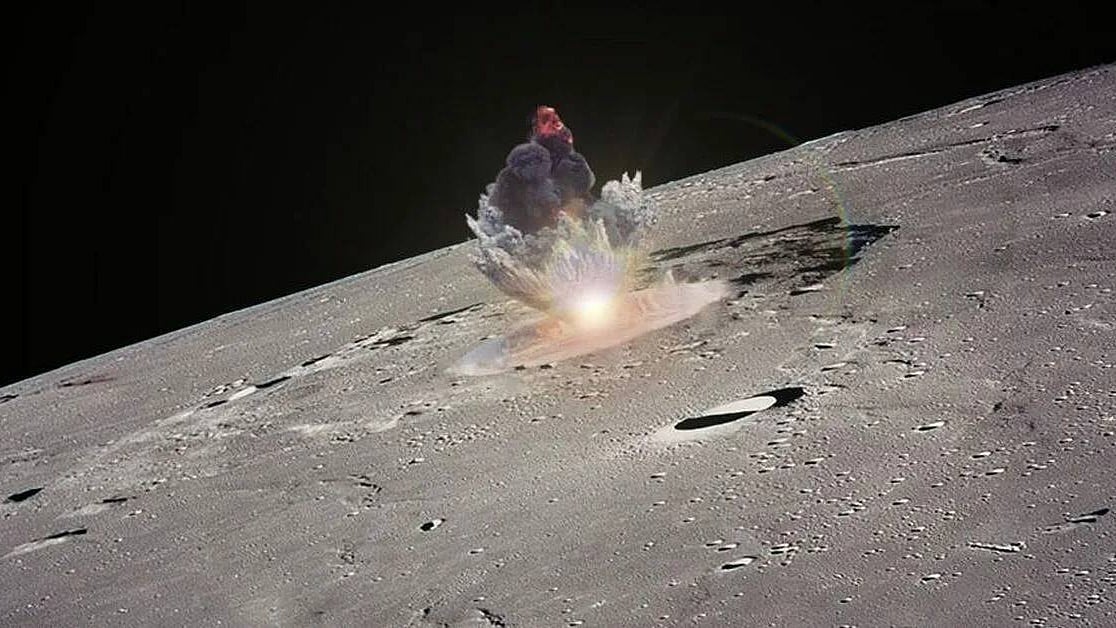
A discarded SpaceX rocket stage is set to crash into the moon on Wednesday, 5 August in a rare accidental impact that scientists hope will shed light on the effects of space debris on future lunar exploration.
The upper stage, which launched two private lunar landers more than a year ago, will strike the moon at an estimated speed of 8,700 kmph, excavating a crater and sending a plume of dust and debris into space.
Space-tracking expert Bill Gray predicts the impact will occur near Einstein Crater on the moon's sunlit western limb. The best viewing conditions are expected in parts of eastern North America and across much of South America, though the impact itself will take place before dawn.
Scientists estimate the collision will release energy comparable to around three tonnes of TNT.
Though researchers say the rocket poses no immediate danger, the incident underscores growing concerns over the increasing amount of human-made debris left in space. "Things are getting crowded up there," Gray said. He plans to observe the aftermath from New Brunswick, Canada.
Experts noted that the collision was never intended. They said the impact could have been avoided had the rocket stage been manoeuvred into an orbit around the sun after completing its mission.
It will be only the second confirmed instance of an abandoned rocket accidentally striking the moon. In 2022, a spent Chinese rocket stage crashed into the moon's far side, leaving behind twin craters. Unlike that impact, Wednesday's collision will occur on the near side of the moon, making it easier for astronomers to study.
Scientists do not expect the initial flash from the impact to be visible from Earth because it will last for less than a second. However, the plume of dust and rock blasted into space could remain visible through telescopes for several minutes.
"The gravity on the moon is low and there is no wind to blow the dust away," said Benjamin Fernando of Los Alamos National Laboratory, who has encouraged both professional and amateur astronomers to observe the event. "Part of the reason for our interest in this event is to figure out how much of a hazard debris impacts pose to future astronauts."
Fernando estimates the impact will leave a crater roughly 27 metres wide and five metres deep. While too small to be seen from Earth, it should be visible to orbiting spacecraft.
NASA's Lunar Reconnaissance Orbiter and South Korea's Danuri lunar orbiter are expected to photograph the impact site before and after the collision. According to Fernando's team, Danuri will pass within a few kilometres of the rocket stage about two minutes before impact.
The abandoned rocket stage, measuring around 12 metres long and weighing approximately 4,500 kg, launched on 15 January 2025 carrying two commercial lunar landers. One of them, Firefly Aerospace's Blue Ghost, became the first privately built spacecraft to achieve a fully successful lunar landing. The second, operated by Japanese company ispace, crashed during its landing attempt.
Scientists say controlled observations of impacts involving known objects provide valuable data that cannot be obtained from unpredictable meteoroid strikes. NASA deliberately crashed rocket stages and lunar modules into the moon during the Apollo programme to conduct seismic experiments. In 2009, the US space agency also intentionally crashed its LCROSS spacecraft and its upper stage near the lunar south pole in a search for water ice.
With several countries and private companies planning more frequent missions to the moon, researchers say improved monitoring of space debris and better traffic management will become increasingly important.
The United States and China are both aiming to return astronauts to the lunar surface in the coming years. Meanwhile, SpaceX and Blue Origin are competing to develop the lunar lander for NASA's Artemis IV mission.
"This impact will not be a problem," retired astrophysicist Jonathan McDowell said. "But in a future where there are long-term bases on the moon, similar impacts would be an issue and we need not to leave rocket stages in chaotic orbits of this kind."
With AP/PTI inputs
Join our official telegram channel (@nationalherald) and stay updated with the latest headlines