Sports
CWG: India take charge of baton as 2030 hosts with an eye on Olympics
A full-fledged Games in Amdavad, however, means costs will at least double up from Glasgow edition
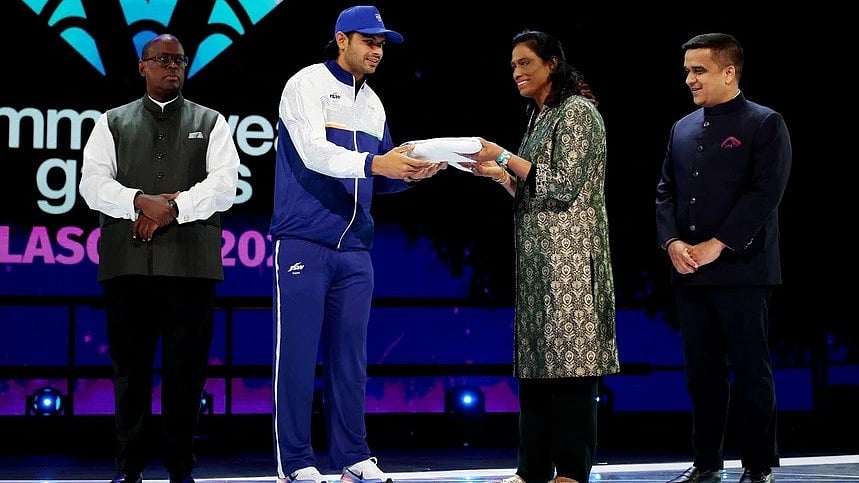
It was a poignant moment on Sunday night when Neeraj Chopra and PT Usha, two of India’s finest representatives in the global athletics community, received the baton as hosts of the 2030 Commonwealth Games in Ahmedabad. A fourth successive fourth-place finish in the final medal tally underlines the country’s potential to be a worthy host, but questions remain over whether the Games will justify the enormous investment involved.
There are no prizes for guessing that India entered the fray in March last year, with Ahmedabad as the default candidate, to host the CWG as a test case to strengthen its bid for the more ambitious 2036 Olympics. However, with the International Olympic Committee (IOC) decision on the 2036 host expected around 2028-29, it will be interesting to see where India stands if its bid is rejected, especially as it faces competition from strong contenders.
It’s an unsavoury thought to dwell on just a day after India received the baton as hosts — albeit for the second time after 2010. However, there is no denying that the CWG, which will complete a century of existence in four years, is skating on thin ice as the relevance of a Games limited to countries that were once part of the British Commonwealth comes under scrutiny. It is common knowledge that both Birmingham and Glasgow, the last two hosts, stepped in only after Durban and Victoria withdrew, though such a situation appears highly unlikely for India.
A top Indian Olympic Association (IOA) official, however, was pragmatic enough not to make any cast-iron promises. “I don’t think one can give any guarantees,” IOA Chief Executive Raghu Iyer told BBC Sport. It was a note of caution suggesting that questions over the Games’ future had not been completely dispelled, despite the truncated 2026 edition managing to deliver a decent event.
The Glasgow model, which followed a blueprint to cut costs on all fronts, and the Ahmedabad model are likely to be poles apart. While Glasgow managed to restrict expenditure to around £160 million (source: BBC) by reducing the number of disciplines by half to 10 and accommodating athletes in hotels instead of a central Games Village, the cost for India is expected to be at least double.
The central venue will, of course, be the 120,000-seater cricket stadium named after Prime Minister Narendra Modi, while most other facilities are expected to be built afresh in cities such as neighbouring Gandhinagar, Vadodara and Ekta Nagar. The Sardar Vallabhbhai Patel International Airport already has a second terminal, with further upgrades expected over the next four years.
Interestingly, India is still counting the costs of the 2010 edition, when New Delhi hosted the Commonwealth Games for the first time. Media reports suggest that an outstanding liability of Rs 28.05 crore was cleared in 2025-26, while another Rs 50 crore has been set aside for 2026-27. More than Rs 13 crore has already been spent on legal and arbitration fees, with 29 cases still pending before various courts.
“It is a big responsibility, but we are ready,” said Harsh Sanghavi, Deputy Chief Minister of Gujarat, who was joined by Shri Hari Ranjan Rao, Secretary at the Department of Sports. He highlighted how hosting the Games could boost India’s chances of securing the 2036 Olympics and Paralympics.
There are precedents from at least two countries — Australia and Canada — which have hosted both the Summer Olympics and the Commonwealth Games in close succession. Melbourne hosted the 1956 Olympics, followed by Perth hosting the 1962 Commonwealth Games, while Sydney staged the 2000 Olympics and Melbourne the 2006 Commonwealth Games. Canada achieved this with an even shorter gap, hosting the 1976 Olympics in Montreal and the 1978 Commonwealth Games in Edmonton.
It’s significant to note that the host cities were different in each case, unlike India, where Ahmedabad has been projected as the Olympic host city. For now, the countdown to the centenary Games has begun and, in the words of Commonwealth Sport CEO Katie Sadleir, the 2030 edition is unlikely to feature the “15 to 17” sports that have traditionally been part of the programme — with cricket virtually certain to make a comeback.
India (or Ahmedabad?) will have its hands full, it seems.
Join our official telegram channel (@nationalherald) and stay updated with the latest headlines