Sports
FIFA World Cup: Will fans in India not watch live telecasts?
No official broadcaster firmed up yet thanks to 'unfriendly' time zone, doubts over advertising revenue
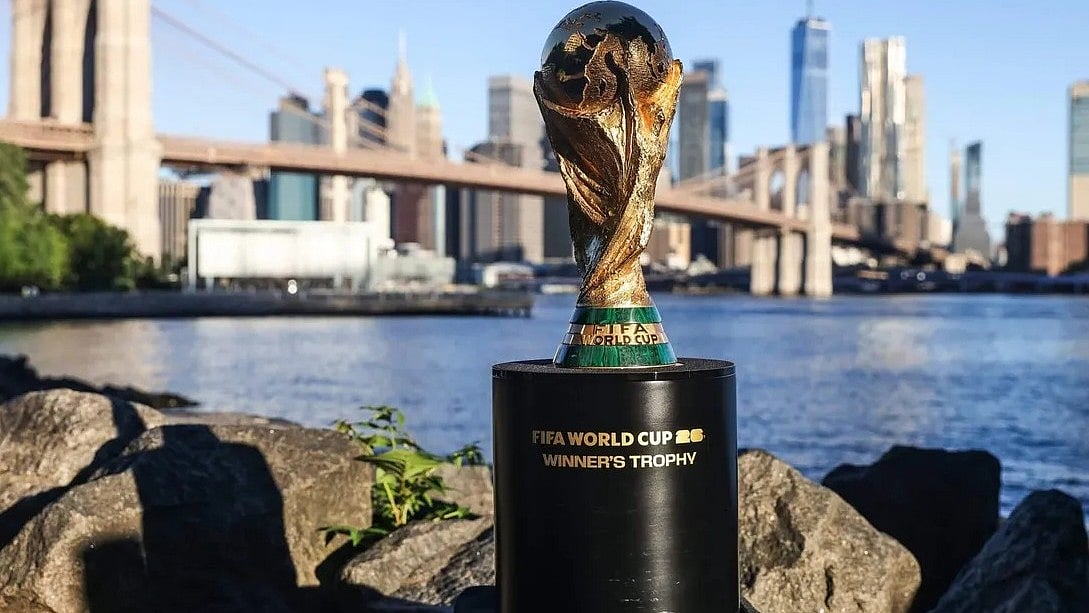
The uneasy question gnawing at the minds of Indian football fans, with barely one-and-a-half months to go for the FIFA World Cup, is that there is no official broadcaster for the country yet. The showpiece, which will see an expanded field of 48 teams and a last hurrah for the two icons Leo Messi and Cristiano Ronaldo, will kick off on 12 June across the US, Mexico and Canada.
The ‘greatest show on earth’ has a huge following in the Indian market — especially in states like West Bengal, Kerala, Goa and Maharashtra — thanks to the exposure to global club football. However, industry watchers feel that time zone differences and the potential dilution in the quality of competition with 16 teams added at one go — not to speak of the uncertainty of advertising revenue — have been a major deterrent for the likes of Jio Hotstar, Sony and Fan Code.
FIFA had, for the 2026 cycle, attempted to bundle two upcoming World Cups (2026 and 2030) and initially sought close to $100 million from the Indian sub-continent. The market didn’t respond favourably, forcing the world governing body to scale it down in a big way but it still failed to draw interest from the big players.
The buzz right now is that the ball is currently in Jio Hotstar’s court but if they don’t enter the fray, the fallback option could well be Prasar Bharati stepping in through Doordarshan.
There have been precedents when India’s sports broadcasting regulations allowed events of national importance to be routed through free-to-air platforms — though the telecast would certainly lack the multi-language, high-production ecosystem experienced in 2022.
Replying to a National Herald query about the possibility of Doordarshan entering the fray in the eleventh hour, a Prasar Bharati veteran said: ‘’If it comes to a crunch, DD may enter the fray from the quarter final stages as they have done it in the past. The corporation has it’s own share of financial woes at the moment, but the government is often moved to act owing to public sentiment and political pressures. Since DD has a slew of GECs (general entertainment channels) in regional languages, they also need footages for providing value to it’s programmes.’’
A sports broadcasting insider, meanwhile, broke it down further as to what could be holding back the likes of a Jio Hotstar with deep pockets. ‘’Any broadcasting major will look for return on investment (RoI) and it looks uncertain due to the match timings — along with the fact that cricket has already eaten into a lion’s share of advertising revenue this year with the back-to-back T20 World Cup and the IPL.
"A few other corporate houses who are invested in sport want to hold their horses as the Asian Games is also scheduled later this year which has got strong Indian participation,’’ he said.
Incidentally, Viacom18 (as Jio’s sporting arm was known as before it’s mega merger with Star Sports) paid roughly $62 million for the 2022 World Cup in Qatar but the match timings suited fine with the Indian audience.
A report in sports website Revsportz suggests that FIFA could also choose to bypass traditional broadcasters altogether and stream the tournament in India via its own digital ecosystem, potentially through a partnership with YouTube. It would not be without precedent — the world governing body has already experimented with direct-to-consumer models via FIFA+, but doing so for a marquee market like India would mark a significant shift.
A YouTube tie-up would guarantee both reach and accessibility, especially among younger, mobile-first audiences - while allowing FIFA to retain greater control over distribution and monetisation. It remains to be seen whether such streaming, with occasional buffering jarring the spectator experience, whet the apetite of the fans in the country.
Join our official telegram channel (@nationalherald) and stay updated with the latest headlines