Sports
Gukesh vs Sindarov: Can the defending champion do it all over again?
Calls Uzbek challenger a 'genius'; Sindarov feels the Indian will be more cautious
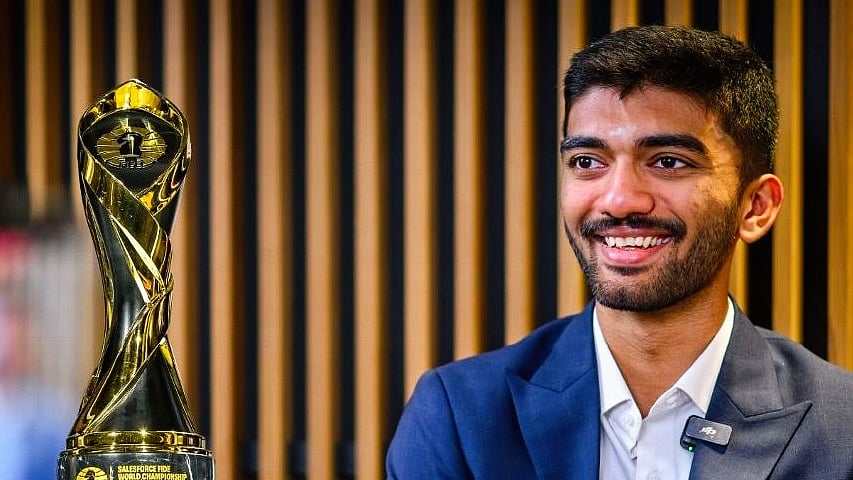
The crunch moment is finally here. Deep down, defending world champion D Gukesh knows that the past two years have been underwhelming by his own lofty standards. But at Sunday's pre-match press conference in Geneva, the 20-year-old chose to deflect the pressure, insisting he was not approaching the World Championship as someone merely defending his title.
"I don't think I'm here to defend anything. I'm here to win it all over again. That's the mindset I am in," Gukesh said.
It may be the right mindset heading into the biggest contest in chess, with the match set to be played by Lake Geneva. But the balance appears tilted towards Uzbek challenger Javokhir Sindarov, at least on current form.
The build-up to the youngest World Championship match in history has seen a role reversal of sorts from two years ago. Gukesh, then 18, was on an upward trajectory after emerging as an exceptional talent at the 2022 Chess Olympiad and going on to qualify for the Candidates, where he stunned the field to earn his shot at the world crown.
This time, it is Sindarov who has seized the spotlight. His dominant performance at the Candidates earlier this year has made him the favourite going into the match.
Yet, having already won the world title once, Gukesh cannot be written off lightly — a fact reflected in the divided opinions among chess greats. While Garry Kasparov is backing Gukesh, multiple world champion Magnus Carlsen believes Sindarov could have his moment.
Sunday's Media Day at the Fondation Martin Bodmer in Cologny, the venue for the championship, also reflected the mutual respect between the two young contenders. Gukesh was particularly effusive in his praise for Sindarov. "He is super talented and energetic, or, in a single word, a genius!" Gukesh said.
Gukesh enters his second World Championship match ranked 26th in the world, with a classical Elo rating of 2710 — a considerable drop from 2783 when he faced the world championship in Singapore two years ago.
It is difficult to believe that the reigning champion has not won a title since claiming the world crown. If 2025 was disappointing, despite decent performances at tournaments such as the Tata Steel Masters and Norway Chess, the first seven months of 2026 were particularly bleak.
Gukesh finished 10th at the Tata Steel tournament in Wijk aan Zee in January, tied for last at the Prague Masters in March, and last again at Norway Chess in June and the Chennai Grand Masters in July.
By the end of March, the slump had become concerning enough for his team to rethink his schedule. Gukesh withdrew from two classical Grand Chess Tour events to avoid extended periods away from home and prioritise training.
In an interview with ESPN, five-time world champion and Gukesh's mentor Viswanathan Anand acknowledged the psychological weight of being world champion, drawing on his own experience of facing similar struggles.
"What Gukesh is experiencing, I've experienced a couple of times. You have no idea why the world refuses to work like it used to. You're working as hard as you think. You want it, you think, you think. But the world is just not bending in like it used to. The only thing I could tell him is that it comes with the territory," Anand said.
It is tough to be in Gukesh's shoes, no doubt. But the famously humble champion is ready to endure the grind once more — with a nation of 1.4 billion watching closely.
What is the prize fund?
The total prize fund is US$2.5 million, net of applicable local taxes. Players receive US$200,000 for every game won, including a win by forfeit, with the remaining prize money divided equally between them.
If the final classical score is 7.5-6.5, with 13 decisive games, or 8-6, with all 14 games decisive, the winner is set to receive US$1.3 million and the runner-up US$1.2 million. The same split applies if the match is decided in tie-breaks.
What is the format?
The match comprises a maximum of 14 classical games. The first player to reach 7.5 points wins the match and the world title. If the score is tied 7-7 after all 14 games, the title will be decided through tie-breaks on 12 December.
How does the scoring work?
A win earns one point, while a draw gives each player half a point. The match ends as soon as either player reaches 7.5 points.
What is the time control?
Each classical game allows 120 minutes for the first 40 moves, followed by an additional 30 minutes for the remainder of the game. A 30-second increment is added after every move from move 41 onwards.
What happens if the match goes to tie-breaks?
If the score is tied 7-7 after the classical games, the title will be decided on 12 December through the following sequence:
Rapid play-off: Four games at 15 minutes, with a 10-second increment per move.
Second rapid play-off: If scores remain level, two games at 10 minutes, with a five-second increment per move.
Blitz play-off: If the tie persists, two games at three minutes, with a two-second increment per move.
Sudden death: If the scores are still level, single three-minute-plus-two-second blitz games will be played, with colours reversed after each drawn game until there is a decisive result.
Where can you watch the World Championship live?
The match will be streamed through FIDE's official website and streaming channels, including its YouTube channel. The first classical game is scheduled for 24 November, the 14th and final scheduled game for 11 December, and tie-breaks, if required, for 12 December.