World
Why India has no place in the ‘Pax Silica’ order
Pax Silica includes countries smaller than India, in both population and market size, some far more dependent on US security guarantees, and some with no pretence to ‘strategic autonomy’
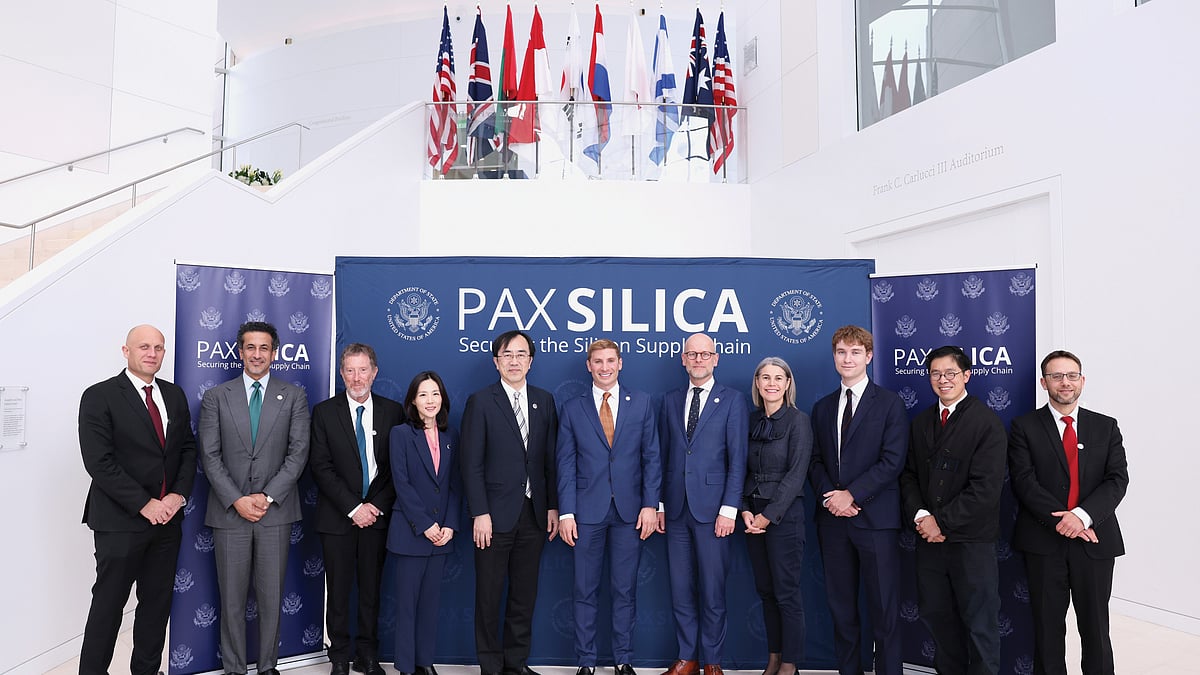
‘Pax Silica’ has emerged in late 2025 as a pillar of President Donald Trump’s new national security strategy, designed to restructure global supply chains in critical minerals, semiconductors and advanced technologies around a tightly knit circle of trusted allies. Its founding members are a new group of seven—the US, Japan, South Korea, Singapore, UK, Israel and Australia, a grouping selected for their technological depth, policy alignment and strategic reliability.
The inaugural Pax Silica Summit was held in Washington DC on 12 December, where the US also hosted additional participants—Taiwan, Canada, the EU, Netherlands, the UAE and others. Guest participants were present to provide advisory inputs, technical expertise and policy guidance while the core members signed the Pax Silica Declaration to cooperate on securing supply chains for semiconductors, critical minerals, AI infrastructure and allied technologies.
India’s absence from the Pax Silica grouping is not accidental; it indicates how the Trump administration assesses India, how peripheral India now is to Washington’s strategic calculus. India’s marginalisation is reinforced by President Trump’s national security strategy released in November 2025, in which India appears only in passing, treated as a secondary regional actor rather than a central strategic partner in shaping the future global order.
The Pax Silica initiative goes well beyond the logic of a mini-lateral partnership. It represents a bid by the US to define the economic architecture of the 21st century by anchoring control over minerals, chips, AI infrastructure and advanced manufacturing within a trusted bloc. Exclusion from such a project at the time of its creation has lasting consequences. It places India on the margins of US strategic planning at a point when technological power is becoming the main currency of global influence. It also exposes the yawning hiatus between years of Prime Minister Modi’s diplomatic rhetoric about special ties with the US and the reality of India’s diminished standing.
The Modi government has so far responded by not responding. That silence itself is revealing. It reflects the difficulty of reconciling domestic triumphalism about India’s global rise with the reality of how India is now perceived in key Western capitals.
Pax Silica includes countries smaller than India in both population and market size, some far more dependent on US security guarantees, and some with no pretence to ‘strategic autonomy’. Manifestly, the US is looking at them as reliable, predictable partners, who are aligned with US priorities in technology and supply chains and share its political values.
The reason for keeping India at an arm’s length is less technical capability and more trust. India does have strengths in chip design, software and a growing interest in semiconductor manufacturing. But Pax Silica is not about potential; it is about policy coherence and alignment. Washington is drawing towards countries willing to embed their industrial strategies within a US-led coalition. That requires regulatory stability, openness to foreign capital, clarity on export controls and a willingness to accept US partnership without constant hedging. India under Modi has moved in the opposite direction.
For years Modi has projected himself as a global statesman who can befriend everyone while offending no one. The emphasis on personal chemistry, grand diaspora events and photo-ops has substituted hard institutional work that forms the bedrock of foreign policy. This personality-driven approach seemed to work for a while, when Washington was eager to court India as a counterweight to China. But with India not looking like a counterweight anymore—not economically, nor technologically nor even in soft-power terms—the US is narrowing its circle and prioritising partners who can be integrated quickly into tightly coordinated technology ecosystems.
The Pax Silica coalition is explicitly designed to reduce dependence on China. Yet India’s own China policy has been marked by contradictions. After the border clashes in Ladakh in 2020, the Modi government not only failed to confront China but also quietly restored economic ties. Chinese imports reached record levels even as China-bashing was amped up for Modi’s domestic audience. Washington can see that India wants the best of both worlds: the benefits of a strategic partnership and the leeway of ‘strategic autonomy’ to pursue other ties and treaties in self-interest.
The oil deal with Russia was exactly such a sticking point. When India continues to expand energy trade with Moscow and signals interest in advanced Russian military systems, it reinforces doubts about where India would stand in a major geopolitical crisis.
Strategic autonomy may be a cherished slogan in New Delhi, but for a coalition built on controlled technologies and sensitive supply chains, ambiguity is a liability. Trade policy is another self-inflicted wound, with the Modi government’s positions sounding like a hodgepodge of protectionist rhetoric, cronyism and unpredictable regulatory twists and turns.
India’s exclusion from the Pax Silica alliance also exposes the limits of Modi’s belief that ideological affinity with right-wing forces in the West would compensate for policy divergence. The assumption that shared ethno-nationalistic beliefs and manufactured personal rapport with leaders like Donald Trump would translate into structural advantages has proven naïve. The Pax Silica pact reflects a cold assessment of who will play ball when it matters.
India’s domestic political trajectory, marked by democratic backsliding and attacks on minorities, has further complicated its image. While Washington is clearly not averse to working with illiberal partners, when necessary, it also assesses their indispensability. India has not made itself indispensable in the critical technologies that Pax Silica prioritises.
Modi has repeatedly claimed that India is indispensable to any global solution, whether on climate, supply chains or security. Pax Silica demonstrates the hollowness of that claim as well. When the US moved to design the architecture of a future technology economy, India was not at the table. This is not because India lacks potential, but because potential alone does not shape coalitions.
Some right-wing commentators think India may be invited later. But entering a club after the rules have been written is not the same as shaping them. Founding members set norms, standards and power hierarchies. Latecomers adapt or remain marginal. Modi’s foreign policy has repeatedly produced this pattern. India joins initiatives after the strategic momentum has shifted elsewhere, then claims success simply by being present.
At the very least, Pax Silica is a reality check for India’s insistence on ‘strategic autonomy’. India cannot be part of the Western technological core without making hard choices. It cannot demand strategic trust from the US while insisting on maximal flexibility.
It bears repetition that India’s exclusion is not the result of Western hostility, but rather because India’s so-called ‘strategic autonomy’ has neither a moral core nor policy coherence; it is simply a patchwork of convenient relationships, which give no indication of which way Modi’s government will turn when push comes to shove.
(ASHOK SWAIN is a professor of peace and conflict research at Uppsala University, Sweden)
Join our official telegram channel (@nationalherald) and stay updated with the latest headlines