


Campus protests to Crime Branch probe: What followed Sahil Wakode’s death at IIT Bombay
Mumbai Crime Branch is examining CCTV footage, digital evidence and allegations of harassment and caste discrimination; no allegation has yet been established
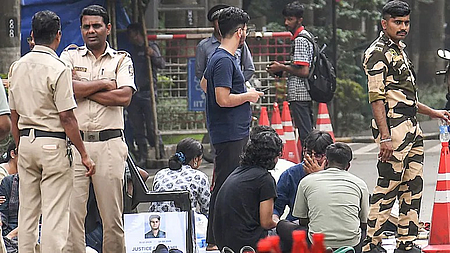


Sahil Wakode, a second-year BTech student, was found dead in his IIT Bombay hostel room on 18 September after an alleged academic-misconduct incident during an examination
Following three days of protests, IIT Bombay signed an 18-point students’ charter covering an independent inquiry, faculty accountability, disciplinary safeguards and mental-health reforms
The Mumbai Crime Branch is examining CCTV footage, digital evidence and allegations of harassment and caste discrimination; no allegation has yet been established
The death of second-year BTech student Sahil Ravindra Wakode at IIT Bombay has led to a police investigation, three days of campus protests and an 18-point reform charter covering institutional accountability, disciplinary procedures and student welfare.
IIT Bombay has apologised for its initial account of the circumstances preceding Wakode’s death and relieved Professor Suryanarayana Doolla of his duties as Dean of Administrative Affairs. Students, however, have maintained that removing him from the administrative position does not meet their demand for his suspension as a faculty member.
The Mumbai Police Crime Branch is now investigating the case following a complaint from Wakode’s father alleging prolonged harassment and caste-based discrimination. The allegations have not been established, and the institute has said further action will be governed by due process.
18 September: Examination incident and Wakode’s death
Wakode, a student in the Department of Energy Science and Engineering, was appearing for a mid-semester examination on the Powai campus on September 18. Reports citing CCTV footage said an incident occurred in the examination hall at around 12.30 pm to 12.45 pm after he was allegedly found using a mobile phone.
In its initial communication, IIT Bombay claimed that Wakode had uploaded the examination question paper to ChatGPT to seek answers. It said he had subsequently been counselled by the instructor, his faculty adviser and the Head of Department, and that no disciplinary action had been initiated against him.
According to reports based on CCTV footage, Wakode later left the examination hall and walked towards his hostel. Footage reportedly showed him entering his room in Hostel No. 4 at around 1.25 pm. He was found dead there later that day. No suicide note was reportedly recovered.
The precise nature of his interaction with the invigilator and other faculty members, whether he was threatened with disciplinary action and the sequence of events between his departure from the examination hall and arrival at the hostel remain under investigation.
19 September: FIR registered on family’s complaint
Police initially registered an accidental-death report. On 19 September, following a complaint from Wakode’s parents, a case was registered under Section 108 of the Bharatiya Nyaya Sanhita, relating to abetment of suicide, and provisions of the Scheduled Castes and Scheduled Tribes (Prevention of Atrocities) Act.
Wakode’s father, Ravindra Chakradhar Wankhade, alleged in his complaint that his son had faced severe mental harassment and caste-based abuse for about three months. He claimed that Wakode had told his family that Doolla referred to him as belonging to a “lower caste”, threatened to harass him and warned that he could be implicated in a false case.
The father also alleged that faculty members and the administration had subjected his son to sustained pressure, with the examination incident becoming an immediate trigger. He rejected the suggestion that the death could be attributed simply to Wakode allegedly being caught using ChatGPT and called for the role of the professor and other officials to be investigated.
These claims form part of the police complaint and have not been proven. IIT Bombay has said that Wakode had not submitted a complaint alleging caste discrimination to either its administration or its SC/ST cell.
A close friend of Wakode separately told NDTV that he did not believe casteism was a factor in the case and had not personally encountered caste discrimination at the institute. He said the death had deeply affected the campus community. His account does not resolve the allegations raised by the family, which are being examined by investigators.
19–21 September: Students launch campus protest
Students began protesting on the campus after Wakode’s death, holding a sit-in near the institute’s main gate. Their representatives stressed that the agitation was not intended to defend cheating or any form of academic misconduct. They said their concerns centred on the handling of the incident, the need for an impartial investigation and wider shortcomings in disciplinary procedures, mental-health support and student representation.
The protesters submitted an 18-point charter seeking the immediate suspension of Doolla and action against any other person found responsible. They also demanded a public apology for what they described as the institute’s “defamation” of Wakode through its initial statement.
20 September 2026: Director signs students’ 18-point charter
At a late-night meeting on 20 September, which reportedly lasted around three hours, IIT Bombay Director Shireesh B. Kedare signed the charter in the presence of protesting students and senior officials. Kedare also indicated that he was willing to resign, though he said the prescribed institutional procedure would have to be followed. IIT Bombay subsequently clarified that he had not resigned.
The charter called for an independent inquiry panel comprising professors, student representatives, external members and nominees recommended by students. It sought an interim report by 30 September and publication of the final findings by 15 October. The proposed inquiry would also examine the emergency and hospital response following Wakode’s death.
Students demanded that the Director, Dean of Academic Programmes and Dean of Student Affairs resign if the promised reforms were not implemented within a month. They also sought weekly progress reports and financial assistance, in consultation with the affected families, for four families that had lost loved ones at IIT Bombay in recent months.
The charter called for voting rights for student representatives on academic and non-academic committees dealing with student matters. It proposed a faculty code of conduct, a formal complaints mechanism and specified timelines for addressing complaints against professors.
It also sought significant changes to proceedings involving alleged academic malpractice. Under the proposed safeguards, a student’s mentor or designated companion and a student-selected “buddy” would be informed immediately, while interactions connected with disciplinary proceedings would be documented and conducted with their knowledge.
Mental-health and medical care formed a substantial part of the students’ demands. They sought at least one counsellor for every 250 students, a counsellor in every hostel, independent audits of the Student Wellness Centre and round-the-clock access to a psychiatrist through IIT Bombay Hospital.
The charter also proposed better-qualified emergency and night-shift doctors, mental-health training for hospital staff and mandatory sensitisation workshops every two months for faculty and other employees who interact directly with students.
Other demands included dedicated weekly hours during which the Dean of Student Affairs would meet students, written responses to concerns within 48 hours, an online portal for tracking complaints and a standing student-wellbeing task force comprising students, faculty members, mental-health professionals and external experts.
Students also sought support for hostel communities, a review of institutional decisions made without consultation and written protection against disciplinary, hostel, financial, legal or indirect action for those who participated peacefully in the protests.
21 September 2026: Town hall discusses charter and implementation
The agreement was discussed with the broader student community at a town hall held at 5 pm on 21 September in the institute’s Common Hall or Convocation Hall. The interaction, attended by senior administrators and representatives of the Board of Governors, reportedly continued for nearly four hours.
Students questioned officials about the examination incident, the initial public statement, the proposed inquiry and the action contemplated against Doolla. They also raised concerns about hostel conditions, emergency medical care, the academic-misconduct framework and an existing grievance system that they said relied too heavily on email.
Kedare acknowledged shortcomings in grievance redressal and announced a student-support portal through which complaints and suggestions could be submitted, including anonymously, and tracked. The institute also indicated that its punishment framework for cases involving alleged cheating or unfair means would be reviewed.
The administration said a committee would examine the 18 demands and prepare an implementation plan within a week. Kedare said the committee would include members sensitised to the seriousness of the issues instead of serving as a token body of faculty members and students.
21 September 2026: IIT Bombay apologises and relieves Doolla of administrative duties
IIT Bombay also apologised for its earlier account of the events preceding Wakode’s death. It acknowledged that it had been inappropriate to characterise the circumstances before the investigation was completed and said the facts remained subject to the proper investigative process.
Doolla was subsequently relieved of his duties as Dean of Administrative Affairs to facilitate what the institute described as an independent inquiry. He continues to serve as a professor, and the administration has said any additional action will depend on due process and the findings of the investigation.
21 September 2026: Faculty Forum defends Doolla
The IIT Bombay Faculty Forum has defended Doolla, saying he was not suspended and had only been temporarily relieved of his administrative responsibilities. Its president, Professor Rajkumar S. Pant, said Doolla remained a faculty member “in good standing” and had contributed to student welfare during his earlier tenure as Dean of Student Affairs.
The forum alleged that Doolla had been vilified through false or misleading accounts in the media. Faculty members also organised a campus march in his support while expressing distress over Wakode’s death and calling for a fair inquiry.
However, Professor Suryakant Waghmore of IIT Bombay’s Department of Humanities and Social Sciences distanced himself from the Faculty Forum’s statement supporting Doolla, saying it did not represent the entire faculty. The Times of India reported that he questioned the forum’s legal status and Professor Pant’s authority to speak on its behalf, and argued that faculty members should not take sides while the investigation was under way.
Waghmore also alleged that the forum’s statements and protest march could pressure the inquiry, criticised what he viewed as a lack of sympathy for Wakode’s family, and said suspension remained a possible interim measure pending the outcome of the probe.
22 September 2026: Crime Branch probe gathers pace
Meanwhile, the investigation has been transferred from Powai Police to the Mumbai Police Crime Branch and is reportedly being supervised by an officer of Assistant Commissioner of Police rank.
Investigators are analysing footage from the examination hall, other parts of the campus and Hostel No. 4 to reconstruct Wakode’s final movements. The Crime Branch has clarified that the CCTV footage has not been released or shown to outsiders.
Police are also examining Wakode’s mobile phone and other digital evidence for messages, communications or material that could clarify the events preceding his death. Faculty members, officials and others connected with the examination incident and the family’s allegations are expected to be questioned.
As of 22 September, no arrests had been reported. The investigation is yet to determine what occurred inside the examination hall, whether Wakode was threatened with suspension or another punishment, whether caste-based harassment took place and whether the actions of any faculty or administrative official amounted to abetment.
Join our official telegram channel (@nationalherald) and stay updated with the latest headlines