


The Lal Dora angle: Satya Niketan collapse exposes Delhi’s wider building safety crisis
The term Lal Dora dates back to 1908, when the British drew a red line on village maps to demarcate residential settlements from agricultural land
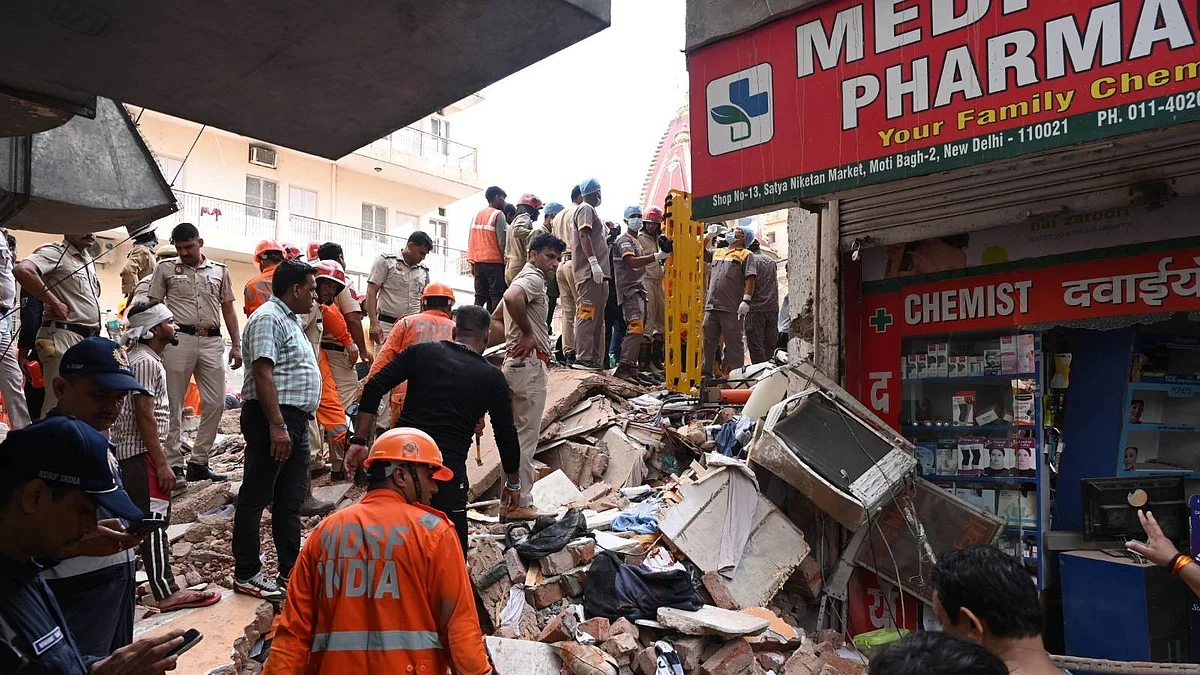


The 6 September collapse of a building operating as a hostel for students in Satya Niketan, in which at least seven people have died, is not an isolated accident.
Experts, officials and past records point to a much larger crisis unfolding across Delhi, where hundreds of unauthorised colonies and urban villages are dotted with buildings that violate construction norms, particularly in Lal Dora areas, leaving millions vulnerable to disasters in the very homes they inhabit.
Preliminary investigations into the Satya Niketan collapse found that the building was weakened by illegal basement excavation in an ageing masonry structure.
The incident has once again put the focus on Delhi’s urban villages, where decades-old regulatory exemptions in Lal Dora areas, have enabled dense and often unregulated construction.
The term Lal Dora dates back to 1908, when the British drew a red line on village maps to demarcate residential settlements from agricultural land. Buildings within these boundaries historically enjoyed exemptions from several standard municipal building plan and approval requirements.
Many of these former rural settlements have since been absorbed into Delhi’s expanding urban landscape and are now densely populated urban villages.
Delhi has around 360-362 Lal Dora villages and residential settlements. Yet, neither the Delhi government nor civic agencies maintain a separate public database documenting building collapses specifically in these areas.
Data from the Delhi Fire Service (DFS), however, underline the scale of Delhi’s wider building-safety problem. The city recorded 1,133 building-collapse incidents between 2022 and 2024, resulting in 98 deaths. The number of house-collapse incidents remained high in subsequent years, with 544 incidents reported in 2025 and 464 in 2024.
In just the first five months this year, the DFS received 76 calls related to house collapses—17 in January, 10 in February, 15 in March, 20 in April and 14 in May.
In June this year, a six-storey building in Saidulajab collapsed after additional floors were allegedly constructed on top of a weak foundation. The entire structure gave way, killing six people.
Perhaps the most devastating reminder of Delhi’s chronic building-safety failures is the Lalita Park tragedy of November 2010. A five-storey building in East Delhi collapsed, killing 70 people and injuring 77. Yet, nearly eight years later, the junior engineer held responsible was penalised with a fine of just ₹21,000.
However, following the Lalita Park collapse, around 3,000 buildings were surveyed, with hundreds reportedly found to have weak foundations, many built on sandy or moisture-laden soil. Despite the findings, experts say enforcement and preventive action have remained inadequate.
The Satya Niketan collapse has now prompted fresh scrutiny of unauthorised constructions and student accommodation across the Capital. The Supreme Court-appointed amicus curiae and the Lieutenant Governor of Delhi have ordered a time-bound safety audit of private hostels and paying guest (PG) accommodations in major university and educational hubs.
Urban planners and structural experts say the pattern has remained largely unchanged despite repeated tragedies. They point to a dangerous combination of unchecked vertical growth, weak or ageing structures, illegal alterations, poor enforcement and alleged corruption within the regulatory system.
The structural audit is focused on high-density student residential areas including Mukherjee Nagar, Laxmi Nagar, Rajinder Nagar, Malviya Nagar and Satya Niketan—neighbourhoods where large numbers of students live in converted residential buildings and often in structures that have undergone extensive alterations.
The Municipal Corporation of Delhi (MCD) has also launched a crackdown on unsafe structures and directed zonal officers to carry out detailed structural inspections. The Delhi government is also working on a permanent policy to require periodic structural-safety certification for older buildings and structures that have undergone unauthorised extensions.
Experts, however, caution that inspections after every tragedy will not address the underlying problem. They argue that building collapses have become a recurring feature of Delhi’s urban landscape because of a deadly combination of illegal construction, unchecked structural alterations, ageing buildings, weak foundations, inadequate regulatory enforcement and environmental factors.
For a city that has expanded far beyond its original settlements, experts believe, the challenge is no longer merely about demolishing unsafe buildings after they are identified. It is about creating a comprehensive system to identify vulnerable structures before they collapse — and ensuring that regulatory exemptions meant for a very different era do not become a licence for unsafe construction today.
Join our official telegram channel (@nationalherald) and stay updated with the latest headlines