


A different kind of politics?
As the Satheesan government completes four months in the saddle, the difference is palpable in Thiruvananthapuram


Retired teacher K.K. Surendran did not go to Chief Minister V.D. Satheesan for a favour. After 23 years of fighting the State, he went to say: “Please don’t appeal against me anymore.”
In 2003, Surendran, a former lecturer with the District Institute of Education and Training in Sulthan Bathery, Wayanad, was arrested after the historic Muthanga tribal agitation. The tribals, alienated from their land and resources for years, were on a long protest for their legitimate rights. As a concerned citizen, Surendran had extended his moral support. He was accused of collusion with the agitators, charged of violence and sabotage.
The criminal case eventually collapsed, and a CBI investigation exonerated him. But Surendran began another long battle: compensation for brutal custodial torture. In 2021, a lower court awarded him Rs 5 lakh, but the then Pinarayi Vijayan-led LDF government argued that releasing the compensation would affect police morale.
In March 2026, an appellate court bumped up the amount to Rs 12.5 lakh with interest and directed recovery from the police officers responsible. The LDF government decided to appeal, and the process was delayed only because of the assembly election.
Encouraged by friends after the UDF returned to power, Surendran met Satheesan on 9 July. Instead of denying his request, the chief minister assured him that the compensation would come through, soonest. According to political observer Damodar Prasad, this is a small episode, but it tells us more about Satheesan’s style of governance than any policy document. “There is an important political statement here,” says writer and political observer Prof. M.N. Karassery. “The Muthanga police action took place under the UDF government. Satheesan was not simply correcting a wrong committed by his political opponents. He was accepting responsibility. That is a different kind of politics.”
As the Satheesan government completes four months in the saddle, the difference is palpable in Thiruvananthapuram.
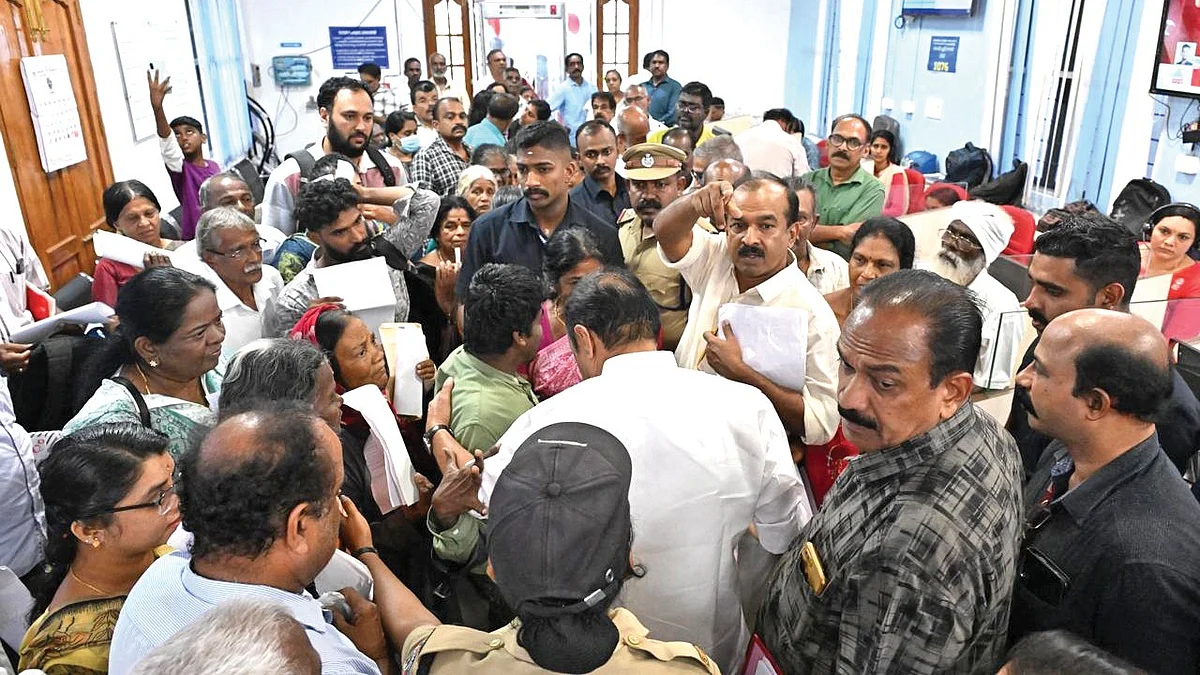
The secretariat is open in a way it hasn’t been for the past 10 years of Pinarayi Vijayan’s rule. The Chief Minister’s Office (CMO) has created time slots for citizens to meet Satheesan; seniors and persons with disabilities are prioritised. When the CM is away, the grievance cell remains open.
“Satheesan may not have instant solutions for all the people approaching him at the secretariat,” says Sojan James, a lawyer with Kerala High Court, and a native of Irinjalakuda in central Kerala. “But at least people feel that the government is there to listen, to treat them with respect and stand with them.”
Kerala had become accustomed to an ever-tightening circle of security and an ever-expanding distance from the chief minister (be it under LDF or UDF). Satheesan’s decision to reduce the scale of his convoy and security arrangements goes beyond logistics: the barriers are lower and the chief minister seems determined to remain within reach. There have been repeated accounts of Satheesan stopping his vehicle when approached with petitions. The image is almost deliberately old-fashioned: a chief minister getting off his car, walking towards the people and taking a memorandum rather than allowing the convoy to whisk him away.
It matters, says V.K. Shyni, a postgraduate who passed the Public Service Commission exam but didn’t get a posting for years. She was part of a protest raising concerns over the expiry of a rankers’ list when, to her disbelief, Satheesan stopped the convoy and reached out.
V.D. Satheesan has made the CMO accessible, prioritising the old and infirm
Cliff House, the chief minister’s official residence, was a fortress during the Pinarayi Vijayan years. When moving in, Satheesan instructed officials: no expensive renovations or lavish makeovers, only essential repairs. And Cliff House became an ‘open house’.
Senior journalist Sunnykutty Abraham says, “There is a change in the way the chief minister relates to media. Satheesan faces journalists after cabinet meetings, not once in a while—every week, as a routine.” At press briefings, Satheesan takes questions about Cabinet decisions, controversies, appointments, finances, political disputes. He argues, and sometimes, he is visibly irritated. But he doesn’t run away.
“This ritual has significance in a state where political communi cation was tightly controlled over the last decade. Satheesan is the only chief minister in India to do this. He is following the ‘Kerala model’ adopted by E.M.S. Namboodiripad, K. Karunakaran, C. Achutha Menon, E.K. Nayanar, V.S. Achuthanandan, A.K. Antony and Oommen Chandy but discontinued under Vijayan,” says Sunnykutty.
Pinarayi projected authority (with totalitarian symptoms); Satheesan projects actionable access. One said: I’m doing it my way. The other says: Let’s decide our path together.
This distinction is clearest in the handling of policies inherited from the previous government. SilverLine is the most obvious example. For thousands of families, the yellow survey stones had become symbols of fear and uncertainty, in courtyards, near kitchens, beside wells and across agricultural land.
The resistance to SilverLine became one of Kerala’s most sustained popular movements. The Satheesan government cancelled the project, scrapped land acquisition and ordered the removal of the yellow stones. It also moved towards withdrawing criminal cases against protesters.
At the same time, Satheesan has refused to accept the opposite proposition that every large infrastructure project must be rejected because the previous government proposed it.
E. Sreedharan’s new high-speed rail corridor was not blindly onboarded as an alternative to SilverLine. The government appointed a four-member expert committee with expertise in railways, finance and environment to examine viability, implications, challenges and benefits. The committee found the proposal incomplete, citing the absence of adequate environmental and social impact assessments, realistic passenger projections, land availability and financial viability. The government put the proposal on hold pending further study.
Recently, Chief Minister Satheesan took his entire Cabinet to IIM Kozhikode for a strategic workshop on AI, climate resilience, disaster management and fiscal reform. Ministers going back to school sent out an important message: a government does not know everything simply because it governs. This willingness to learn and the humane face of governance are resonating with people.
Take six-year-old Ruvani from Vizhinjam. She made a video appeal for a house that wouldn’t leak during the rains the way her current home did. Her appeal reached Satheesan, who contacted her mother and assured the family that a house would be provided.
Or Seethalakshmi Ammal, affectionately known as Ammalu Amma. She met Satheesan during the 2018 floods, when he was the Paravur MLA involved in relief work. Years later, she travelled to Thiruvananthapuram for his swearing-in ceremony, carrying an old photograph. When asked what Satheesan meant to her, she did not say he was like a son, she said he was her son. Satheesan recognised her, embraced her and brought her up on stage.
Palakkad entrepreneur Joshy Thomas had spent nearly a year trying to obtain documents required for his business. His grievance reached the CMO through a comment on a local newspaper’s Facebook page. The documents were reportedly delivered in a day.
Satheesan’s government will eventually have to demonstrate that its early strengths of openness, willingness and people-friendliness translate into administrative efficiency, fiscal prudence and better public services.
Sometimes change is signalled in smaller ways. Reducing the distance between the citizen and the State is one such.