


Provoking a Million Mutinies?
Farmers are being asked to absorb the shocks of extractive policies while the State looks the other way. Protests across the country suggest the State ignores farmers at its own peril
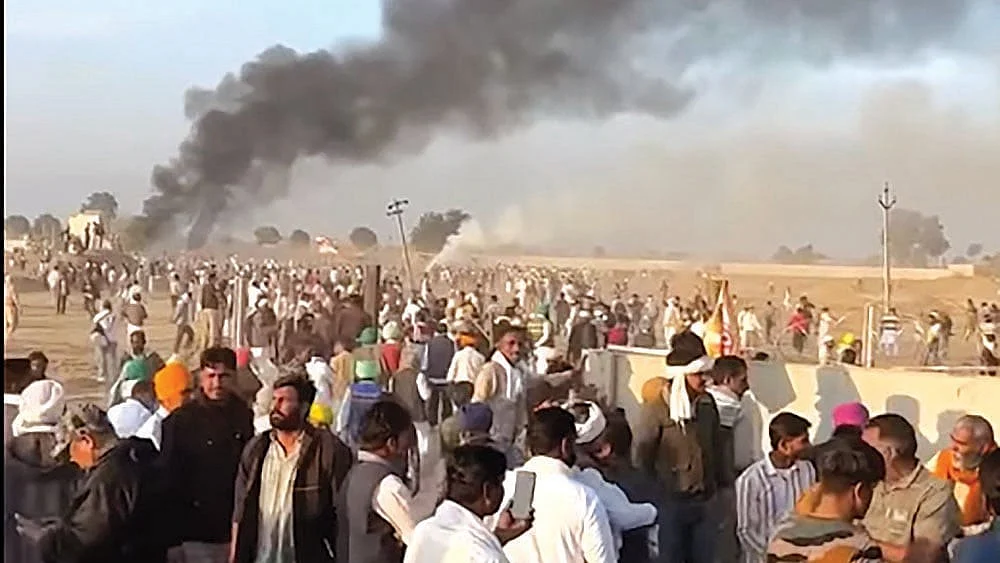


On 10 December 2025, Tibbi tehsil in Rajasthan became the site of a face-off between protesting farmers and the police. Thousands of farmers had gathered from surrounding villages for a ‘mahapanchayat’, called in opposition to the construction of an ethanol plant in Hanumangarh district.
Following the ‘mahapanchayat’, the farmers left for the factory site on foot, accompanied by a convoy of tractors. The police used teargas, lathis and plastic bullets to stop the protestors—who had brought down the boundary wall—but fell back before the massive crowd. Several vehicles were subsequently torched and scores injured on both sides.
Unnerved by the clash, the administration informed Chandigarh-based Dune Ethanol Pvt Ltd that work must stop on what is being touted as Asia’s biggest ethanol project. While the industrial house insists the plant will neither contaminate groundwater nor pollute the air, farmers know this defies both experience and common sense.
Balwan Poonia, former MLA and joint secretary of the All India Kisan Sabha is emphatic when he says that ethanol factories are more polluting than oil refineries. “Scientific data shows that ethanol factories release hazardous air pollutants, and consume huge quantities of water. To produce one kilo of ethanol you need 2,800 litres of water! We studied the impact of the ethanol plant set up in Ganganagar district and found that its toxic waste water also pollutes the groundwater,” he added.
After one-and-a-half years of peaceful protests—which went unheeded by government and company alike—the farmers of Hanumangarh had clearly reached breaking point. At the time of writing, another ‘mahapanchayat’ had been scheduled for 17 December.
A string of farmers’ protests from Rajasthan to Odisha have gone largely unnoticed. Local and regional media have been reporting what mainstream media has pointedly ignored. The same old issues are front and centre: distress sales, shortage of fertilisers, inability to sell produce even at minimum support price (MSP), dwindling groundwater, acquisition of agricultural land for mining and industry. Farmers have had enough and are taking to the streets, blocking roads and railway tracks, seeking action on their long-pending demands.
On 8 December, farmers in Punjab held protests across several cities over the anti-people, anti-consumer Electricity Amendment Bill 2025, which will lead to a sharp increase in prices. Farmers also burnt copies of the draft Seeds Bill 2025 which—if implemented—will destroy India’s seed sovereignty and dilute the federal rights of states.
Apart from demanding the immediate withdrawal of both these bills, farmers also voiced longstanding concerns about rising input costs that result in distress sales of cotton, pulses, soya bean and mustard.
The farmers of Madhya Pradesh, Gujarat and Maharashtra are also on the warpath. In MP, where nine farmers were recently driven to suicide, thousands staged a mass protest on 1 December 2025. Mobilised under the banner of the Rashtriya Kisan Mazdoor Sangh, farmers from Barwani, Dhar, Khargone and Khandwa districts marched to Khalghat toll plaza and blocked NH-52 for eight hours. Their demand? Loan waivers, better prices, MSP for crops.
The shortage of fertilisers is another flashpoint. In August this year, we saw farmers in Uttar Pradesh queuing for hours under the blazing sun for urea, only to be turned away emptyhanded. Similar scenes were witnessed in MP, from August through October. In Tikamgarh district, 50-year-old Jamuna Kushwaha died on 8 December, after three days in a fertiliser queue at the Badoraghat distribution centre. Just a week earlier, 50-year-old Bhruiya Bai died after waiting for 48 hours at a fertiliser centre in Guna district.
On 8 December, farmers staged a blockade in MP’s Chhatarpur district to highlight this systemic collapse and raise urgent questions about the administration’s (mis)management of urea distribution. Farmer leader Ramkripal Sharma says, “We believe this shortage is deliberate and stems from disputes between cooperative bank managers and committee workers.”
Maharashtra continues to top the grim roster of farmer suicides, with NCRB data confirming 781 in 2025 alone. Says Shivaji Rustum Gaikwad, a leader with the Kisan Mazdoor Parishad, “The cost of inputs has doubled since 2014, while farm product prices keep falling. What else can farmers do?”
Gaikwad’s own farm in Nashik is a case in point. He has 500 mausami (sweet lime) trees ripe and ready to be plucked. But labour costs have become so prohibitive small farmers like him cannot afford to hire workers. The fruit remains on the trees. “Middlemen offer me Rs 15 per kilo, which they will sell in cities for over Rs 100,” he says. While the price of gold, silver and every other commodity spikes, farmers are still paid a pittance. “I have no choice but to sell my land,” says Gaikwad.
The pattern, he says, repeats across crops.
“Soybean seeds cost Rs 10,000 per quintal but we are being forced to sell it for Rs 3,000 per quintal. It is the same with pulses, maize, cotton and mustard. Look at how high retail mustard prices are in the market. Have we gained from it? No. Our earnings keep shrinking.” Between the farmer and the mandi, the gains are systematically siphoned off.
In Gujarat, unseasonal rains have devastated crops across 16,000 villages, affecting 1.3 million farmers. They are now sitting on dharna, demanding compensation for crop damage, 100 per cent debt waivers and comprehensive crop insurance—given that fake seeds have been flooding the market unchecked. Farmer Shaktisinh Gohil from Limda village in Bhavnagar raises a question being repeated across the country, “If industrialists’ debts can be waived, then why not farmers’?”
Meanwhile, in Odisha, intensified mining explorations are tightening the noose. Farmers and Adivasis around the Niyamgiri hills are once again on tenterhooks after Vedanta chief Anil Agarwal announced—following a meeting with the chief minister in October 2025—that he expects a second referendum to clear bauxite mining in the area. This comes despite the Supreme Court-mandated referendum of 2013, which saw the Dongria Kondh Adivasi tribe voting unanimously against the project.
The stakes are enormous. The Niyamgiri hills are estimated to hold 73 million tons of bauxite, used to make aluminium. For the Dongria Kondh, Agarwal’s renewed push signals a determined attempt to overturn a settled democratic verdict. They are preparing for a long battle to save their sacred hills. According to Aflatoon, general secretary of the Samajdwadi Jan Parishad, the forest advisory committee had already granted Stage-1 clearance to Vedanta’s Sijimali bauxite mines on 2 December 2025, allowing the diversion of 708.24 hectares of forest land.
Aflatoon says this large-scale land acquisition is taking place in a Schedule V area without the prior consent of the gram sabhas. When farmers protested, they were harassed and jailed.
As African countries increasingly clamp down on Vedanta’s mining operations, getting the Sijimali project operational has become Agarwal’s top priority. Kartika Naik from Banteji village in Rayagada district warns that once these mines become operational, 50 villages will be hit—not 18 as claimed by Vedanta. “Mining on this scale will require 725,000 litres of freshwater daily, which will result in water scarcity, crippling our agricultural production, not to mention worsening air pollution.”
Across states and sectors, farmers are being asked to absorb the shocks of climate volatility, market manipulation and extractive policies—while the State looks the other way. But the State may be playing with fire.
Also Read: The big fat tribal land grab
Join our official telegram channel (@nationalherald) and stay updated with the latest headlines