


When even disaster relief is a political tool
The Centre’s selective aid sanctions and delays give away its small-mindedness about Opposition-ruled states
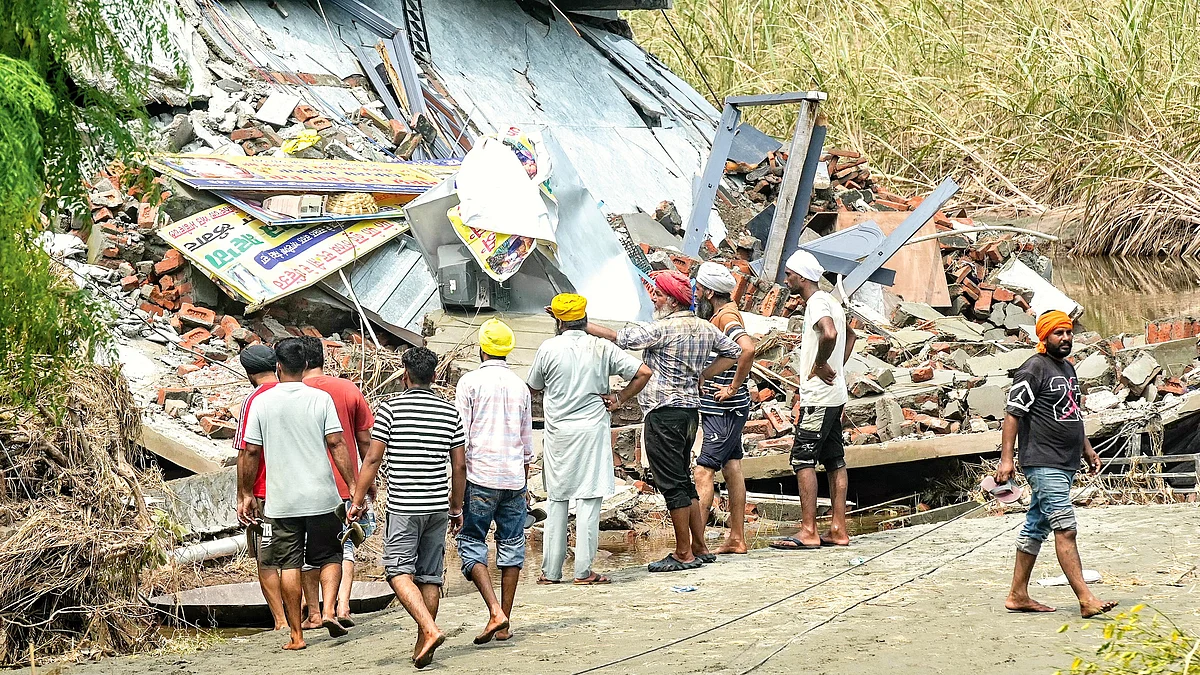


Not a single rupee: that’s how much Punjab had received of the Rs 1,600 crore disaster relief package announced by the prime minister, said chief minister Bhagwant Singh Mann on 29 November.
On 2 December, when Congress MPs Charanjit Singh Channi and Sukhjinder Singh Randhawa raised the matter in the Lok Sabha, the Centre replied it had already released Rs 481 crore to Punjab.
Also on 2 December, chief minister Sukhvinder Singh Sukhu informed the state Assembly that neither had Himachal Pradesh received a single penny of the Rs 1,500 crore disaster-relief assistance announced by the prime minister.
Both relief packages had been announced by Prime Minister Narendra Modi on 9 September, when he visited the two flood-ravaged states.
Pertinently, the Rs 481 crore for Punjab was allocated under the State Disaster Response Fund (SDRF), a mandatory fund to which each state contributes. The Finance Commission fixes the formula that determines how much assistance a state can receive. But even within this system, calculations differ: states present one estimate of losses, the Centre prepares another. The gap leaves enough room for political discretion (or discrimination) and funds are released accordingly.
It’s crucial to note that the chief ministers of Punjab and Himachal were not talking about SDRF allocations. They were referring to the headline-grabbing special financial assistance announced personally by the prime minister. Months later, both states are still waiting for the promised funds.
As per details provided later by the Union government, part of this assistance would come through existing schemes; the rest would be drawn from the Prime Minister’s Disaster Relief Fund. This was to include direct financial aid to victims — Rs 2 lakh for the family of each person who died and Rs 50,000 for every individual who was seriously injured. None of it has come through.
The Centre has another mechanism to help states during calamities: the National Disaster Response Fund (NDRF).
Substantial relief from this fund is possible only when a disaster is officially classified as ‘severe’. Severity is determined by the Inter-Ministerial Central Team (IMCT) after inspecting affected areas. Although the IMCT did visit both Punjab and Himachal, the final classification remains wrapped up in red tape.
There is a third way — the Centre can choose to waive the loans of those hit by disaster. Such decisions, more often than not, depend on political considerations rather than humanitarian ones.
Punjab and Himachal may be distinct states, but they share one undeniable similarity — both are governed by non-BJP parties. Punjab, ruled by the Aam Aadmi Party, and Himachal under the Congress appear to be at the receiving end of the Centre’s discrimination. Just like other Opposition-ruled states. This, in an era where ‘double-engine’ governments are promoted as the golden passport to central assistance.
****
To grasp this imbalance fully, one must look back at the disasters that struck Himachal Pradesh and Uttarakhand in 2023. Himachal endured devastating losses due to cloudbursts, incessant rainfall and landslides, with the state estimating damages worth Rs 9,000–10,000 crore.
That year, Uttarakhand faced no major natural calamity. The appearance of cracks in houses due to land subsidence in Joshimath were enough to be viewed as a grave crisis. The state initially sought Rs 2,945 crore as assistance: this was later revised to Rs 3,500 crore.
While it is true that no two calamities can be compared directly, what can be compared is the starkly different approach of the Union government in each case.
Himachal Pradesh received Rs 2,640 crore in central assistance, barely 26 per cent of what it sought. BJP-ruled Uttarakhand, on the other hand, got Rs 1,658 crore, 56 per cent of its demand.
Not surprising then that Sukhu complained of “injustice against a non-BJP state”. Uttarakhand’s chief minister Pushkar Singh Dhami not only accepted the Centre’s decision, he publicly welcomed it. This is not the only instance of such unequal treatment.
Perhaps the clearest example of the Centre’s discriminatory attitude is Bihar. In 2017, the state was ravaged by floods that impacted 20 districts and affected 15 million people. More than 400 lives were lost. Bihar, ruled by the JD-U at the time — requested Rs 9,571 crore in relief. The prime minister announced only Rs 500 crore. Nitish Kumar’s grievances at the time were not unlike Sukhu or any other non-BJP chief minister's.
In 2020, Bihar experienced floods again — albeit less severe. By then, the political landscape had shifted. Nitish Kumar was still the chief minister, but the BJP had joined the state government. Suddenly, the central government was more generous. The SDRF transferred Rs 566 crore as immediate assistance, and Bihar eventually received Rs 1,416 crore from the fund. In addition, the NDRF provided Rs 1,255 crore.
When a state is governed by a non-BJP party, the Centre has gone so far as to even deny that a disaster is a disaster. The 2024 floods in North Bengal are a case in point. The calamity claimed more than 50 lives and caused extensive damage to public infrastructure and private property. Yet the Centre refused to extend any relief, arguing that the Damodar Valley Corporation was responsible and that the floods were therefore ‘man-made’, not a natural disaster. Although the Centre eventually released Rs 1,290 crore under the Flood Management Programme, none of this money reached the disaster-hit residents as direct assistance.
The Kerala High Court’s observations in October 2025 revealed how blindingly obvious the pattern was.
Following the Centre’s refusal to waive the loans of those hit by the Wayanad landslide, the bench of Justice A.K. Jayasankaran Nambiar and Justice Jobin Sebastian criticised its “stepmotherly attitude”. The court noted how swiftly and generously the Centre had sanctioned aid to Gujarat and Assam for less severe disasters in 2024, underscoring differential treatment or an “unwillingness to act”.
The judges emphasised that federalism does not permit discriminatory conduct, and issued a reminder that “party politics cannot negate the constitutional guarantee of protection of the fundamental rights of the people in a democratic republic”.
When a calamity hits a state, it does not distinguish between the political parties ruling it. Neither should the government.
Join our official telegram channel (@nationalherald) and stay updated with the latest headlines