Art and Culture
Booked for fraud
Fake AI-generated titles and fictitious authors hit Coimbatore’s Periyar Arivulagam library. K.A. Shaji reports
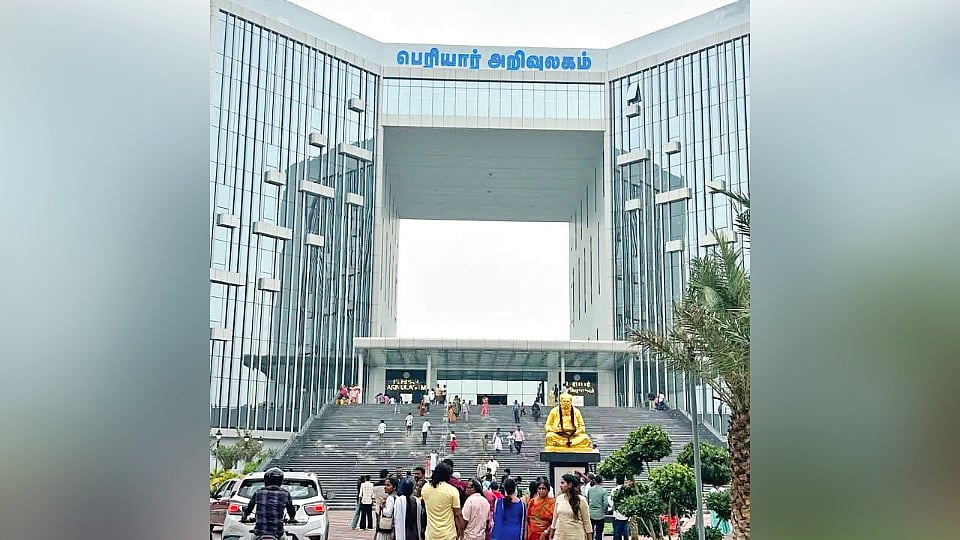
A library can be one of the most powerful instruments of social transformation. Books can open doors that poverty, caste and social exclusion have kept shut. In Coimbatore, Periyar Arivulagam was conceived with precisely this ambition.
Named after the formidable social reformer E.V. Ramasamy, popularly known as Periyar, whose lifelong struggle challenged caste oppression, superstition and social inequality, the institution was envisioned as a public space where knowledge would be accessible, scientific curiosity encouraged and intellectual inquiry liberated from social and economic barriers.
Spread across nearly seven acres on the city’s busiest Dr Nanjappa Road, the imposing eight-level complex has a built-up area of approximately 1.98 lakh square feet and cost Rs 301.71 crore to build. Its facilities include a planetarium, science centre, digital library, children’s reading sections, competitive examination facilities, STEM laboratories, an incubation centre and specialised spaces for persons with disabilities. The idea was to bring reading, scientific learning and research under one roof, particularly for students and first-generation learners who cannot afford expensive private educational resources.
Initiated by the previous DMK (Dravida Munnetra Kazhagam) government, the foundation stone was laid by then chief minister M.K. Stalin on 6 November 2024. His successor, C. Joseph Vijay, inaugurated it on 16 October this year. Book lovers in the region say the change of political administration did not change the public purpose of the institution.
Yet, barely a month after its inauguration, it has become the centre of a scandal that threatens to undermine the very principles on which it was established. Books manufactured using artificial intelligence, attributed to authors whose identities could not be established and purchased with public money at improbable prices, have triggered a vigilance probe that reached some of Tamil Nadu’s most prestigious libraries and sparked larger concerns.
It was the celebrated Tamil novelist and academic Perumal Murugan who first realised something was wrong. Examining the Tamil collection, he identified nearly 1,800 titles (bearing the Agal Vilakku Pathippagam imprint) and more than 100 titles (from Phoenix Publications) that were rife with elementary factual errors, questionable literary references and unfamiliar author names.
“One example was particularly revealing,” Murugan, told National Herald. “A book titled Naladiyar: A Guide to Life (a 300-page book priced at Rs 1,445) treated this celebrated classical Tamil collection of moral verses as though it were the work of an individual poet and philosopher! Other publications carried dubious historical claims and material that appeared to have been assembled without editorial scrutiny. The problem was not simply that these were poorly written books. Their very authorship and intellectual credibility were in question.”
Murugan’s intervention was particularly significant because he had been associated with the book recommendation process for the library. How did such books enter a publicly funded library despite the existence of expert committees and procurement safeguards?
Soon after Murugan’s reactions made headlines, Madras High Court intervened. On 10 November, the Madurai bench of the high court directed Tamil Nadu’s directorate of vigilance and anti-corruption (DVAC) to register an FIR, freeze the bank accounts of the publishers and identify officials responsible for the procurement.
The court examined violations of its earlier directions on transparent library purchases and, in its 11 November order, observed that ‘bound stationery passing for books’ had been purchased using public money. It also ordered that suspect books be removed and the money recovered.
On 15 November, DVAC registered the FIR, naming publisher R. Mohan, proprietor of Agal Vilakku Publishers and Phoenix Publications, and pointing to unidentified public servants involved in the procurement. The FIR said the two publishing firms received Rs 1.74 crore for supplying books not only to Periyar Arivulagam but also to prominent government libraries across the state. The government suspended five senior library officials.
On 16 November, DVAC arrested Mohan and conducted searches at seven locations. Three bank accounts containing approximately Rs 22 lakh were frozen.
DVAC authorities say the manipulation went beyond dodgy manuscripts. Agal Vilakku submitted 2,339 titles and Phoenix 99. Purchase orders covering 1,857 books were issued in February. The FIR alleges that a coordination committee introduced titles that had not been recommended by the expert committee, without properly recording those additions in the relevant files. Investigators allege that the lists were subsequently accepted without adequate scrutiny.
The FIR further alleges that books were created under fictitious author identities using material collected from websites and online applications, including ChatGPT. Some authors were credited with an extraordinary number of publications across unrelated subjects. In one instance, the same book appeared under two different fictitious names. The investigation has also raised questions about ISBN numbers, originality, copyright and inflated prices. The investigation covers procurement across several public libraries, including Chennai’s Anna Centenary Library.
“This is where the controversy acquires national significance. Generative AI has made it possible to produce manuscripts, summaries, biographies and apparently authoritative texts at a negligible cost. It can imitate scholarly language and churn out plausible references. But artificial intelligence cannot approve a book for public purchase, certify its delivery or authorise payment from the government treasury. Those decisions remain entirely human,” points out Chennai-based publisher Badrinarayan Seshadri.
Tamil Nadu school education minister A. Rajmohan described the controversy as India’s first AI scam and accused the previous DMK government of facilitating large-scale irregularities. He said similar publications had reached Chennai’s legendary Connemara Public Library, Madurai’s Kalaignar Centenary Library and other district libraries. He promised that the government would recover “every rupee” spent on the disputed books and announced plans for a special committee to examine library collections.
The DMK has rejected the allegations. Former minister and Assembly whip Govi Chezhiyan pointed out that the previous administration had introduced a transparent procurement policy and constituted expert recommendation committees, which included Murugan. He demanded full disclosure of the publishers, authors and titles approved for purchase, and insisted that the guilty face legal action.
“Whatever the justifications, the political contest must not obscure the central question of accountability. The FIR does not establish the involvement of any minister or prove that political leaders directed the alleged fraud. Those questions must be settled through evidence, not political accusations. An impartial probe must be conducted,” opines researcher and academic V. Arasu.
“The Rs 1.74 crore mentioned in the FIR represents payments to the two publishing firms. It is separate from the Rs 50 crore allocated for books and e-books at Periyar Arivulagam, including an authorised advance of Rs 30 crore. Reports have also identified nearly 70,000 problematic publications worth approximately Rs 7 crore across government libraries, a figure that requires comprehensive official verification,” points out Tamil writer S.V. Rajadurai.
The implications extend well beyond Tamil Nadu. Public libraries, universities, research institutions and government departments across India could face similar vulnerabilities as AI-generated material becomes increasingly difficult to distinguish from legitimate publications. ISBN registration alone cannot establish authorship, originality or intellectual value. Procurement systems must move beyond checking catalogues and invoices to independently verifying publishers, authors, manuscripts and the content between the covers.
“AI may have supplied the words, but it could not have put these books on public shelves, approved their purchase or released taxpayers’ money. Human beings did that. Identifying them, establishing the full financial trail and fixing institutional responsibility will be the acid test of this investigation,” says Rajadurai.
Periyar Arivulagam was intended to democratise knowledge. That promise must not be lost in a scandal involving fabricated authorship and fraudulent procurement.
K.A. Shaji has chronicled rural distress, caste and tribal realities, environmental struggles and development fault lines. More by the author here
Join our official telegram channel (@nationalherald) and stay updated with the latest headlines