Art and Culture
Book extract: ‘Just leave it!’
‘An instinct kept warning me that my actions would have far-reaching consequences...’
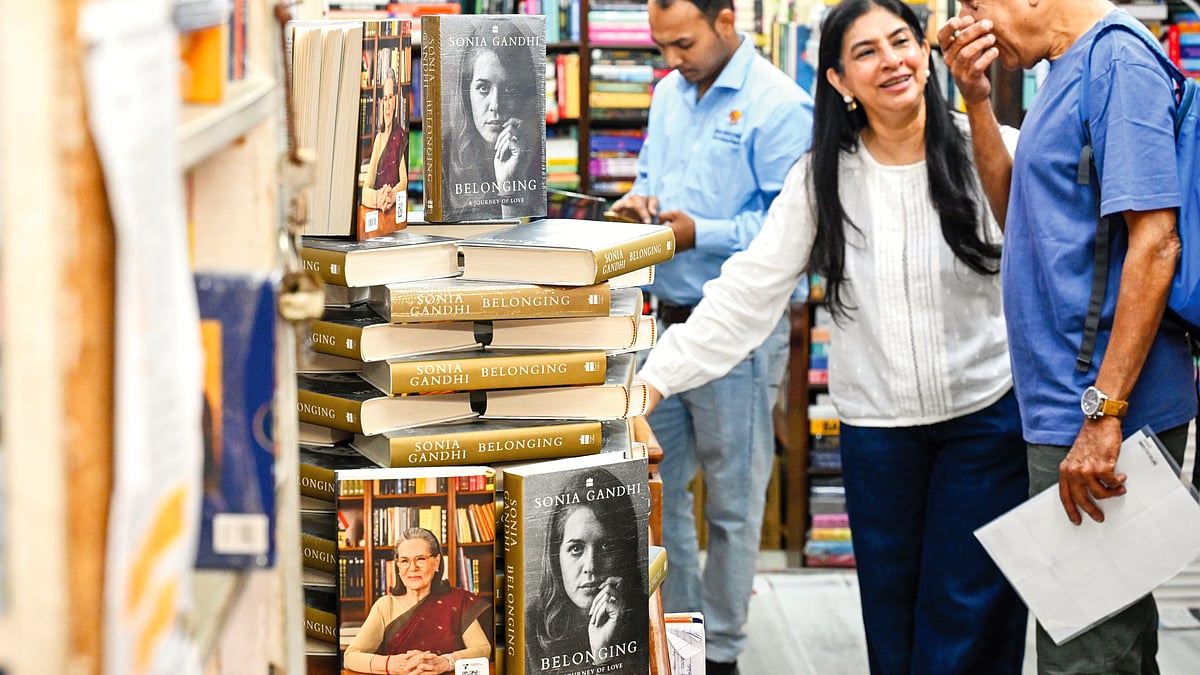
Title: Belonging: A Journey of Love
Author: Sonia Gandhi
Publisher: HarperCollins Publishers India
Price: Rs 1,299
Some months before the election, my children and I had discussed the issue of my possible prime ministership. One of them asked me straight out whether I would accept the post, just in case our party pulled off a victory. “Absolutely not!” I’d said, almost indignantly. “Are you sure?” they pressed me. “I’m very clear,” I said emphatically.
Neither Rahul nor Priyanka felt that I should become prime minister. They’d lived through the trauma of their grandmother’s assassination and the brutal murder of their father. In their minds, holding that office was intrinsically linked with heightened danger. They looked relieved and I, too, felt lighter, having said my views out loud on the question for the first time. And there the matter rested. I never spoke of it to anyone else. Throughout the election, I’d give a noncommittal answer whenever I was asked this question in public.
We were in a battle for our survival and I had to keep my party together, to face our foes head-on as a cohesive team. It wasn’t an option to allow a leadership struggle to arise between the contenders in our party. I kept my views firmly to myself, not even confiding in my closest colleagues. I just knew instinctively that the person to carry forward the legacy of past Congress governments would have to be someone with long experience in government and an impeccable record of integrity.
We returned from Rashtrapati Bhawan to my home at 10 Janpath. I saw Dr. Singh to his car. There had been no discussion about the prime ministership between the two of us on the drive back, nor had there been before that. I said nothing to him even now. He had quite naturally assumed, like everyone else, that it would be me. The right-wing parties went into full gear again.
****
The trip to the president’s house had brought home the enormity of the situation I found myself in. How was I going to admit to all my colleagues and my allies, to the workers who had exhausted themselves rallying together and shouting slogans in my name and that of our party, for months on end — to the whole country, in fact — that I had led this entire campaign knowing full well that I’d refuse to lead the government? I felt a hollow in my chest. I didn’t know whether I could go through with it now, how I could face them all. I had a day full of meetings ahead. I felt I couldn’t breathe.
****
Years ago, when I took the first step of the journey that had brought me to this point, I knew in my heart what my husband and my mother-in-law would have expected of me. I had felt an inner call of duty towards them and all that they had fought for throughout their lives. But now I was at sea; I had to search within my troubled self for an answer. One part of me rejected the idea completely, the other part was calling on my sense of obligation towards the party workers who’d be hurt and disappointed by my refusal, but also to the people who’d given us their vote. My emotions were changing, moment to moment. One minute I was clear, the next, I was torn.
A meeting had been fixed with the leaders of the alliance. They were to come to my house the next afternoon. “We’ll convince her,” they’d assured my colleagues. When I look back at those moments, they take on their own pace, as they unspool in time. […] A meeting is going on with some of the leaders of the alliance in Rajiv’s conference room at the far end of my house. They’ve been talking in turns for over an hour, urging me to agree to their proposal, while I listen silently. As the discussion comes to an end, they look towards me for a response. I muster up as much courage as I can and I say my piece.
There is an uproar amongst them, they stand up and move towards me. I, too, stand up. They physically surround me. “We will not accept this,” one of them says. “You cannot take this decision, Madam,” says another. Their tone is forceful, almost aggressive. “We will not take no for an answer.” I am shaken. I feel overpowered. “Theek hai,” (“All right,”), I mumble almost inaudibly. The assembled leaders don’t even wait for me to finish my sentence, they begin to congratulate me, one by one. “She has agreed, she has agreed,” someone says. I just stand there, numb, unable to say anything further. The leaders depart, satisfied.
****
I walked into my bedroom and placed another call to AP. I told him that, despite what had just transpired with the alliance leaders, I was still in the process of taking a decision, either way. I wanted him to contain any fallout of the leaders having stated in public that I had agreed.
****
An instinct kept warning me that my actions would have far-reaching consequences, not just for my party but for India. […] My entry into politics had been driven by the conviction that the BJP, propelled by the RSS and its many fanatical wings, would encourage strife between communities and subvert the Constitution if they came to power.
I knew very well that the noise being made now by them, and the propaganda they had drummed up through the election campaign, wouldn’t abate if I accepted. The BJP and its allies would for certain use my ‘foreign origin’ as an issue, they would stir up emotions and create havoc that would subsume every other good—of the past, and of the coming years. How could I agree to holding the office of prime minister knowing it could wound my country, the country that I loved? No, never!
Night was drawing to a close. It had been a long night […] I retreated into my bedroom and lay quietly as always on my husband’s side of the bed. One voice within me said, “Sonia, this is a ridiculous proposition. You were born and brought up in Italy and here you are, being chosen to lead a nation of more than a billion people at the other end of the world.” Another voice replied, “This is your country; you owe your whole adult life and allegiance to it. When you lost the man you loved, it took you in its arms as one of its own. Its people have comforted you and nurtured you through shattering tragedies. How can you abandon your responsibility to those who have placed their faith in you, in your party?”
A flood of emotion overcame me, and I longed for Rajiv’s comforting presence. As I was drifting into sleep out of sheer exhaustion, my mind suddenly cleared itself of the last shreds of doubt. “Sonia, be true to yourself,” I could hear myself say. “You’ve always known it. Just leave it!”
I woke up in a few hours, went straight to my son’s room, and knocked on the door. “I’ve made up my mind. I’m going to stick to my stand,” I told him. He stepped up to me and with his arms around me said, “It’s the right decision.” I felt at peace for the first time since the election results had been declared. No one would be able to sway me now from my purpose.
Join our official telegram channel (@nationalherald) and stay updated with the latest headlines