Business
‘Prime Minister’ Ambani and ‘President’ Musk in tussle over Starlink in India
Musk’s ‘PM Ambani’ jibe sharpens Starlink row, fuelling questions over whether Modi and Ambani are invisible hand behind delay
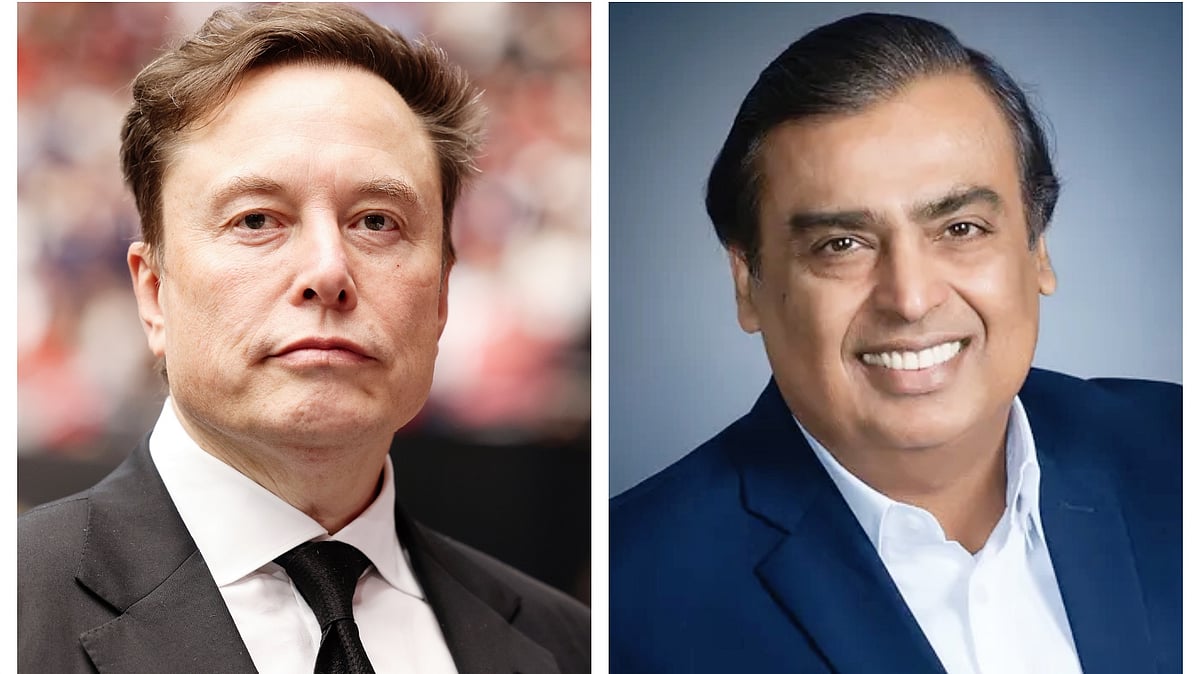
Musk mocks Ambani as ‘Prime Minister Ambani’ amid delays in Starlink’s India entry.
Government denies discrimination as security clearances for satellite communication services remain pending.
Starlink’s rural reach raises questions over affordability, technological self-reliance and national security.
Elon Musk’s posts asking whether ‘Ambani is the real boss of India’ and now addressing him as ‘Prime Minister Ambani’ have lent a sharper edge to his apparent frustration over the delay in securing licences to operate in India. Conspiracy theories abound, among them the question of whether Modi and Ambani are the invisible hand directing the plot.
Late in the evening, at 10.33 pm to be precise, on Friday, 9 October, Elon Musk addressed the ‘prime minister of India’. In a post designed to grab attention, he wrote, 'Dear Prime Minister Ambani, please accept my humble apologies for not realising that you are the real boss of India. Naturally, you would prefer to maintain your monopolistic exploitation of the great people of India, but would you nonetheless consider allowing Starlink to compete?'
He then went on to claim that in rural India, where there are no internet connections, Starlink would change the lives of children and small businesses. He also underlined Starlink’s role in saving lives during natural disasters when all other communication systems failed.
Reactions from India were sometimes savage. A particularly acerbic comment on his post read, 'Dear President Elon, please accept my humble apologies for not realising that you are the real boss of the USA. Naturally, you would prefer to maintain your monopolistic exploitation of the great people of the USA and not allow Chinese cars to compete with your cars.'
Musk’s earlier post asking whether Ambani was the real boss of India and accusing Indian oligarchs of not allowing Starlink to enter India had also received mixed reactions. While a minority felt that Starlink would indeed help India and Indians, many more pointed out that its services would be far too expensive for most Indians. Others argued that India should develop its own satellite-based communication system and raised concerns over data sovereignty and national security.
'If anything, Elon is a bigger oligarch than Adani or Ambani. He’s as much a crony capitalist as either of them. He was even put in charge of a US government initiative called DOGE until he fell out with Trump. After Trump’s second election victory, Elon was invited to share the stage with him, only to perform what appeared to be a Nazi salute.
'He continues to give the worst kind of people free rein on this platform, and is a major reason why right-wing hate has proliferated across the world. He has played, and continues to play, a significant role in the global rise of fascism, while advocating policies that enrich the rich and make the poor poorer,' AltNews co-founder Pratik Sinha commented icily.
The Government of India has denied any delay or discrimination designed to stall Starlink. Pointing out that Airtel, Jio and Eutelsat had also applied for licences alongside Starlink, government spokespersons have said that clearances and scrutiny for all of them are at the same level. So, does India need Starlink badly, or does Starlink need India more? Or do they both need each other?
M.K. Venu, former managing editor of The Financial Express and one of the founding editors of The Wire, puts the issue in context. “Modi govt invited Elon Musk to invest in satellite communications in India. Modi govt amended the Telecom Act 2023 to enable allocation of Satcom spectrum administratively and not via auction. Modi govt opened up 100% FDI in satellite communication to make way for SpaceX.”
“SpaceX even signed infrastructure sharing and distribution agreements with two existing players, Reliance Jio and Bharti Airtel. Also recall how PM Modi and his top aides gave Musk head of state status during Modi’s US visit last year and how Musk came for that much-televised meeting with his wife, children and their nanny in tow, sitting across PM and his negotiating team! So, what has suddenly gone wrong, forcing Musk to complain about not being allowed to operate in India?” he wonders aloud.
For Indians living in cities, Starlink is unlikely to offer a better value proposition than Jio or Airtel. Their plans are much cheaper and often provide equal or better speeds. However, Starlink can provide broadband to ships and fishing boats at sea, and to villages from Arunachal to Ladakh. With both Jio and Airtel having signed agreements to distribute and support Starlink services in India, they appeared ready to distribute the service in areas where 5G is not practical.
Asked to position Starlink in the context of India, an AI tool came up with this gem: 'Starlink is not India’s next Jio; it is India’s next BSNL-in-the-Himalayas.'
While security clearances for Starlink remain pending as the government weighs the pros and cons, Maharashtra has become the first state to sign an agreement with Starlink India. Elon Musk’s company is aggressively wooing state governments to subscribe to the connectivity it offers for districts, panchayats, police outposts, disaster management centres and teams, and operations inside forests.
Experts believe that India can technically replicate much of what Starlink does. But the key question is not whether India can build it. The real questions are how long it would take, how much it would cost, and whether it makes economic sense to duplicate everything. India did not invent GPS, but built NavIC; India did not invent launch vehicles, but developed a highly capable launch ecosystem through ISRO; India did not invent mobile networks, but created one of the world’s largest and cheapest telecom systems.
Yet, is it wise to depend on a foreign-owned communication system? The debate is unlikely to end soon.
Join our official telegram channel (@nationalherald) and stay updated with the latest headlines