Business
India leans on oil reserves as Hormuz disruption drives up crude prices
Strategic stocks offer short-term relief, but longer routes and rising freight costs could raise the import bill if West Asia tensions persist
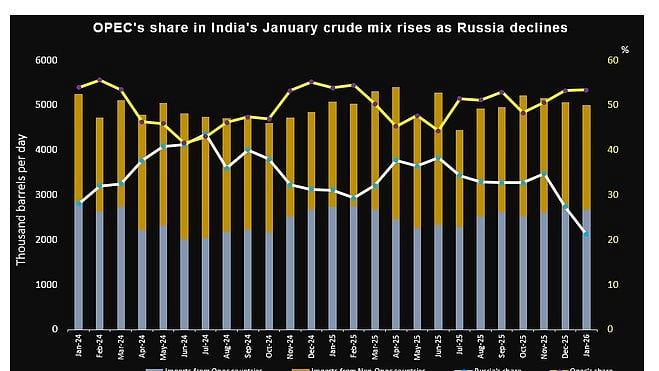
India is relying on a substantial stockpile of crude oil as escalating tensions in West Asia disrupt tanker traffic through the Strait of Hormuz, a vital maritime corridor that carries roughly a fifth of global petroleum liquids consumption.
Commercial inventories, strategic petroleum reserves and cargoes currently en route together amount to around 100 million barrels, according to energy analytics firm Kpler. At current import rates, these supplies could meet domestic requirements for an estimated 40 to 45 days if flows through the strait are significantly curtailed.
Oil markets reacted sharply to the mounting uncertainty, with Brent crude climbing close to $80 a barrel after registering a near 7 per cent jump at the start of the week. Shipping activity through the waterway has slowed dramatically, intensifying concerns over supply continuity and freight costs.
India depends on the passage between Iran and Oman for nearly half of its crude imports, equivalent to about 2.5 million barrels per day out of total imports of roughly 5 million barrels per day. The disruption has prompted refiners to examine alternative sourcing options, even though longer-haul cargoes would raise landed costs.
Industry analysts estimate that India’s combined strategic and operational storage capacity — including reserves at Mangaluru, Padur and Visakhapatnam, along with refinery and port tankages — could provide a buffer of about 70 to 75 days. This cushion may help avert immediate shortages, but it does little to shield the economy from higher prices.
According to projections from JP Morgan, a three- to four-week constraint on traffic through the strait could force Gulf producers to curb output, potentially pushing Brent prices above $100 per barrel.
Refiners are therefore reassessing procurement strategies. While Middle Eastern crude typically reaches Indian ports within four to seven days, shipments from the Atlantic Basin — including Brazil and Guyana — can take between 25 and 45 days. The extended transit not only increases freight and insurance costs but also ties up working capital and limits refiners’ flexibility to respond to price swings.
Freight differentials are significant. Per-barrel shipping costs from West Asia are estimated at 40 to 70 cents, compared with $2.5 to $4 for cargoes from the Americas. Even so, diversification is gaining traction.
Indian Oil Corporation recently secured 2 million barrels of Brazil’s Búzios crude for March loading. Although Brazil currently accounts for only about 1 per cent of India’s crude imports, the value of purchases has risen sharply year on year. India has also stepped up intake of Guyanese crude, alongside ongoing supplies from Russia.
Additional volumes from the United States and West African producers such as Nigeria and Angola are also under consideration, depending on freight economics and availability. While these sources are unlikely to fully replace shipments from Iraq, Saudi Arabia, the United Arab Emirates and Kuwait, they could serve as partial hedges against transit risk in the Gulf.
The Ministry of Petroleum and Natural Gas said it is closely monitoring developments and has reviewed supply arrangements with public sector undertakings. The government has pledged to take all necessary measures to ensure adequate availability and affordability of fuel and liquefied petroleum gas.
The broader economic implications remain substantial. Analysts warn that for every $10 increase in the average crude price, India’s annual import bill could swell by $13–14 billion. Elevated prices would also squeeze the margins of oil marketing companies, particularly through weaker retail marketing spreads and higher under-recoveries on subsidised LPG sales.
While inventory buffers may provide short-term stability, sustained disruption in the Gulf risks exposing India to higher energy costs and renewed pressure on inflation and public finances.
With PTI input
Join our official telegram channel (@nationalherald) and stay updated with the latest headlines