Environment
SC quashes retrospective green clearance memo, protects existing projects
Court says post-facto environmental clearances cannot be granted through administrative orders but saves projects already cleared under the 2021 regime
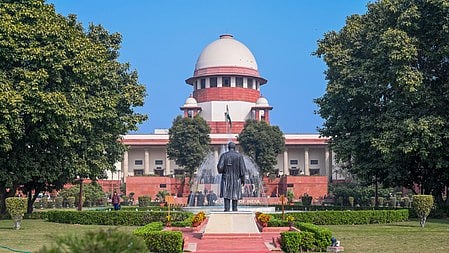
The Supreme Court on Wednesday quashed a 2021 office memorandum (OM) that allowed retrospective environmental clearances (ECs) for projects that had begun without prior green approval, holding that such clearances cannot be granted through executive instructions.
A three-judge Bench comprising Chief Justice Surya Kant and Justices Joymalya Bagchi and Vipul M. Pancholi, however, ruled that its judgment would operate prospectively, protecting projects that had already received retrospective clearances under the 2021 regime from demolition or other punitive action.
The court held that while post-facto environmental clearances are legally permissible, they must be granted only through statutory notifications issued under Section 3 of the Environment (Protection) Act, 1986, and not by way of an administrative office memorandum.
"The 2021 Office Memorandum is invalid and is quashed with prospective effect," the Bench said, invoking its powers under Article 142 of the Constitution.
Centre can notify amnesty schemes
The court clarified that the Centre retains the power to formulate amnesty schemes for specified categories of non-compliant projects through valid statutory notifications if doing so serves a larger public interest.
Such projects could include critical public infrastructure such as hospitals, airports, irrigation schemes and slum rehabilitation projects.
Among the projects cited by the court were the AIIMS Medical College and Hospital in Odisha, the Centre of Excellence for Cancer Diseases in Tamil Nadu, Vijayapura Airport in Karnataka, irrigation projects in drought-prone regions and slum rehabilitation schemes.
The Bench said the 2021 OM created a perpetual mechanism for granting environmental clearances to projects that had violated the requirement of obtaining prior approval, thereby fundamentally altering the environmental clearance regime established under the 2006 notification.
"It supplants an earlier delegated legislation through an administrative instruction, which is impermissible in law," the court observed.
'Perpetual amnesty' impermissible
Authoring the judgment, Justice Bagchi said the office memorandum effectively created a "perpetual amnesty scheme" without laying down any rational criteria for selecting projects eligible for post-facto clearance.
The court held that the memorandum failed the tests of proportionality and reasonableness and violated Articles 14 and 21 of the Constitution.
Observing that environmental protection and economic development must be balanced, the Bench said courts have a duty to reconcile the right to a pollution-free environment with developmental needs.
Referring to Mahatma Gandhi's philosophy, the court noted that "the world has enough for everyone's need, but not enough for everyone's greed", saying environmental jurisprudence must be guided by principles of sustainable development and ecological proportionality.
Existing projects protected
The court said projects that had already secured retrospective clearances under the 2021 OM would not be affected because of the legal uncertainty that prevailed over the validity of the policy and the significant public interest involved in several ongoing projects.
It also directed that no fresh applications under the 2017 notification or the quashed 2021 office memorandum would be entertained.
Further, the Centre has been restrained from issuing future administrative orders granting ex post facto environmental clearances, except through valid statutory notifications under the Environment (Protection) Act.
The verdict came on a batch of 49 petitions, including review pleas, challenging the legality of retrospective environmental clearances.
The Supreme Court had reserved its judgment on April 1 after hearing arguments over six days.
Join our official telegram channel (@nationalherald) and stay updated with the latest headlines