World
British Navy readies Hormuz mine-clearing mission as allies await Iran peace deal
Royal Navy prepares deployment to secure key oil shipping route, though US officials say no mines have yet been detected in the Strait of Hormuz
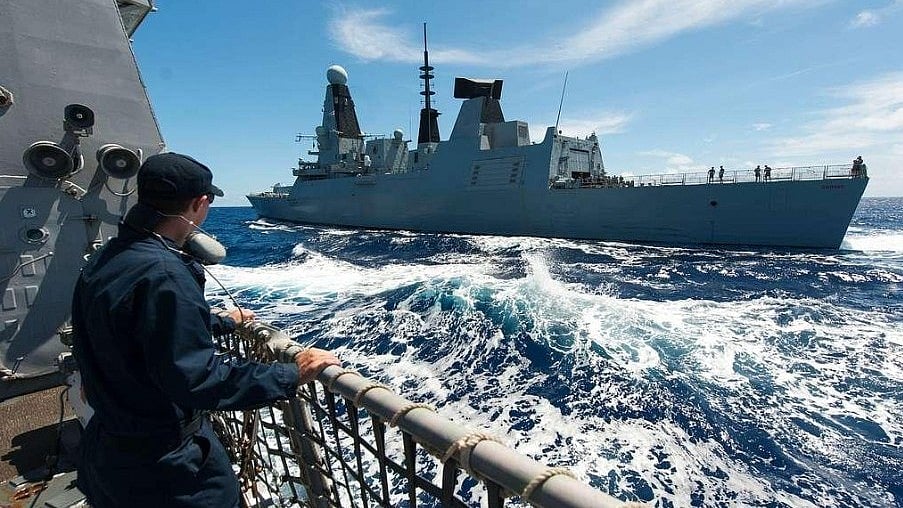
The British Royal Navy is preparing for a possible multinational mine-clearing operation in the Strait of Hormuz, positioning personnel, equipment and specialist vessels for deployment once a peace agreement is reached to end the conflict involving Iran, even as US officials say there is currently no evidence that mines have been laid in the strategic waterway.
Docked off Gibraltar, the amphibious support vessel RFA Lyme Bay is being loaded with ammunition, mine-hunting sea drones and underwater surveillance systems as part of preparations for a potential operation expected to involve the United Kingdom, France and other allied nations.
The deployment plans come amid continuing disruption to commercial shipping following hostilities between Iran, Israel and the United States, which have sharply reduced maritime traffic through one of the world's most important energy corridors.
Mission linked to post-conflict security effort
British Armed Forces Minister Al Carns said the operation would only proceed after a peace settlement is reached.
The mission would involve RFA Lyme Bay joining the HMS Dragon and other allied vessels before transiting through the Suez Canal towards the Persian Gulf.
Carns said the objective was to provide sufficient confidence for commercial shipping and insurance companies to resume normal operations through the strait.
Responding to criticism from US President Donald Trump regarding allied contributions to regional security, Carns defended Britain's role and highlighted its ability to coordinate multinational maritime operations.
Advanced mine-hunting systems deployed
Royal Navy officials said the vessel has been equipped with autonomous underwater systems capable of mapping the seabed using sonar technology significantly faster than traditional crewed operations.
Commander Gemma Britton, head of the Royal Navy's Mine and Threat Exploitation Group, said Iran could potentially deploy a wide variety of naval mines, including seabed mines, tethered mines and devices triggered by sound, movement or light.
The autonomous systems generate detailed sonar images of underwater objects ranging from pipelines and fishing equipment to potential explosive devices. Once suspicious objects are identified, they can be examined using specialist cameras and acoustic equipment.
The Royal Navy is also testing remotely operated underwater vehicles capable of placing explosive charges near mines, reducing the need for divers to enter hazardous areas.
According to Britton, the initial priority would be establishing a secure transit lane to allow hundreds of stranded vessels to exit the strait before opening a route for inbound traffic. Fully clearing the waterway could take months or even years, she said.
No evidence of mines so far
Despite the preparations, uncertainty remains over whether mine-clearing operations will ultimately be required.
A US official familiar with military assessments told AP that American forces had neither detected nor destroyed any mines in the Strait of Hormuz and that no vessels had been damaged by such devices.
The official said commercial shipping continued to pass through the strait, albeit at significantly reduced levels compared with pre-conflict traffic.
When asked whether the British preparations were partly intended to reassure allies or respond to political pressure from Washington, Carns acknowledged that some mines may have drifted away or been destroyed but argued that commercial operators required complete certainty before resuming normal operations.
“That is what this capability will provide,” he said.
Awaiting diplomatic breakthrough
The military planning comes as efforts continue to secure an agreement ending hostilities in the region.
Trump said on Saturday that a deal with Iran had been “largely negotiated”, although he indicated that final details remained under discussion.
British officials, however, cautioned that no timeline for an agreement had been established.
“We don't know when the Americans, Iranians and Israelis are going to come up with a suitable solution,” Carns said.
Until then, RFA Lyme Bay and its crew will remain on standby in Gibraltar, awaiting orders for a mission that could play a crucial role in restoring maritime traffic through one of the world's most strategically important waterways.
Join our official telegram channel (@nationalherald) and stay updated with the latest headlines