World
S. Korea: Yoon Suk-yeol sentenced to life for martial law decree
Court finds former president guilty of rebellion; supporters and critics rally outside Seoul court
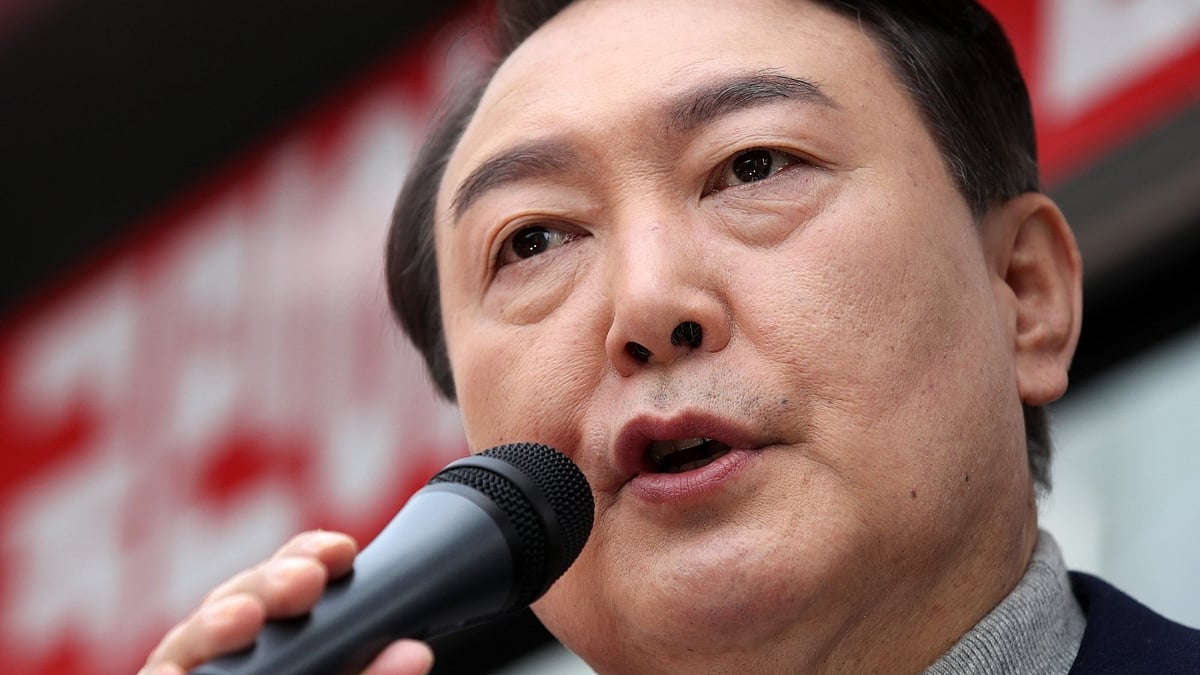
Former South Korean President Yoon Suk-yeol has been sentenced to life imprisonment for declaring martial law during a political standoff that plunged the country into its gravest crisis in decades.
The ruling, delivered by Judge Jee Kui-youn of the Seoul Central District Court, found Yoon guilty of rebellion. The court held that he unlawfully mobilised military and police forces in an attempt to overpower the opposition-controlled National Assembly of South Korea, detain political leaders and consolidate unchecked authority for a “considerable” period.
Yoon’s downfall began on 3 December 2024, when he abruptly declared martial law and deployed troops to surround the National Assembly in what prosecutors described as a bid to neutralise lawmakers. The decree — the first such move in over 40 years — granted sweeping powers, including suspension of political activity, media controls and arrests without warrants.
The order lasted roughly six hours. Lawmakers forced their way past a military blockade, convened with a quorum and voted unanimously to revoke the decree.
He was impeached on 14 December 2024, suspended from office and formally removed by the Constitutional Court in April 2025. Since July, he has been in custody facing multiple charges, with rebellion carrying the harshest penalty.
In explaining the verdict, Judge Jee said the decision to send troops to the legislature was central to establishing intent.
“This court finds that the purpose of (Yoon’s) actions was to send troops to the National Assembly, block the Assembly building and arrest key figures, including the speaker and leaders of both ruling and opposition parties, in order to prevent lawmakers from gathering to deliberate or vote,” the judge said.
He concluded that Yoon had sought to obstruct or paralyse the Assembly so that it could not properly perform its constitutional role.
Prosecutors argued that even under martial law, Yoon had exceeded his authority and deliberately attempted to prevent legislators from overturning his decree.
Yoon’s lawyer, Yoon Kap-keun, accused the court of delivering a “predetermined verdict” based entirely on the prosecution’s case and claimed the “rule of law” had collapsed. He said the legal team would consult with the former president about a possible appeal.
Yoon himself told the court that his declaration of martial law was intended merely to alert the public to what he described as legislative obstruction by liberal lawmakers. He insisted he would have respected a parliamentary vote rejecting the measure.
A special prosecutor had sought the death penalty, arguing that Yoon’s actions posed a grave threat to democracy. However, many analysts anticipated a life sentence, noting that the attempted power grab — though dramatic — did not result in fatalities.
South Korea has maintained a de facto moratorium on executions since 1997, despite capital punishment remaining on the statute books.
The imposition of martial law revived painful memories of South Korea’s authoritarian past, when military-backed governments deployed soldiers and armoured vehicles to suppress dissent. Emergency decrees during that era were frequently used to curb protests and restrict civil liberties.
Yoon’s conviction marks the first time since Chun Doo-hwan that a former South Korean president has received a life sentence. Chun was initially sentenced to death in 1996 for his role in the 1979 coup and the brutal 1980 crackdown on pro-democracy demonstrators in Gwangju that left more than 200 people dead or missing. His sentence was later commuted to life imprisonment, and he was pardoned in 1997. He died in 2021.
The Seoul Central District Court also convicted several former military and police officials who enforced Yoon’s decree. Among them was former defence minister Kim Yong Hyun, who received a 30-year sentence for his role in planning and executing the mobilisation.
In a separate case last month, Yoon was sentenced to five years in prison for resisting arrest, fabricating aspects of the martial law proclamation and bypassing a legally required full Cabinet meeting before declaring the emergency.
Former prime minister Han Duck-soo was sentenced to 23 years in prison for attempting to legitimise the decree through a Cabinet Council session, falsifying records and lying under oath. He has appealed.
As Yoon was brought to court, hundreds of police were deployed around the complex. Supporters gathered outside, chanting as the prison vehicle carrying him passed, while critics assembled nearby demanding the harshest possible punishment. No major clashes were reported after the verdict.
The life sentence closes a dramatic chapter in South Korean politics — a stark warning, analysts say, about the resilience of democratic institutions in the face of executive overreach.
Join our official telegram channel (@nationalherald) and stay updated with the latest headlines