World
Sheikh Hasina’s homecoming gambit
The mere announcement of her intention to return on Victory Day has raised the political temperature in Bangladesh
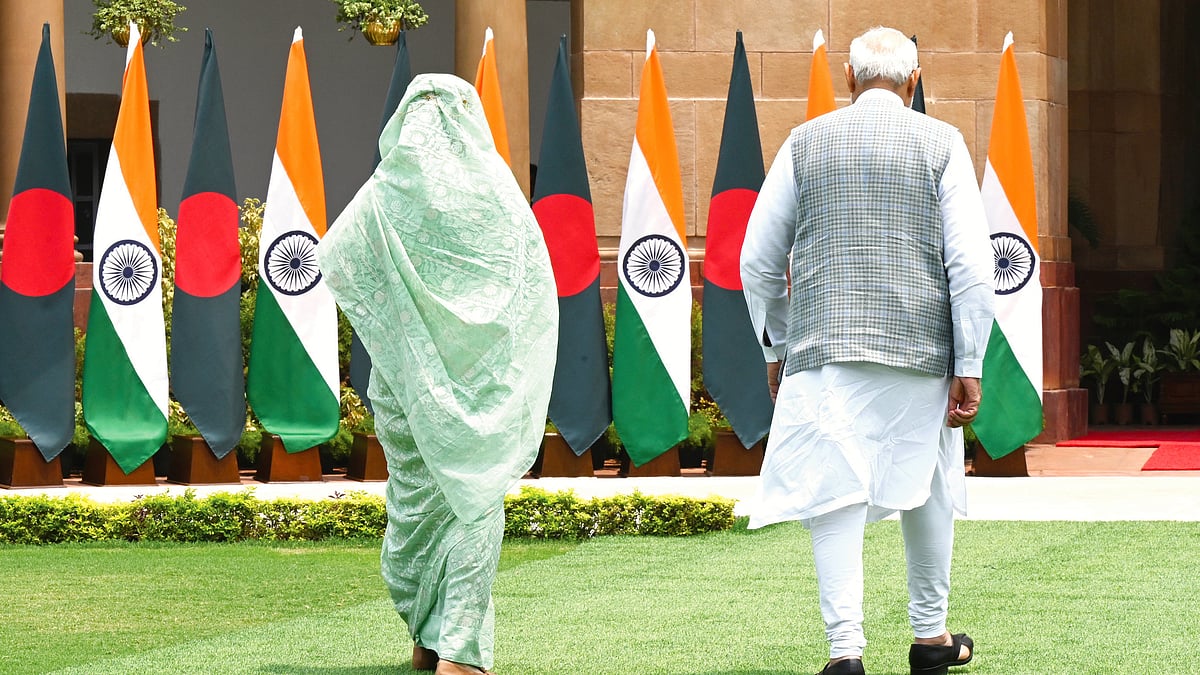
Bangladesh’s ousted Prime Minister Sheikh Hasina has picked a date to end her exile. According to Reuters, Hasina intends to fly back to Dhaka on 16 December — Victory Day, the anniversary of the country’s independence from Pakistan — aboard a state-arranged Biman Bangladesh Airlines flight. The Tarique Rahman administration lost no time in ruling out the proposition. Dhaka insists Sheikh Hasina will return in handcuffs, extradited from India and under police custody.
The timing of her decision is easily explained. Hasina, who fled the country in August 2024, senses an opportunity as anti-incumbency sets in against the Bangladesh Nationalist Party (BNP) government. The Awami League remains a banned outfit and party workers have gone underground or fled the country. The remaining workers face criminal cases, arrests and detention besides attacks on homes and establishments.
Hasina herself has been sentenced to death by a tribunal after a questionable trial in absentia. Her return to Bangladesh — even in handcuffs — her supporters believe, would revive her political relevance. Her arrest would draw international attention to the legality of her trial and the manner in which she was ousted. Worse, if she is executed as some BNP leaders have declared, she would be seen as a martyr and could well revive the Awami League.
Hasina’s camp claims her return is a constitutional right. Syed Mozammel Ali, her spokesperson, asserts she was forced into exile illegally and argues that Dhaka is obligated to arrange her passage.
Humayun Kabir, the state minister for foreign affairs, dismissed the demand outright, saying she will return only under strict surveillance. Reuters also reported that no official level talks have taken place with New Delhi on chartering an aircraft.
Dhaka is not too keen to facilitate her return. The mere announcement of her intention to return raised the political temperature in Bangladesh. Awami League supporters emerged from the woodwork and street clashes escalated with Jamaat and BNP workers. Gopalganj, Hasina’s ancestral home and traditional bastion, has been worst hit.
In Tungipara, protests over the arrest of eight people escalated into clashes with security forces; a police station was attacked, patrol vehicles torched, roads blockaded and the house of S.M. Jilani, a lawmaker from the ruling BNP, damaged by fire.
Elsewhere, branches of Grameen Bank and the ancestral home of Nobel laureate Muhammad Yunus, who led the post-uprising interim government, faced arson attacks. In Pirojpur, a bus helper died after assailants, allegedly chanting Awami League slogans, set the vehicle ablaze.
There is also the concern that her return would focus attention on her questionable trial and lead to a comparison between her governance record and the dispensations that followed. For Rahman’s government, the challenge is twofold: maintaining order on the streets and preventing Hasina’s political resurrection.
Earlier this month, Matrix Chambers, a London-based law firm representing Hasina, approached the Bangladesh High Commission in New Delhi to request a new passport and national identity card. Meanwhile, senior Awami League leaders have vowed to resume political activities in December despite the ban. Shafiul Alam Chowdhury Nadel, a senior party leader, told National Herald that BNP’s effort to build a broader political coalition reveals its fear of an Awami League comeback.
****
Is Sheikh Hasina’s intended ‘ghar wapsi’ just political theatre then? Or is it a real possibility? Some political observers see this as a last-ditch effort by the 79-year-old leader to remain in the news and revive her party.
The buzz in New Delhi is that it is unlikely she can return on her own terms. It seems even more unlikely for India to extradite her as demanded by Dhaka. She arrived in India in an official Air Force plane and as the prime minister of a friendly country, not as a convicted felon, Delhi has argued.
Although a section of the foreign policy establishment appears keen to send her back, hoping it would lead to the revival of the historically friendly Awami League, the political establishment is said to be reluctant to send ‘behenji’ back to face the music.
The mandarins instead appear in favour of slowing things down. They would rather let legal and diplomatic complexities run their own course, buy time and encourage Hasina to delay her return.
At the heart of this debate are starkly divergent readings about Awami League’s — and Hasina’s — current political strength. Indians anchored to the 1971 liberation legacy underscore the need to have Awami League back in power in Dhaka, saying only its revival can weaken the BNP. They argue that the 2026 electoral mandate is incomplete because the Awami League did not contest the general elections in February.
Critics, on the other hand, are quick to point out that the BNP won roughly 50 per cent of the votes and a two-thirds majority in an election widely regarded as free and fair. They also argue that Hasina’s backers in New Delhi overlook how much the party has changed over time — weighed down by allegations of corruption, human rights abuses, extra-judicial killings, and entangled with hardline Islamist groups — eroding its political appeal, especially among younger voters.
It was the Awami League government which executed several leaders of the Jamaat between 2013 and 2016 for their alleged role during the 1971 liberation of Bangladesh. It was again Hasina’s government which denied passports to leaders of the Jamaat and BNP in exile. The indiscriminate arrest and sham trial of Awami League leaders, observers point out, has a precedent. The Awami League too had hounded BNP and Jamaat leaders when it was in power.
On 22 November, four senior Awami League leaders surveyed border crossing points in West Bengal — Darshana-Gede and Petrapole-Benapole. The idea was to assess if ‘lakhs of people’ could be assembled on the Bangladeshi side to form a human shield and escort her to Dhaka. Hasina’s request for an aircraft reportedly was made after the recce team reported that the party was in no position to gather ‘lakhs of people’.
How will she then go back? Without a valid passport she cannot fly. The Indian government is unlikely to escort her to the border; and travelling on her own over 1,700 km to reach the nearest border is certainly not practical. The only other twist in the tale is for her to show up at the nearest Bangladesh High Commission and claim political persecution and threat to life. Will she?
Join our official telegram channel (@nationalherald) and stay updated with the latest headlines