World
Trump-Xi-Putin summit ends with little beyond photo ops and broad pledges
Three leaders pledge cooperation on nuclear risks but offer few concrete outcomes after their unprecedented meeting in Shenzhen
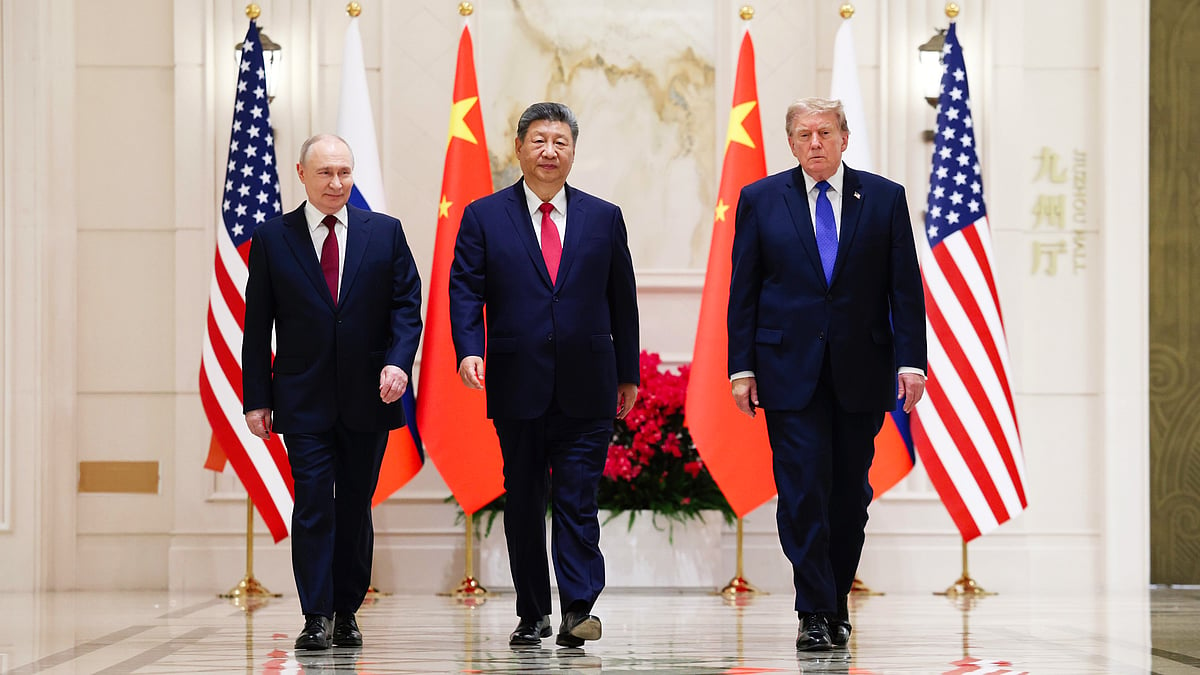
Trump, Xi and Putin hold their first trilateral summit in Shenzhen, but announce few concrete agreements.
Nuclear arms control, Iran, Ukraine and the ICC feature in discussions.
Trump's claims of personal ties contrast with the deeper strategic partnership between Xi and Putin.
US President Donald Trump had hoped that bringing together the leaders of China and Russia would be a diplomatic triumph, demonstrating his ability to negotiate with two of Washington's most formidable rivals. Instead, an unprecedented trilateral summit with Xi Jinping and Vladimir Putin ended on Thursday with little more than broad declarations and a carefully choreographed display of bonhomie.
Ahead of the meeting at a villa in the Chinese technology hub of Shenzhen, Trump had gone out of his way to describe both leaders as friends. The agenda was ambitious: the wars in Ukraine and Iran, nuclear arms control and ways to reduce the threat posed by the world's largest nuclear arsenals.
But after roughly 70 minutes of closed-door discussions, the three leaders offered a far narrower set of areas for cooperation, expressing interest in reforming the United Nations, expanding fossil-fuel production and limiting the reach of the International Criminal Court (ICC).
What had been billed as a historic diplomatic gathering ended up looking more like an elaborate photo opportunity. Trump left the villa and boarded Air Force One without addressing reporters about the discussions.
The modest outcome contrasted sharply with the grand rhetoric that had preceded the summit.
"We are really making history," Trump declared at the outset. "The United States, Russia and China are uniquely positioned to discuss how to reduce the number of nuclear weapons on Earth and also to lessen the risk of those weapons being used."
Xi had said the meeting would focus on "promoting world peace", while Putin stressed that the three countries shared responsibility for maintaining international peace.
After the meeting, Xi described the discussions as positive, constructive and fruitful. Putin called them open and candid, and characterised the trilateral format as "useful and substantive".
Asked whether the symbolism of the gathering mattered more than its actual outcome, Putin insisted that it represented serious diplomatic engagement. "It is a serious collaborative work," he said.
The summit came at a particularly sensitive moment for global nuclear arms control. The last remaining nuclear arms agreement between Washington and Moscow, the New START treaty, expired in February. Trump has said he wants a "new, improved and modernised" agreement that would also include China.
Beijing, however, has considerably less incentive to accept restrictions on its arsenal, which is estimated at more than 600 warheads — far below the more than 5,000 believed to be held by each of the US and Russia.
Daryl Kimball, executive director of the Arms Control Association, said the meeting could, at best, mark the beginning of a process leading to sustained negotiations on reducing nuclear arsenals.
"We need more than diplomatic theatre and photo opportunities between Xi, Putin and Trump," Kimball said. "And one meeting will not likely produce dramatic breakthroughs."
### Iran, trade and the Ukraine question
The trilateral gathering followed separate meetings between Trump and the other two leaders, with Iran, energy supplies, trade and the war in Ukraine featuring in their discussions.
Trump's bilateral meeting with Xi was their third substantial engagement this year. The US president said both countries had a shared interest in keeping oil flowing through the Strait of Hormuz, a crucial shipping route for global energy supplies that had repeatedly been disrupted by attacks during the Iran war. He also indicated that he would press Beijing to purchase more American agricultural products.
Xi, meanwhile, described US-China relations under Trump's presidency as "generally stable and improved". According to China's official Xinhua news agency, he also raised Taiwan and stressed the need for better communication between the two countries on economic and trade issues.
Trump also held separate talks with Putin, the first time the two leaders had met for discussions since their meeting in Alaska last year failed to produce an agreement on the war in Ukraine.
"Wonderful things can come out of this — or at least start," Trump said, describing Putin as "my friend".
Trump has repeatedly touted his personal rapport with the Russian president, even as relations between Washington and Kyiv have deteriorated. He has resisted fresh sanctions against Moscow, while disruptions to satellite support for Ukrainian drones have further complicated Kyiv's war effort.
The three leaders also found common ground in their criticism of the International Criminal Court, accusing it of exceeding its jurisdiction and arguing that government officials should enjoy immunity from prosecution before the tribunal.
The position carries particular significance for Putin, who is wanted by the ICC. Trump's administration, meanwhile, has imposed sanctions on the court and some of its officials as part of a wider campaign against investigations involving the US and its allies, including Israel.
### Trump boasts of personal ties, but Xi and Putin have a closer bond
Trump's ambitions for the summit evoked an older tradition of great-power diplomacy, in which the world's most powerful countries sought to determine the fate of smaller nations without necessarily involving them. Ukraine was absent from the discussions, as were US allies such as Germany, France, the United Kingdom, Japan and South Korea, all of whom have significant stakes in the issues being discussed.
Trump has long believed that his ability to establish personal relationships with other leaders gives him a diplomatic advantage. Xi offered a symbolic gesture of goodwill on Wednesday by departing from protocol to receive Air Force One on the tarmac. The two leaders subsequently turned their handshake into a one-armed embrace.
Yet the warmth Trump has displayed towards both Xi and Putin does not necessarily translate into the kind of strategic affinity the Chinese and Russian leaders share.
At the Asia-Pacific Economic Cooperation (APEC) summit on Wednesday, Xi greeted Putin as "my old friend". The Russian president responded by calling Xi his "dear friend". Beijing has provided crucial economic support to Moscow since Russia's 2022 invasion of Ukraine, helping Putin withstand the financial impact of Western sanctions.
Xi was considerably more restrained during his state visit to the White House in September, when he described his relationship with Trump as a "personal rapport" and said the two had stayed in touch. The US and Chinese presidents are scheduled to meet again at the G20 summit in Florida in December.
Despite Trump's public praise for Xi, Thursday's proceedings also offered glimpses of continuing friction between Washington and Beijing.
Chinese officials barred a Bloomberg reporter from the trilateral meeting after she asked a question during the earlier Trump-Xi engagement. Chinese television also broadcast footage showing Trump appearing drowsy, while the White House released a clip of the US president helping Xi up an escalator.
For all the talk of friendship and historic cooperation, the summit offered little evidence that personal diplomacy alone could bridge the strategic differences separating the three powers.
With AP/PTI inputs