Nation
A trade deal and a $500 billion question
US officials indicate they expect India to accept the terms of the deal as binding, though it has not been signed or even fully drafted
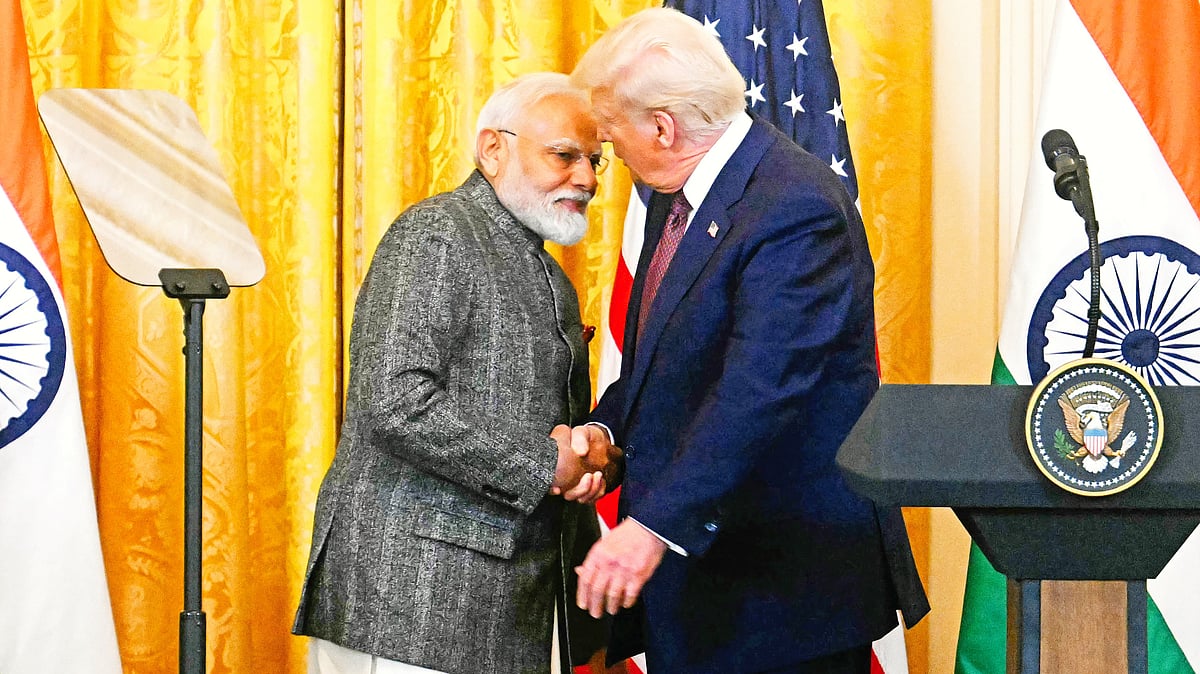
A month after India and the US ‘agreed’ on a trade deal that was practically dictated by the US President, three weeks after the salient points were unilaterally released in what was supposedly a ‘joint statement’ and more than a week after the US Supreme Court threw out Trump’s ‘emergency’ tariffs as illegal, the much-discussed trade deal is as clear as mud.
Since we’re now used to hearing it from Trump first — be it war or trade — many presumed the US President’s annual State of the Union address would perhaps reveal where the deal now stands. But no such luck — his focus was on claiming the tariff regime as a spectacular success and on issuing threats to invoke other laws to take it forward.
In his first public reaction, though, after the Supreme Court declared his tariff actions illegal, Trump was emphatic that the ‘India deal’ was still on, that Modi, ‘a smart man and a great friend’, would deliver despite the ruling. Some 48 hours later, he warned countries, without naming them, that they better not play games with him on the basis of the court ruling.
His new 15 per cent tariff has been imposed via a proclamation under Sec. 122 of the US Trade Act of 1974 — a rarely used law that allows the executive to impose tariffs of up to 15 per cent for 150 days, after which the US Congress must ratify it. As per Trump, though, ‘Congressional action’ will not be necessary.
While not specifically naming India, Trump described the tariffs and trade deals with different countries as ‘historic’ and good for the US economy. These agreements, he said, were opening foreign markets to American goods and bringing home revenue. And the US Supreme Court judgment was but a temporary obstacle; his administration would ultimately prevail.
India may have stalled the visit of its trade delegation for follow-up discussions on the ‘interim agreement’, but even if the Modi government has had belated second thoughts, it won’t be easy to renegotiate terms.
Punitive terms like surrendering its sovereign right to buy crude oil from Russia. India has also committed to $500 billion worth of US imports over the next five years, and is the only trading partner to agree to charge zero tariff on most US goods while paying 18 per cent on its own exports to the US. It has opened up vulnerable markets at home to US imports and made not a peep of protest when tariff differentials with competitors like Bangladesh put Indian cotton and textiles at a huge disadvantage.
Signals from US officials indicate they expect India to accept the terms as binding, even though the deal has not been signed nor even fully drafted yet. Even the joint statement of a ‘framework for an Interim Agreement’ — whatever that means — released on 6 February was unsigned.
Given that Trump’s tariffs are in constitutional limbo, given that the rest of the world is also weighing its options, does India have the political will to insist on a renegotiation? Even though it wasn’t sharp enough to wait till the Trump administration managed — if at all — to re-validate the tariffs the US Supreme Court has struck down.
****
What forced Prime Minister Narendra Modi to suddenly agree to such a one-sided deal? All through 2025, India did stall for time even as the UK and EU, Malaysia, Japan and Vietnam fell in line. In November 2025, US commerce secretary Howard Lutnick was venting his frustration at the delay in the trade deal with India, apparently only because PM Modi had not called President Trump.
With the Budget session under way, what prompted PM Modi to make that phone call on 2 February? Even if he had no intention to take the Opposition into confidence, he could easily have played for time; the ongoing Budget session was a handy pretext.
It’s plausible that the government even had intelligence which way the US Supreme Court might go on Trump’s ‘emergency’ tariffs. Officials reportedly advised Modi to wait until the US court ruling, but he ignored their counsel. There was no cabinet meeting either to clear the deal. Was it plain hubris, then, to go ahead with the phone call? Or pressure from ‘dear friend Doland’?
On 2 February, while the Budget session was on, Trump tweeted that his ‘great friend’ Narendra Modi had called to signal India’s readiness to sign a trade deal. He claimed Modi had agreed to cut Russian oil imports and increase purchases from the US, that he would lower tariffs on Indian goods from 25 per cent to 18 per cent and remove the 25 per cent penalty (levied when India was still batting for the ‘strategic autonomy’ to buy Russian crude) and that India would charge ‘ZERO’ on US imports.
****
A trade deal, as former finance secretary Subhash Chandra Garg points out, should ideally benefit both countries. The terms of the still-unsigned deal suggest that it is overwhelmingly in America’s favour. The current nominal GDP of the US is seven times India’s, its per capita income more than 30 times. Why has the Indian government made commitments to ‘reciprocal and balanced trade’ with a much larger, much richer economy, asks economist Prasenjit Bose.
The US has long been India’s largest export market, with Indian exports to the US topping $86 billion in 2024-25, accounting for over 19 per cent of total exports of $437 billion. While India’s overall trade deficit widened to $283 billion that year, it ran a$40 billion surplus with the US. Between April and December 2025-26, India’s goods trade surplus with the US stood at $26 billion.
So, while India does need to diversify its export markets, walking away from a deal with the US is not really an option. But even that should not preclude hard negotiations to protect domestic interests.
Asked at the Munich Security Conference (13–15 February) whether India had agreed to the US ban on Russian oil, external affairs minister S. Jaishankar said India’s energy choices are guided by national interest and ‘strategic autonomy’. Commerce minister Piyush Goyal has tried to dodge the question, saying it is for the oil companies to decide their sources.
Really, Messrs Jaishankar and Goyal? Wasn’t it under US pressure that India forfeited its right to source cheaper oil from Iran in 2019, and hasn’t it bowed again to the same bully in 2026?
If indeed ‘strategic autonomy’ guides India’s foreign policy, why did India get arm-twisted into buying oil from Venezuela (effectively the US)? What does India’s commitment to ‘buy American’ mean? Why must India import coal from the US? And what does it mean for sovereign India to let the Trump administration monitor India’s crude oil imports?
Data from the ministry of commerce and industry shows that India’s crude imports from Russia rose from 50.85 million metric tonnes in 2022-23 to 83.02 MMT in 2023-24 and 87.54 MMT in 2024-25, while the price per barrel fell from $79.41 to $66.49 between April 2022 and March 2025.
The share of Russian Urals oil in India’s total crude imports jumped from less than 2 per cent in 2020-21 to over 35 per cent in 2024-25. In 2025-26, this share is already declining and is expected to fall below 20 per cent by the end of the financial year.
What did India gain in these negotiations? The interim agreement cited India’s ‘intention’ — or ‘aspiration’ as Piyush Goyal put it — to buy $500 billion worth of US goods over five years, but there was no reciprocal pledge for the US to boost imports from India.
India should have bargained harder for zero tariffs on its labour-intensive exports, argues Garg — on textile and apparel, leather and footwear, plastics, rubber and artisanal products, which were earlier taxed at 0–3 per cent and now face 10–18 per cent tariffs. India must leverage its large market for fresh negotiations, he says.
But can India renegotiate the deal? That’s a $500 billion-dollar question.
Join our official telegram channel (@nationalherald) and stay updated with the latest headlines