Nation
Bihar: Stricken by floods and deluged by ads
More than 50 lakh people have been hit by floods this year, but it has barely made news outside Bihar
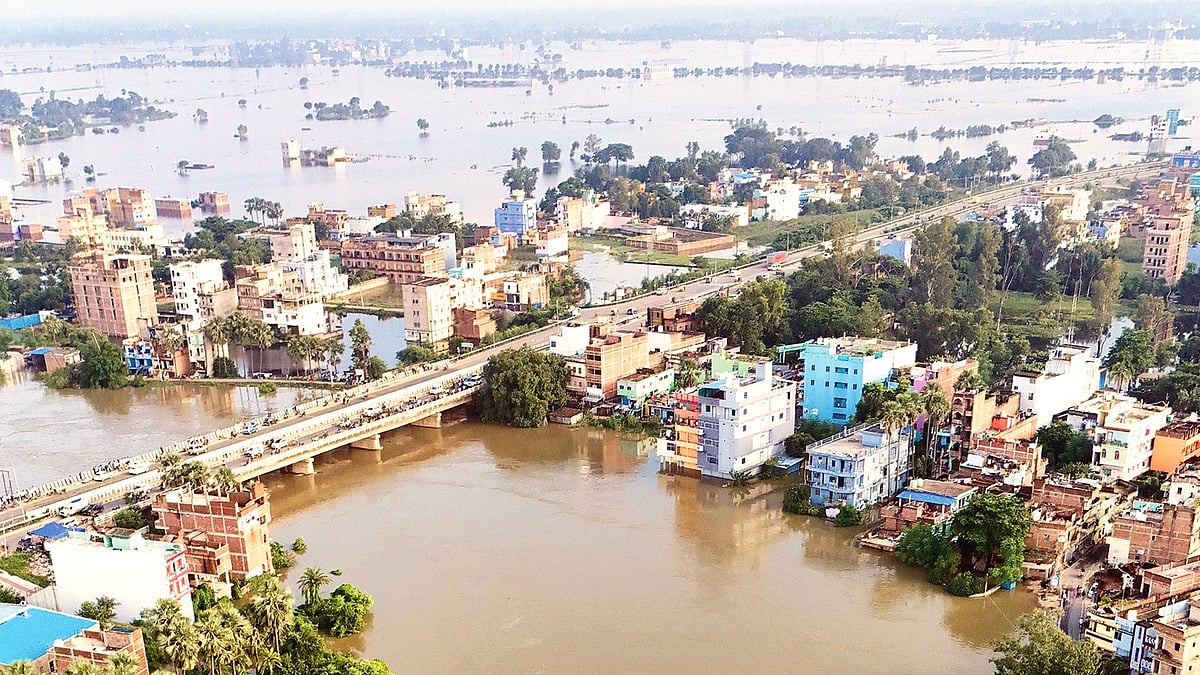
The story goes that in the mid-1990s, celebrity American photojournalist Steve McCurry went back from flood-ravaged Bihar without taking a single photograph. For four days, he travelled through affected areas but not once did he take out his camera, claimed one of his local guides. Perhaps he can be excused, but what about Indian media? Are floods such a boringly familiar annual feature in the state that they fail to grab national headlines?
More than 50 lakh people have been hit by the floods this year. Many have been displaced. Some have taken refuge on embankments with their livestock and some on the highways. Others have been forced to spend days on rooftops, even treetops. A few may have died of snakebite, others of water-borne diseases. But it’s not news outside the state. Is this because floods have been normalised? Or is it because mainstream media is deluged by a flood of government advertisements, leaving no room to cover poor disaster management and the plight of those affected?
The media was (surprisingly) equally indifferent to the activities of two different political parties. When the Congress Seva Dal took to country boats, often wading through water to reach dry rations, tarpaulins, water purification packets and baby food to the stranded, setting up community kitchens to serve hot meals to the displaced, the media took scant notice. Ditto, when Union minister Shivraj Singh Chouhan repeatedly invoked the name of Prime Minister Narendra Modi and BJP leaders exhorted flood victims to join in and shout ‘Narendra Modi zindabad’.
Another intriguing feature this year has been the noticeable presence of coaching institutes doing relief work. Patna’s ‘Khan sir’ was seen distributing food packets, clean water, milk and basic medicines to stranded public and families. Educator Alakh Pandey and his Physics Wallah team were spotted handing out dry ration kits as was coach Roshan Anand, who provided food as well as study materials to displaced students appearing for various competitive tests.
The educators, who had drawn adverse publicity in recent months for the unhealthy rivalry between their coaching institutes, were clearly keen to change public perception.
Floods in Bihar are especially severe when it rains heavily in Nepal. Bihar is virtually flat. The Kosi, Gandak, Bagmati and Kamla Balan — all Himalayan rivers — roar into the Bihar plains carrying enormous amounts of silt. As they slow down, they deposit this silt. To check their surge, Bihar has built embankments which are not a permanent solution. They cannot stop waterlogging and when breached or over-topped, release large volumes of water into densely populated areas.
A more realistic goal would be to make the state flood-resilient, say experts. Another oft-repeated suggestion is for both India and Nepal to manage the entire river system together, with early and real-time forecasting, joint monitoring of sediments and coordinated water management.
Bihar accounts for around 17.2 per cent of India’s flood-prone terrain. Of its 94.16 lakh hectares, 68.80 lakh ha (76 per cent of north Bihar and 73 per cent of south Bihar) is officially described as flood-prone. Sceptics however say these floods are manmade disasters that are allowed to take place.
Floods have turned into a lucrative business for contractors, officials and politicians. Emergency funds and expenditure require no approval and follow no norms. With flood victims totally dependent on relief and rehabilitation measures, there is a lot of public money floating around but very little accountability.
Dr Dinesh Kumar Mishra, arguably the best known expert on flood management in the state, recalls a ‘flood conference’ held in Patna in 1937.
“In the mid-1940s, another meeting was convened and after Independence, two experts — Dr K.L. Rao and Kanwar Sen — were sent to China to study the river management system of the Wang Chhu which had changed its course nine times,” recalls Dr Mishra, who has written several books and monographs on Bihar’s rivers. Since 1986, however, no serious deliberation has been held on flood-control, he told National Herald.
Former director of the A.N. Sinha Institute of Social Sciences, Dr D.M. Diwakar is also of the opinion that floods in north Bihar are manmade disasters, the result of mismanaged water resources. The design of the Kosi river embarkments are, he says, faulty, and built against the natural course of the water. Hailing from flood-prone Madhubani, he points out that the silt load from Nepal needed disposal through wider embankments. Instead, they were reduced from 6 km to 1.5 km.
****
Chacha Chaudhary’s comical plans
An announcement a day keeps the real problems at bay. That seems to be the logic behind chief minister Samrat Chaudhary’s grand ambitions. Since taking office in April, he has announced plans to set up 12 satellite townships around key cities, a world trade centre in Patna at a cost of Rs 4,000 crore to attract global corporates, 10,000 industrial units in the next five years, 700 model schools, 211 new degree colleges, digital education, health screening, women’s employment, students’ credit card… you name it.
These daily announcements, lavishly advertised in the media, have overshadowed growing lawlessness, youth unrest, molestation of women and a rising tide of corruption. So much so that BJP ally Chirag Paswan has publicly said he is ashamed to be part of the NDA in Bihar.
What has infuriated people, especially academics, is the announcement that 100 assistant professors will be sent to Oxford University for a month of training. ‘Chacha Chaudhary’, as the CM is called, has also announced the setting up two state universities, namely Mata Sita Women’s University in Patna and Ramdhari Singh Dinkar University in Begusarai, and a whole new Physics University.
Former Patna University professor O.P. Jayaswal fumes, “Whoever heard of a Physics University? And why do we need new universities and colleges when the existing ones are dying for want of funds and proper infrastructure?”
Dr Diwakar pointed out that teachers are not receiving their salaries on time and pensions are delayed. Bihar’s fiscal deficit is three per cent of the gross state domestic product (GSDP) and its outstanding debt 37 per cent of GSDP. The state’s own revenue generation remains inadequate, making it heavily dependent on central transfers. Institutional capacity building, fiscal prudence and improved living conditions should have been the priorities, Diwakar added.
In most of Bihar’s colleges, basic infrastructure is crumbling, clean washrooms are scarce as is drinking water, faculty positions lie vacant, libraries have no funds to buy new books or subscribe to journals. So what’s the logic of flying 100 assistant professors to England? How will they be selected, what kind of training will be imparted, and by whom? It looks more like an expensive PR exercise or a junket as part of ‘educational tourism’, quipped one academic.
“We have become a laughing stock. We don’t have a single flight from Patna to Bhutan or Nepal but the state government is planning a massive network of airports in cities like Sonpur, Sultanganj, Raxaul, Muzaffarpur, Rajgir, Chhapra, Bhagalpur!” exclaimed an entrepreneur.
The process of land acquisition has already begun, looking suspiciously like yet another conduit to siphon off public funds.
Join our official telegram channel (@nationalherald) and stay updated with the latest headlines