Nation
Delhi Police impose restrictions, metro gates shut ahead of protest against CEC
Security tightened at Jantar Mantar as student and youth groups plan a demonstration seeking Gyanesh Kumar’s resignation despite being denied permission
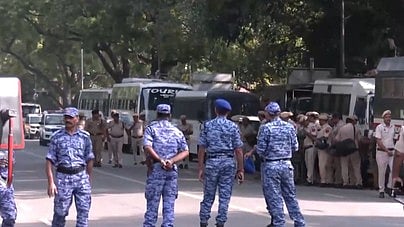
Prohibitory orders under Section 163 of the BNSS are in force across New Delhi district, restricting unauthorised gatherings and protests
Entry and exit at 11 metro stations are closed until further notice, with interchange facilities available at four stations
AISA, SFI and DYFI plan to proceed with the Jantar Mantar protest; a separate mobilisation has been announced in Mumbai
Delhi Police imposed prohibitory orders across New Delhi district on Friday and stepped-up security at Jantar Mantar ahead of a planned protest demanding the resignation of chief election commissioner Gyanesh Kumar.
Entry and exit gates at several metro stations were also closed as student and youth organisations prepared to mobilise on Gandhi Jayanti over concerns about the Election Commission’s functioning and its handling of electoral rolls.
Police personnel and water cannons were deployed at Jantar Mantar. The demonstration, announced by the All-India Students’ Association (AISA), Students’ Federation of India (SFI) and Democratic Youth Federation of India (DYFI), has not received police permission.
The organisations have nevertheless indicated that they intend to proceed. A member of one of the groups said around 1,500 people were expected to participate.
The restrictions, imposed under Section 163 of the Bharatiya Nagarik Suraksha Sanhita (BNSS), prohibit gatherings of five or more people, processions, demonstrations, picketing and sit-ins without prior written permission.
The order also bars participants from carrying firearms, weapons, sticks, swords, brickbats or other potentially dangerous objects. Slogans and speeches at unauthorised gatherings are prohibited.
Deputy commissioner of police Sachin Sharma said the restrictions were in force throughout New Delhi district and urged people to comply with the law and cooperate with police. Unauthorised protests and sit-ins would not be permitted, he told reporters.
Metro entry and exit closures cover Janpath, Patel Chowk, Central Secretariat, Rajiv Chowk, Seva Teerth, Mandi House, Lok Kalyan Marg, INA, Chawri Bazar, Ramakrishna Ashram Marg and New Delhi stations.
Interchange facilities remain available at Rajiv Chowk, Mandi House, New Delhi and Central Secretariat, allowing passengers to change lines despite the closure of station gates. The entry and exit restrictions will remain in place until further notice.
The planned demonstration follows criticism from activists and student organisations over the Election Commission’s management of electoral rolls, including the Special Intensive Revision exercise.
Separately, Abhijeet Dipke, founder of the Cockroach Janta Party movement, announced a “Jail Bharo Andolan” at Mumbai’s Shivaji Park at 4 pm on 2 October.
Dipke had earlier said Mumbai Police had refused permission for the group’s proposed protest against Kumar. He subsequently announced plans to hold the mobilisation on Gandhi Jayanti.
Mumbai Police said they were not authorised to approve a gathering at Shivaji Park because of a 2013 Bombay High Court order. They also pointed out that the area is a designated silence zone.
With IANS inputs
Join our official telegram channel (@nationalherald) and stay updated with the latest headlines