Nation
In Bengal, Jalil Akhtar’s days in hell
"Look at this SIR. Our names have been struck off. Can you tell me if we’ll ever get back on the rolls?”
Rasakhowa is one of the oldest and largest weekly markets in north Bengal’s Uttar Dinajpur district. Sunday is haat day. Buyers and sellers come here from far and wide.
At the heart of this weekly market was gorur haat (cattle market), spread across an enormous tract of land. Farmers, householders, cattle-rearers, milkmen and butchers came here to buy and sell animals. Everyone had a different way of judging a cow or bullock: one man would inspect its teeth, another would slap and feel its flanks.
The tumult of the Sunday cattle market was a big feature of the agrarian economy of Karandighi’s villages. Around it flourished other sections of the market: for fruits and vegetables, for jute, paddy and rice, and for pulses, especially the roasted mashkalai dal (also known as urad). The buying and selling didn’t stop altogether on the other days of the week.
People from distant villages gathered here regularly, and for that reason, schools, madrasas, student hostels and government offices had also sprung up around the haat. Rasakhowa, built over centuries from the accumulated sediment of village life, was a mirror to the lives of these people.
29 July 2026. The government bus that left Raiganj bus depot at seven in the morning dropped us at Rasakhowa before nine. There were four of us. It was Wednesday, not haat day, but even so, its torpor seemed somehow unnatural. The first thing that struck us was a vast emptiness. This was where the gorur haat used to sit.
No longer. A ban was enforced on the buying and selling of cattle just before Bakrid this year. Police and Hindutva musclemen came to Rasakhowa and smashed all the structures of the cattle haat. It has now been shut for more than two months.
We spoke to a few shopkeepers and ‘toto’ drivers. (These are the battery-powered three-wheelers ubiquitous in Bengal.) Pointing out the boundaries with their fingers, they showed us how, in just these two months, portions of the cattle haat ground had already been encroached upon. New rooms had been built, but these folks had no clue what kind of new shops might come up there. As they spoke, one could sense the fear that had congealed inside them.
We went to a tea stall inside the haat and struck up a conversation with a middle-aged Muslim shopkeeper, who had opened his shop that morning and come over for tea. We were unfamiliar faces, so he asked where we’d come from.
The conversation turned to the closure of the cattle haat. He said it was not just Rasakhowa: all three major cattle haats in Karandighi block had been shut down.
He fell silent for a moment and then said: “How long can people who raise cattle to sell them keep feeding them at home? So they sell them, if they manage, at half-price or even a third, to the very people who put saffron tilaks on their foreheads and say they are gau-rakshaks, who then sell them to dalals (middlemen) of meat-export companies. It is only when we Muslims buy and sell cattle that it becomes a crime. This Bakrid we Muslims decided we wouldn’t buy cattle, and we didn’t. But if this goes on, where will the cattle for the plough come from? Where will the milch cattle come from?”
I asked whether he thought this centuries-old cattle haat had now been closed for good. He fixed me with a fierce look. “Isn’t that what it looks like? Look at this SIR. Our names have been struck off. Can you tell me how they will ever get back on the rolls?”
Looking me straight in the eye, he went on: “In our Karandighi block, one and a half lakh people have had their names deleted from the voter list. Almost all are Muslims, most of them women. People rummaged through their belongings to find whatever papers they could find, belonging to their fathers/grandfathers/ancestors, stuffed the documents into bags and went to the election babus.
"But nothing came of it; they couldn’t vote. Now they live in fear, wondering when they will hit another wall at a bank, a ration shop, a thana, a government office... They say tribunals will put all the names back. Three months have passed and only 151 people have had hearings at the district magistrate’s office. And now even the tribunal has stopped functioning. Nobody knows what will happen or when. Do you?”
I lowered my head.
“And what good is having your name on the voter list anyway? Look at Jalil Akhtar of Bagroi village. The police picked him up and took him to a holding centre. His name was on the voter list. He even voted. And now they are calling him a ‘Bangladeshi’.”
****
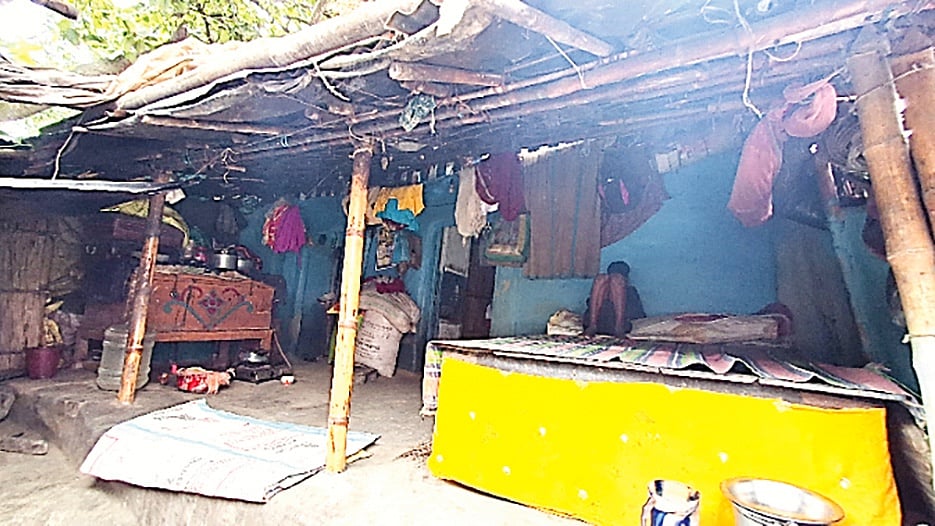
It was after reading about Jalil Akhtar in a newspaper that we’d come to Rasakhowa. We took a toto to Bagroi village, where we were headed, some 25 km away. The villages we crossed on the way were predominantly Muslim; there were brick-and-mortar structures too but mainly the dwellings were thatched huts. Jalil Akhtar’s was a kutcha home, which stood next to his maternal cousin Motiur Rahman’s pucca house.
Motiur Rahman is over 60. The room we sat in is where he sleeps at night. Jalil Akhtar’s dwelling lies across a narrow alley.
When the police took Jalil away on the night of 29 June, Motiur heard nothing. Jalil had been sleeping on a chouki, a simple wooden cot, laid out on the veranda. His wife, asleep inside, heard nothing either.
Motiur said the police came quietly, woke Jalil and told him to come with them. When Jalil tried to call out to someone, a policeman pressed a gun to his head and told him that if he made a sound, they would shoot him.
That was how they took Jalil away.
When his wife woke in the morning and found him gone, she first assumed he had gone for Fajr namaz (the first of the ritual five a day). But when the morning wore on and he still did not return, Motiur and other neighbours began searching everywhere.
There was no trace of him.
Finally, someone in the village said the police had entered the village at night. Could they have taken him?
There was a police camp within walking distance. Everyone went there together.
“Baro-babu, (the senior officer at the camp), is not a good man,” Motiur told us. “If somebody makes a complaint, he summons the complainant and the accused separately, and frightens and extracts money from them both.”
The police had information, Baro-babu said, that Jalil was a Bangladeshi. So, he was handed over to the BSF. The villagers were dumbfounded. They demanded to know who had said Jalil was Bangladeshi when his family had lived there for generations. Nobody in the family had even seen the Bangladesh border. Jalil’s name had remained on the voter list after the SIR. Jalil had voted in the election.
Baro-babu roared: “We have all the information. The days when you could raise your voice like this are over. The government has changed now.”
Still Motiur Rahman and the others did not curl up in fear. They resolved to try every possible way to bring Jalil back. Motiur collected every document he could find: Jalil’s voter card, his Aadhaar card, ration card and panchayat papers. He even obtained proof that Jalil’s grandparents had appeared on the electoral rolls in elections held in the 1950s.
The inspector-in-charge (IC) of Dalkhola thana in Uttar Dinajpur had been on leave since the day of the incident. On 9 July, the day after he returned to work, Motiur and several members of Jalil’s family went to Dalkhola thana with all the documents and met him.
Before this, with the help of Dulal Rajbanshi — an organiser in Islampur of the Voting Rights Protection Coordination Committee, formed to demand restoration of names deleted during the SIR — they had also met the SP at Islampur and shown him all the evidence. That’s when they learnt Jalil had been taken to the holding centre at Fulbari.
After examining the papers, the SP at Islampur assured them that if it was a mistake, it would be corrected. He told them to approach the Dalkhola IC because, apparently, the matter fell under him.
The Dalkhola IC too said Jalil might be released in a day or two. But as his anxious relatives kept pleading with him, he blurted: “You keep saying, release him, release him… do you know the pressure I am under? I have been handed a list of five hundred people to pick up. Just yesterday another fifty names arrived…”
Who was sending him these names? Where and how were these lists being drawn up? Who was putting him under pressure?
Motiur and the others returned to the village suspended between hope and fear.
Jalil Akhtar has two daughters and two sons, all married. The family is poor, so both sons work outside the state as migrant labourers — one in Delhi, the other in Hyderabad.
When they heard their father had been taken away, both were beside themselves with anxiety. They called every day, often in tears. But they could neither get leave from work nor scrape together enough money to come home.
More than ten days had passed since the documents were submitted at Dalkhola thana. Repeated entreaties drew the same answer: the police were so burdened with other important work that they hadn’t been able to verify the documents. But the family was told that Jalil had been shifted from the Fulbari holding centre to the one at Chakulia.
Tired of these stories, the villagers decided to mount a protest. On 20 July, over 300 villagers assembled at Rasakhowa haat to demand the release of Jalil Akhtar. The police surrounded them. They couldn’t take out the procession, but their spontaneous protest broke through the pall of terror that had enveloped the villagers.
The next morning, Jalil Akhtar’s family went to the Chakulia holding centre. They were told Jalil was no longer there. Nobody would say where he had been sent.
With the help of the Voting Rights Protection Coordination Committee, they held a press conference at the Uttar Dinajpur Press Club in Raiganj. Jalil’s wife Tofa Bibi and daughter Kulsum Khatun were outspoken. The following morning, the police informed them that Jalil Akhtar was being produced in Islampur court.
Motiur Rahman rushed there. He found the police had submitted a wholly fabricated report — not a word about Jalil’s detention, the police claimed he’d been arrested only the previous day. And Jalil had been declared a resident of Haripur in Thakurgaon district of Bangladesh. No evidence was produced for this outrageous claim; the court was simply told that ‘verification’ was under way and all the evidence would be produced once the process was complete.
On that basis they sought police custody. The court granted it.
Several weeks and court dates later, the police have still not completed their ‘verification’ or produced the ‘evidence’ for their case. They keep asking for more dates, and the court keeps granting them.
Jalil Akhtar’s health has broken down completely. The family now fears for his life. BSF jawans at Chakulia tell them Jalil barely eats. He cries inconsolably and says: “I have never been to Bangladesh. I don’t know anyone there. Where will I go? Instead of pushing me across, you may as well kill me here.”
At the Islampur lock-up, Jalil told his relatives that twenty-two other detainees had been held with him at the Fulbari holding centre. All of them had been taken away to be pushed back into Bangladesh. He didn’t know what happened to them. At the Chakulia holding centre, there were six or seven other detainees. He didn’t know what became of them either.
****
As we sat in Motiur Rahman’s house that day, and villagers trooped in and gathered inside the front room where we sat and around its doorway, everyone seemed to be silently searching for a way out. At some point, tea and biscuits arrived for everyone.
A middle-aged man spoke, almost to himself: “They won’t listen to appeals and petitions. Maybe if everyone takes to the streets, the way they did in Delhi, they will be forced to budge…”
I was startled. The Jantar Mantar protests had come to a head just days earlier. And its echoes had reached even this village where nobody has the money or connections or even the dream of sitting a NEET examination or becoming a doctor.
****
The toto driver had initially said he wouldn’t wait for us. But after reaching Bagroi, he readily agreed to stay — and watched and listened with keen interest. It was mid-afternoon when we climbed back into his toto and set out for Rasakhowa.
Whenever Jalil Akhtar’s case comes up for hearing in the Islampur court, I telephone Motiur Rahman. “The police still haven’t submitted their report… They have got another (court) date… I don’t know what will happen… Are they going to kill the man?”
What am I supposed to say?
This is a much-abridged translated version of the story that first appeared in the Bangla webzine Guruchandali
Join our official telegram channel (@nationalherald) and stay updated with the latest headlines