Nation
Of black gold and broken shores
The demand for heavy mineral sands is opening up yet another frontier of dispossession, writes K.A. Shaji
An Enforcement Directorate investigation into alleged financial transactions involving Cochin Minerals and Rutile Ltd (CMRL) and Exalogic Solutions, the IT company owned by T. Veena, daughter of former two-term Kerala chief minister and current leader of opposition in the state Assembly Pinarayi Vijayan, has once again thrust a relatively obscure industry into the national spotlight.
The controversy has largely been framed as a politico-legal issue. Yet beyond the allegations and courtroom battles lies a larger story about one of India’s most strategic natural resources and the intense battles surrounding its extraction. CMRL operates in a sector that sits at the intersection of geopolitics, national security, industrial policy, environmental conflict and corporate power.
The renewed attention on the company has revived questions about the vast deposits of heavy mineral sands buried under the beaches of Kerala and Tamil Nadu, resources that have become extremely valuable in a world driven by electric vehicles, renewable energy, advanced electronics, aerospace manufacturing and defence technologies.
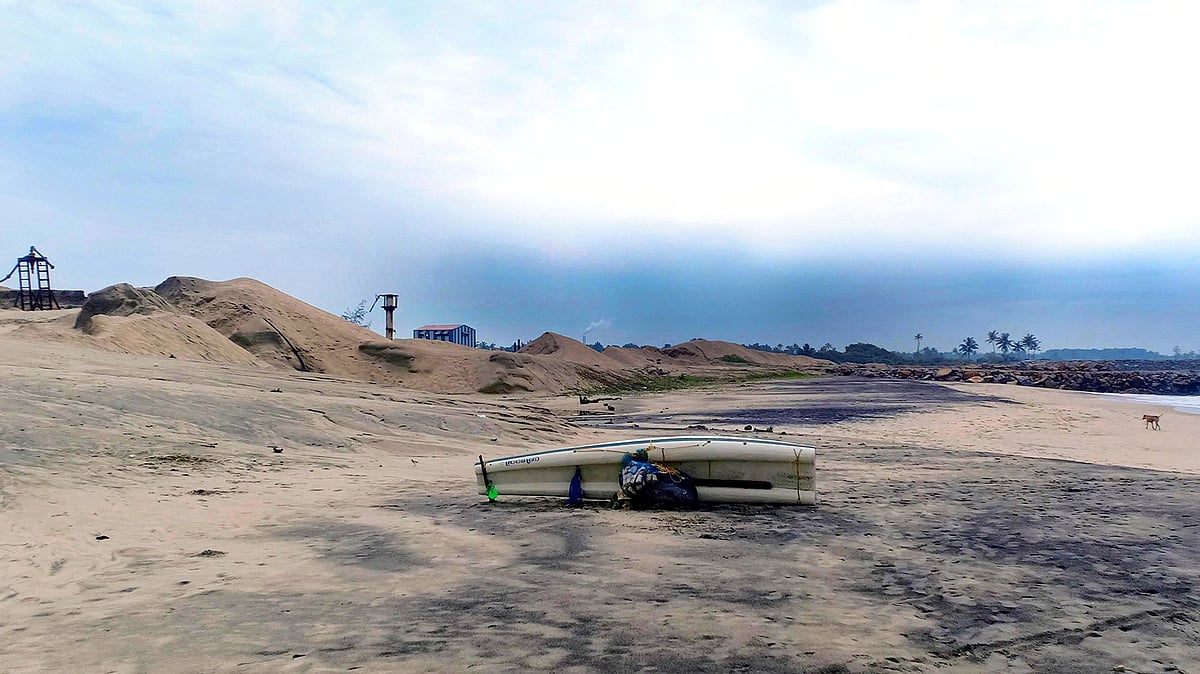
For governments and corporations, these black sands spell enormous wealth and strategic opportunity. For coastal communities, though, they present an entirely different reality — of eroding shorelines, shrinking livelihoods and a protracted battle against extraction projects.
The sands of power
The dark sands that line stretches of Kerala’s coast contain some of the world’s most valuable mineral deposits. Mixed with ordinary beach sand are ilmenite, rutile, zircon, garnet, sillimanite and monazite, minerals that have become indispensable to modern industry.
Ilmenite and rutile are the principal ores of titanium, a metal prized for its strength, corrosion resistance and low weight. Titanium is used extensively in aircraft, spacecraft, missiles, naval vessels and medical implants. Zircon is vital for ceramics, electronics and specialised industrial applications. Monazite, perhaps the most strategically important mineral found in these deposits, contains thorium and rare earth elements.
Thorium has long occupied a central place in India’s three-stage nuclear programme, while rare earth elements are essential for electric vehicles, wind turbines, semiconductors, missile systems and a range of advanced technologies that increasingly define economic and military power.
India possesses one of the world’s largest monazite reserves. The Chavara belt in Kollam district and the adjoining Tamil Nadu coastline constitute one of the richest heavy mineral sand (HMS) provinces in the world. The significance of these deposits has grown dramatically as countries scramble to secure critical minerals needed for clean energy technologies and advanced manufacturing.
China currently dominates global rare earth processing and refining, giving it enormous leverage over international supply chains. Governments in the US, Europe, Japan and India are seeking alternative sources and building new supply networks.
In this emerging contest, India’s coastal mineral wealth has acquired unprecedented strategic value. What lies under the beaches of Kerala and Tamil Nadu is now linked to electric vehicle factories in Europe, semiconductor industries in East Asia, renewable energy projects across continents and defence establishments around the world.
The enormous value of these resources inevitably attracts political and commercial interest. Control over mining leases, processing facilities, transportation networks and export channels translates into economic influence.
For the very same reason, the mineral sands sector is also mired in controversies. Questions of regulatory oversight, political patronage and corporate influence have surfaced repeatedly over the years. The current controversy involving CMRL is only the latest reminder of how closely mineral wealth and political power are intertwined.
The coast that pays the price
While governments speak about strategic minerals and industrial development, coastal communities tell a very different story. For fisher families, beaches are not merely deposits of valuable minerals. They are workplaces, community spaces and protective barriers against the sea.
Fishing boats are anchored there. Nets are repaired there. Fish are landed, sorted, processed and sold there. The beach is not barren landscape; it’s an extension of everyday life. Any change in its nature has direct consequences for livelihoods and survival.
B. Bhadran, leader of the Alappuzha-based Anti Mineral Sand Mining Action Committee (a.k.a. Samiti), says coastal communities are always ignored in discussions about ‘development’.
“Governments see minerals. Corporations see profits. We see our future dis-appearing. Every truck carrying mineral sand away from the coast takes away part of the protection that stands between our homes and the sea. The benefits go elsewhere; the risks remain here. Fishing communities are expected to pay the environmental price for the creation of wealth they’ll never enjoy.”
According to Bhadran, local residents have repeatedly demanded independent environmental assessments, transparent public consultations and real participation in decision-making. But they find themselves confronting institutions far more powerful than themselves.
Kerala’s coastline is already facing a profound ecological crisis. Large stretches of the state’s 590-km coastline are affected by erosion. Villages have watched the sea move closer over the past two decades. Houses have collapsed, roads have disappeared and public infrastructure has been damaged. Thousands of families have experienced repeated displacement.
Climate change and sea-level rise are major drivers of this crisis. But scientists point to the impact of human interventions along the coast. Ports, breakwaters, sea-walls, dredging projects and sand extraction have altered natural sediment movement, affecting the delicate balance that sustains beaches and coastal ecosystems.
Environmentalist Sreedhar Radhakrishnan argues that discussions on mineral extraction cannot be separated from Kerala’s larger coastal crisis.
“The coast functions as a connected ecological system. Beaches and dunes absorb wave energy, buffer storms and protect inland settlements. When these systems are disturbed, the consequences are rarely confined to one location. We are already witnessing the impacts of climate change, rising seas and largescale infrastructure projects. Adding further stress without understanding cumulative impact is dangerous.”
A history of conflict
The battle over mineral sands is not new. It has shaped politics, environmental movements and community struggle across Kerala and Tamil Nadu for decades. Chavara in Kerala’s Kollam district has been associated with mineral extraction for nearly a century. Across the border in Tamil Nadu, the mineral-rich belt extends through Kanyakumari, Tirunelveli and Thoothukudi districts. Together, these regions form one of the most valuable coastal mineral zones in the world.
Yet they have also been the site of some of India’s most controversial mining disputes. The environmental impact of mineral sand extraction is a subject of intense debate. Mining involves excavation, separation and processing of large volumes of coastal sediment. The process alters dune systems, removes vegetation, affects groundwater dynamics, disturbs habitats used by birds, marine organisms and nesting turtles, and makes vulnerable communities living near mining areas.
Monazite introduces another layer of complexity because it contains thorium, a radioactive element. Although authorities maintain that operations are regulated and monitored, activists demand greater transparency in the handling and movement of radioactive minerals.
The demand for critical minerals is expected to rise sharply in the coming decades. The transition to renewable energy, electric mobility and advanced manufacturing will intensify pressure to extract these minerals, with all its attendant consequences.
The ED investigation involving T. Veena may dominate the headlines now, but the bigger question is whether extraction can occur without damaging fragile ecosystems? Can communities participate meaningfully in decisions affecting their future? Can governments effectively regulate powerful commercial interests?
K.A. Shaji is a South India–based journalist who has chronicled rural distress, caste and tribal realities, environmental struggles and development fault lines. More of his writing here
Join our official telegram channel (@nationalherald) and stay updated with the latest headlines