Nation
Manipur: When and how will the conflict end? Two voices, two solutions
Both Meitei and Kukis feel let down by New Delhi's baffling silence. Three years into the conflict, there is still no consensus on the way forward
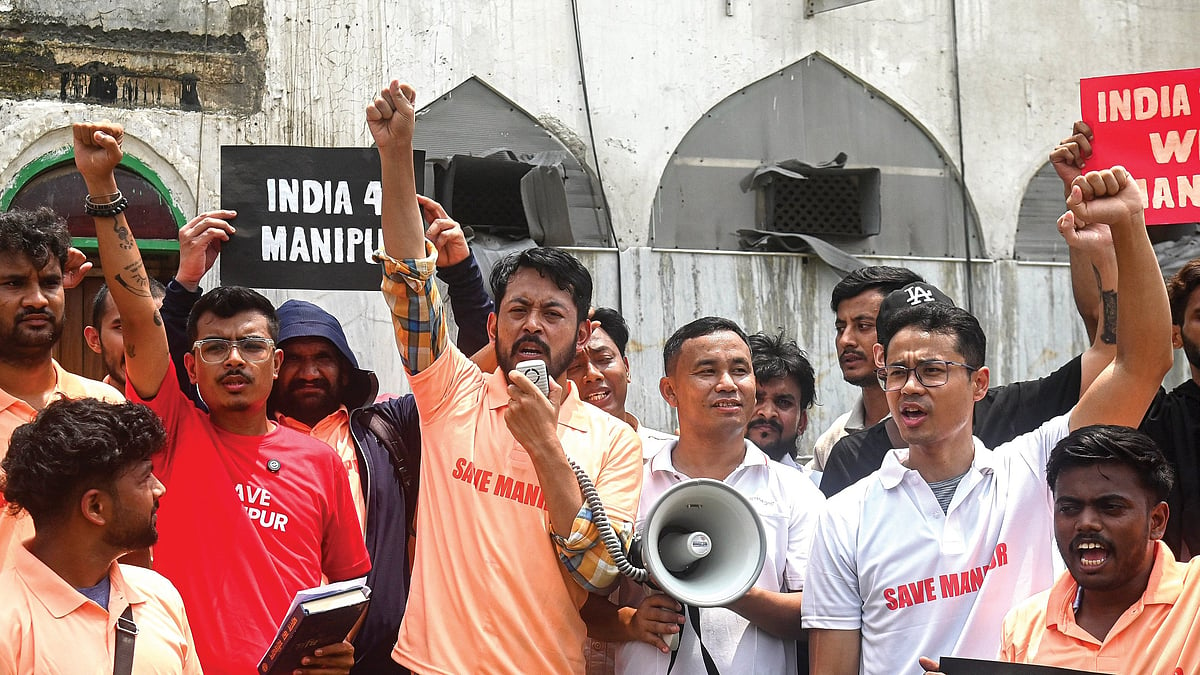
The continued silence of Prime Minister Narendra Modi and Union home minister Amit Shah on Manipur has baffled everyone. Both Meitei and Kukis feel let down by New Delhi. Three years into the conflict, there is still no consensus on the way forward.
According to a Manipur home department report tabled in the state assembly, 28,899 people are in relief camps and temporary shelters as internally displaced persons (IDPs), as of September 2026. Attacks on civilians by armed groups intensified in August–September. In targeted killings over a 30-day period in August–September, 23 civilians were killed in the hill districts, forcing villagers to take refuge in nearby paddy fields and forests.
For Meiteis, the situation has improved in Meitei-dominated Imphal Valley and the trouble is now confined to the hills where Nagas and Kukis reside. Kukis believe Meiteis and Nagas have colluded against them. Meanwhile, Nagas—who share their home and faith with Kukis—are hedging their bets.
“Violence has resurfaced in the hills despite AFSPA being in force. Why is the Suspension of Operation (SoO) agreement with Kuki armed groups not being implemented in the hills?” asked Mayengbam Dhananjay, spokesperson for the Coordinating Committee on Manipur Integrity, an umbrella coalition of major Meitei civil society organisations.
Some leaders with skin in the game see a way out of the current mess. Sourabh Sen spoke to Pramot Singh of Meitei Leepun and to Paolienlal Haokip, spokesperson for Kuki Inpi Manipur, to get their perspective on the conflict. Excerpts from the conversations:
Drug war and Myanmar are the main issues
Pramot Singh, a Meitei hardliner associated with Meitei Leepun, which he describes as a cultural organisation to preserve Meitei values and heritage and which Kukis describe as a Meitei militant organisation with links to the RSS, explains why Modi is showing no interest in settling issues in the state. Both China and the US, he says, are fighting for the resources in Myanmar and Modi’s intervention may complicate the issue. Edited excerpts:
It is a drug war, not an ethnic clash
The conflict in Manipur is a drug war engineered by traffickers manifesting as ethnic conflict. All the drug lords are in powerful political positions. During my UNDP-supported research work in 2006, I found common syndicates, protected by politicians, non-state actors and security forces, running human, drugs and arms trafficking across the India-Myanmar border.
Government failure to persuade Kukis through SoO
There have been two resolutions in Manipur assembly to revoke the SoO with Kukis. Nobody is listening. I recently met a VHP leader who told me that Kukis would support rebuilding mandirs destroyed in violence. If so, why can’t the central government tell Kuki armed groups not to disturb Meiteis?
The local BJP says it was the Congress which introduced SoO. So why can’t the present BJP government repeal it? Nobody—not even the state government—knows who took the decision behind closed doors to extend SoO which is a tripartite arrangement. This is frustrating.
PM’s intervention can turn a local conflict into a geopolitical issue
Then there is the question of geopolitics. The US is interested in the area because it wants to stop China from controlling Myanmar’s energy and critical mineral assets. This is one of several reasons why Modi is quiet on Manipur. His engagement can add geopolitical complications to a conflict which has so far remained local in a sensitive border area.
Partition not the solution
In a Kuki homeland project, Kuki customary laws would be paramount. In Nagalim, all social systems would be under Naga customary laws. Manipur has a tradition of communities co-existing peacefully and respecting one another. That was how our fathers and forefathers protected and preserved this land. This is the only way Manipur can survive. The concept of Kuki homeland cannot work because Meiteis, Nagas and others will not agree. Nagalim cannot work because Meitei, Kukis and others will not agree.
Trifurcate the state, expand the border
Paolienlal Haokip, BJP legislator from Saikot constituency of Churachandpur district and spokesperson for Kuki Inpi Manipur, the Kuki apex body, believes trifurcation of Manipur—a part each for Meiteis, Nagas and Kukis—is the only lasting solution. His other radical suggestion is that India intervene militarily in Myanmar and annex Kuki and Naga-dominated territory across the international border. Edited excerpts:
Hill people must stand together to end discrimination
The Union government—Prime Minister included—is silent over Manipur. However, unless a political solution protecting Manipur’s hill people from developmental bias is found, there can be no durable solution. While a section of Nagas is trying to take advantage of the Meitei-Kuki conflict, the ‘sensible’ Nagas feel that Manipur’s tribal hill community should come together so Meiteis can no longer meddle in our right to govern our own business.
Partition is one way to end the conflict
Trifurcation of Manipur is the only way forward. There may be unrest for a year or so. But it will settle the issue once and for all.
Indian foreign policy needs more teeth
There is a large Naga and Kuki population in Myanmar’s Sagaing division. They are opposed to the military junta. Indian government could explore the possibility of expanding its boundaries. Myanmar will undoubtedly resist such a move; but if we claim to be the largest democracy of the world, we should support the democratic aspirations of the people in Sagaing. India's foreign policy is half-baked as far as the neighbourhood is concerned.
Sourabh Sen is a Kolkata-based independent writer and commentator on politics, human rights and foreign affairs
Join our official telegram channel (@nationalherald) and stay updated with the latest headlines