Nation
Targeting ‘logical discrepancy’?
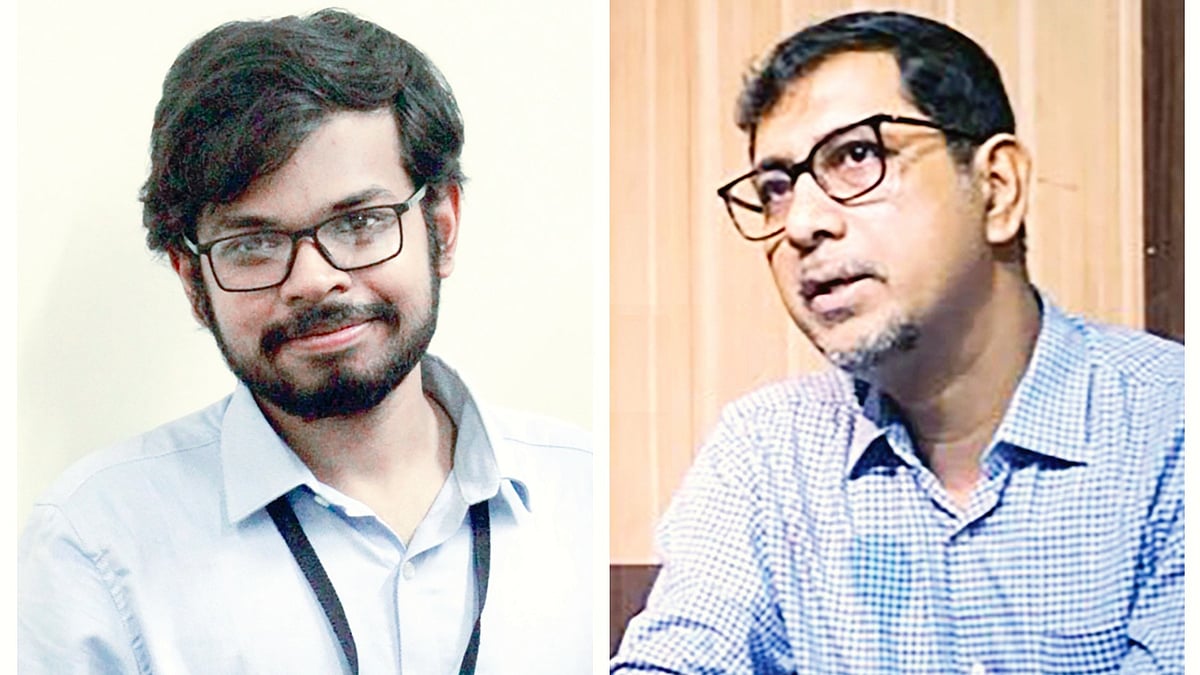
Sabir Ahamad and Ashin Chakraborty of SABAR Institute in conversation with Sourabh Sen on the SIR in West Bengal
A narrow staircase leads to a room on the third floor of an old, decrepit building opposite St Thomas School in Kolkata’s Khidirpur area. An A4-size printout pasted on the door confirms that the staircase leads to the SABAR Institute, a registered trust. ‘Data for better lives’ reads the tagline, spelling out the motto of the organisation.
While SABAR has been engaged in data-driven research for the past decade and more, what has drawn national attention is its work during the last six months on the Special Intensive Revision (SIR) conducted in West Bengal by the Election Commission of India (ECI).
Founded by 48-year-old data researcher Sabir Ahamad, SABAR has a young team. They recall with some amusement the call they received from the office of the chief electoral officer, West Bengal. Was it an invitation or a summons, they joked. Were they going to be arrested?
The team had just released its analysis of the draft list of voters issued by the ECI in December 2025, in which 58 lakh voters had been deleted under ‘ASDD’ (Absent, Shifted, Dead and Duplicate) categories. They were cordially received by ECI officials and its consultants and asked if they would like to collaborate. Officials were also most keen to know how such a young and small team had cracked so much data in such a short time.
It was a fairly simple task, says Ashin Chakraborty, an associate with a master’s degree in economics, though it’s painstaking work. The draft list was in a machine-readable format, and contained all the relevant details including reasons for deletion. Subsequent lists, they found, had firewalls, making it much more difficult for researchers to crunch the data.
Sabir Ahamed, founder of SABAR and an RTI activist with 20 years of experience, describes himself as a “barefoot researcher”. Between them, his team members bring expertise in economics, statistics, computer science, AI, machine learning and large language models. Some are associates, others are interns. A few students and several voluntary researchers round off the team he leads.
When did you notice that the SIR had selectively targeted Muslims?
The draft list of December 2025 with 7.04 crore voters was not suspicious. It had deleted roughly seven per cent of the electorate from the July 2025 list, which is consistent with other states and West Bengal’s population. In Kolkata’s Bhabanipur — Mamata Banerjee’s constituency — around 22 per cent of the electorate were deleted under the ASDD category, including both Hindus and Muslims, who constitute 20 per cent of voters in the constituency.
It was also consistent in Muslim-dominated border districts. In rural Bengal, though, women formed the overwhelming majority among the deleted, showing up as ‘shifted’. The ECI’s software could not map a large number of women after their surnames changed post-marriage.
This consistent pattern flipped after the ECI introduced the ‘logical discrepancy’ category, which flagged 1.32 crore voters who had made it to the draft list after filing enumeration forms, producing documents and mapping themselves to the 2002 voters’ list.
So, Muslims in bordering districts like Murshidabad and Malda were able to map themselves successfully?
Yes. In fact, the unmapped rate in these districts was below the state average and much lower — one or two per cent — than in Kolkata and even North 24 Parganas, a Matua belt, where the unmapped constituted 12 to 14 per cent.
In Kaliachak (Malda), where a mob protesting deletions detained seven judicial officers for nine hours on 1 April, the unmapped rate was 0.58 per cent. Deletions under the ASDD category were possibly higher in Kolkata and its suburbs where blue-collar migrant workers from Bihar and Uttar Pradesh live.
The ASDD data after the first round also did not validate the BJP’s claim about West Bengal’s changing demography due to infiltration from Bangladesh or, for that matter, the state being a hub for issuing fake Aadhaar, PAN and voter cards. Union government data on new and active PAN, Aadhaar and voter cards were also consistent with the trend value of around seven per cent, which is West Bengal’s share in India’s population.
What happened after ‘logical inconsistency’ was introduced?
This led to 60 lakh additional names — over and above those deleted under the ASDD category — being flagged as suspects and put ‘under adjudication’. Our study found that ‘logical discrepancy’ disproportionately affected Muslims.
It is possible, though it is admittedly mere speculation until the ECI furnishes details, that a bias was introduced into the AI software by embedded consultants. We suspect this as most of the ECI officers we interacted with appeared to be digitally illiterate.
The percentage of Muslims deleted jumped to 52 per cent due to ‘logical discrepancy’. In constituencies like Kolkata Port, Metiaburuz and Ballygunge, Muslims make up 80 to 90 per cent of the ‘logical discrepancy’ list. So far, we haven’t found any constituency in West Bengal where the percentage of ‘logical discrepancy’ of Muslim names is less than the percentage of Muslim voters.
Is it possible to cite some examples?
State government employee Mohammad Ayub, for example, possessed all the necessary documents — birth certificate, passport, PAN and Aadhaar card.
He was marked for adjudication because in 2002, he was listed as Ayub Mohammad. He now has to appear before the appellate tribunal since his name was not restored at the hearing stage. The problem is, even on 14 April, less than 10 days before the first phase of polling, these tribunals are not functional.
Do you have reason to suspect that the ECI’s actions are politically coloured?
We deal with data and will not get into politics or psychology. Having said that, several things surprised us, including the level of the ECI’s distrust of state government officers. We were surprised to see the ECI engage thousands of micro-observers.
Also, why would the ECI make it difficult for researchers to access data? The ASDD list could be searched and analysed. For subsequent lists, the ECI resorted to releasing data in scanned PDF format, with ‘Under Adjudication’ stamped across the names. We had to download 8,000–10,000 PDF pages per constituency and manually clean up the overriding stamps before making the data workable.
There also seems to be an unending number of supplementary lists, running up to 17 lists in some constituencies, for deletion as well as addition.
Despite the Supreme Court’s clear instructions, the ECI is yet to release the ‘logically inconsistent’ list. The lists on the CEO’s website seem random, some in English and some in Bengali. Is there a particular reason why the list for Behala in Kolkata is in English but the list for Jadavpur, also in Kolkata, is in Bangla? Why are the lists published in the dead of night? Why do ECI servers shut down the moment the lists are uploaded?
Join our official telegram channel (@nationalherald) and stay updated with the latest headlines