Nation
Varanasi’s phantom 'Bangladeshis': Another migrant scare comes to nothing
On Monday, Varanasi Police stormed a locality to investigate 'Bangladeshis' allegedly living on property linked to a Samajwadi Party leader
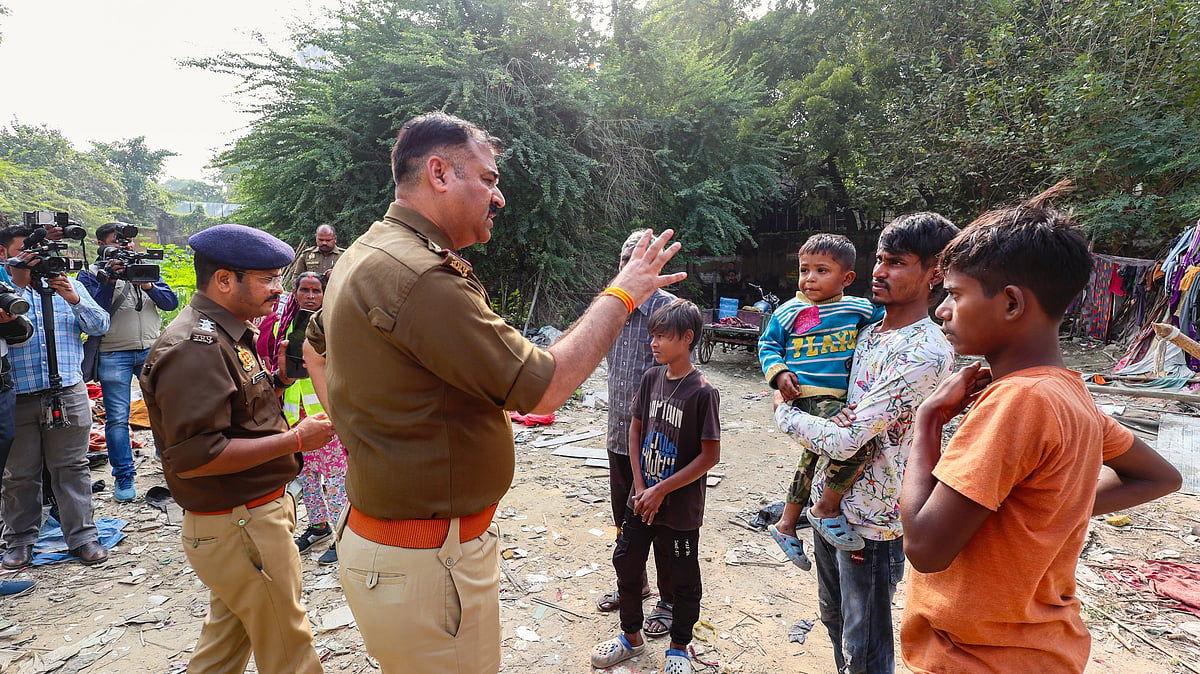
Varanasi Police appear to have joined the race to conjure up crises that evaporate on contact with reality. On Monday, officers stormed into the city's Sigra locality to investigate what had been breathlessly framed as a nest of 'Bangladeshi families' allegedly sheltered on property linked to a Samajwadi Party leader.
It was, in other words, vintage BJP-era political theatre: the familiar choreography of suspicion, spectacle and stern warnings about infiltrators — followed, inevitably, by the discovery that the supposed foreigners were simply Indian citizens trying to get on with their lives.
As one official admitted, almost sheepishly, “During the verification, it was found that the families were originally from West Bengal and have been living in the area for several years.” The disappointment among those invested in the ruling party’s favourite bogeyman — the ever-multiplying “illegal Bangladeshi” or ghuspaithiya — must have been acute.
Deputy commissioner of police T. Sarvan insisted that the operation was part of an ongoing campaign to identify illegal immigrants, including Bangladesh nationals and Rohingya migrants. Acting on instructions from the police commissioner, officers descended on the area after “reports” that 30 to 35 Bangladeshi families were living there. Yet what they found were long-settled Indians whose only offence appears to have been speaking Bangla within earshot of overzealous informants.
The DCP assured that details such as family size, purpose of residence and ID documents were being collected for verification, in what has become a routine ritual for Bengali-speaking residents — more so if they're Muslim — across northern India: prove your citizenship again and again, lest your language land you on the wrong side of political paranoia.
DCP (Kashi Zone) Gaurav Banswal added that the exercise formed part of the seven-day 'Operation Torch' to verify street vendors and slum dwellers. “Verification is being carried out across multiple locations to identify those residing illegally. Action as per law will be ensured,” he said.
One might note, however, that the only 'action' reliably reported in recent months is the targeting of poor internal migrants who sound vaguely foreign to Hindi-speaking ears.
And it is here that the Sigra non-saga intersects disturbingly with a much darker story — one that exposes what can happen when the BJP’s simplistic 'Bangladeshi infiltrator' narrative is applied not just clumsily, but brutally.
Just months ago, in an episode far grimmer than the Sigra farce, a young Bengali-speaking woman — 26-year-old Sunali Khatun from West Bengal's Birbhum district — was arrested in Delhi, accused of being an illegal Bangladeshi, and forcibly pushed across the border. This, despite possessing valid Aadhaar and voter-ID documents. Her crime? Speaking Bangla while being poor enough to be invisible to the state until it needed bodies to fit its favourite storyline.
Sunali was not just vulnerable — she was heavily pregnant at the time of her deportation in June. Yet she, her husband Danish Sheikh, their eight-year-old son, and another family were handed over to the BSF and pushed into Bangladesh with no trial, no credible evidence, and no respect for due process. From there, she was taken into custody and held in a prison in Chapai Nawabganj.
Her own testimony, published in the media after her eventual return, is harrowing: “It was torture.” She described being kept in a solitary cell, terrified, with only her son for company. Her husband was separated from her; she did not know if she would ever see him again. Her pregnancy advanced under conditions unfit for any human, let alone someone who had committed no crime.
It took 162 days, sustained legal pressure, media scrutiny, and finally the intervention of the Supreme Court of India, for the government to hurriedly negotiate her return on “humanitarian grounds”. On 5 December, she was brought back through the Mahadipur border in Malda and immediately hospitalised. Her husband remains stuck in Bangladesh, his fate uncertain.
Sunali’s case made national headlines not because it was an exception, but because it so perfectly illustrated the grotesque excesses of a system where Bengali-speaking equals suspect, and where the state’s eagerness to root out mythical infiltrators routinely devours its own citizens.
Against this backdrop, the Sigra verification drive appears not as an isolated administrative exercise, but part of a wider pattern. A pattern in which:
Bengali-speaking Indians are routinely asked to 'prove' they are Indian
Police act on unverified rumour with disproportionate force
Political narratives of infiltration override common sense
Internal migrants — especially Muslims from West Bengal — are treated as expendable collateral in electoral theatre
The BJP government’s narrative machinery has spent years painting Bengali Muslims as demographic threats, often using loose references to 'Bangladeshis' to blur the line between internal migration and foreign intrusion. The Sigra incident — where decades-long residents are mistaken for foreigners — shows how deeply that narrative has penetrated local policing.
But Sunali’s ordeal demonstrates the far more dangerous endpoint of such thinking: where suspicion becomes policy, and policy becomes persecution. Where a pregnant Indian woman can be pushed into another country, imprisoned, rescued only after judicial intervention — and still have parts of the government insist that the system is working as intended.
Despite all this, one can be certain that the next rumour of 'Bangladeshis hiding somewhere' will produce another raid, another round of headlines, and another opportunity for the BJP to posture as protectors of the realm. Facts, experience, and repeated embarrassments do nothing to slow the machinery. The myth is simply too politically useful.
And so the pantomime continues: the police chase shadows, the government congratulates itself, and ordinary Indians — especially Bengalis — brace themselves for the next knock on the door.
Join our official telegram channel (@nationalherald) and stay updated with the latest headlines