Nation
What are the factory workers fighting for?
Nandlal Sharma reports on the spontaneous combustion of labour agitations across the country
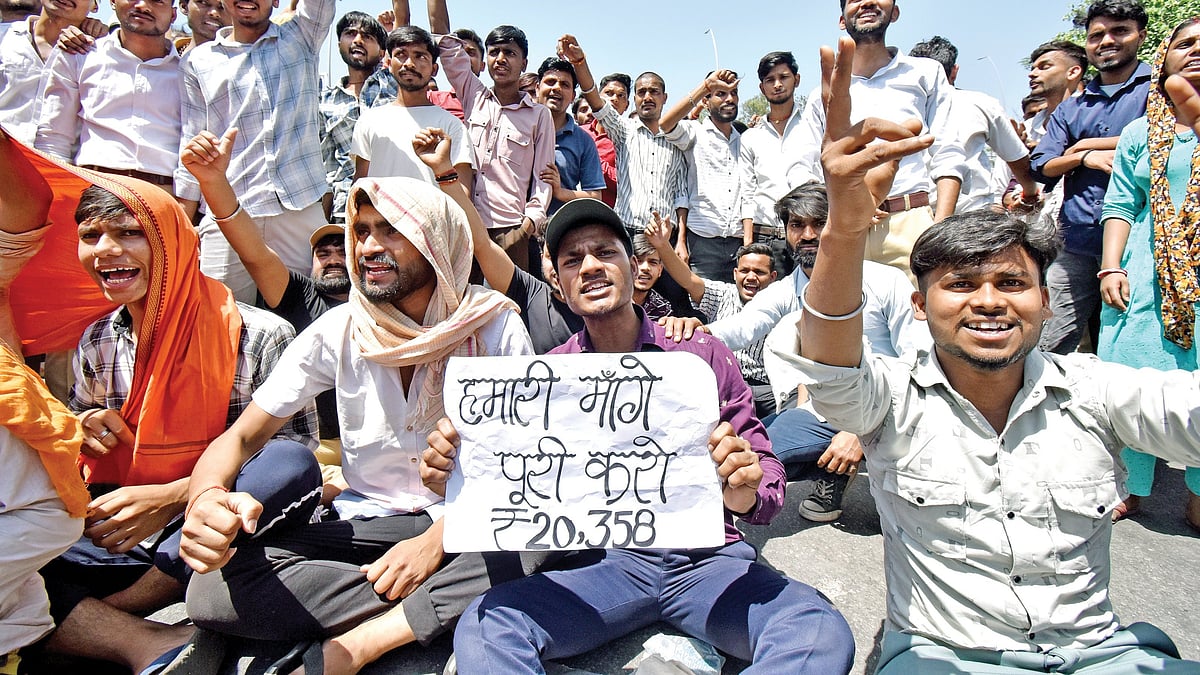
No poster boys, no leaders, no unions. Yet, a wave of protests spread systematically across the country, with millions of workers agitating for higher wages.
The beginning of this uprising can be traced to early February, when contract workers at Indian Oil’s refinery in Barauni (Bihar) demanded their wages be increased, working hours be fixed at eight hours per day, and they be provided benefits such as Provident Fund (PF) and Employees’ State Insurance Corporation (ESIC).
On 23 February, more than 30,000 contract workers at Indian Oil’s refinery in Panipat, Haryana, went on strike. On 27 February, 5,000 contract workers employed by Larsen & Toubro at the ArcelorMittal Nippon Steel project in Hazira, Surat (Gujarat) went on strike.
Between January and March, more than two dozen worker strikes were reported at major power plants and key energy hubs: NTPC Patratu (Jharkhand), NTPC Nabinagar (Bihar), Adani Thermal Power Plant Korba (Chhattisgarh), Vedanta Power Plant Sighitarai (Chhattisgarh), Hindustan Zinc Limited Chittorgarh (Rajasthan), Indian Oil Vadodara (Gujarat), and the Obra Thermal Power Plant in Sonbhadra (Uttar Pradesh).
The first strike in this wave took place on 1 January, when gig workers protested for better working conditions and rights.
In March-April, protests gathered rapid momentum in Haryana, particularly in several companies located in IMT Manesar. These included Honda, Munjal Showa, Satyam Auto Components, Roop Polymers Limited, Richa Global and Modelama Exports. Compelled to concede, management raised salaries from Rs 11,000 to Rs 16,000. While an extra Rs 5,000 may not seem like much, other workers took heart.
Jharkhand AITUC-affiliated trade union leader Anand Kumar says that the protestors are contract labourers from the organised industrial sector (petroleum, energy, automobile, electronics, cement, hosiery). He notes that while the movement is primarily driven by these workers, domestic workers are also joining in.
In this movement, the workers’ biggest weapon has been the mobile phone on which they create and share videos and reels. Their growing awareness stems from their own precarious lives. Labour rights activist Sunand says, “Wherever workers protested, they raised their voices through social media. In this way, workers from one factory inspired those in another to speak up for their rights. They gained confidence: if they can fight, so can we. The fuel crisis that emerged after the Iran war acted as a catalyst with workers forced to migrate.”
Bharti Kumari, who works as a checker at Shahi Exports in Noida Phase 2, says, “We work 12 hours and earn around Rs 12,000. Room rent is Rs 6,000. Petrol is nearing Rs 100 per litre. Gas costs Rs 400 per kg. Electricity costs Rs 10-12 per unit. On top of that, there’s children’s education. Schools ask for both semesters’ fees at once. What are we supposed to eat? Our salary should be Rs 20,000 per month.”
It’s not as if state governments didn’t attempt to suppress the protests. On 7 April, the Haryana government imposed Section 144 across the Manesar-Gurgaon region, banning gatherings of workers. The workers didn’t back down. On 8 April, even larger numbers went on strike. As their struggle intensified, the government began its crackdown. On 8 April, workers in Manesar were lathi-charged. On 9 April, Haryana police arrested more than 50 workers, including over 20 women.
Meanwhile, on 11 April, the Uttar Pradesh police arrested four labour activists from the Botanical Garden metro station in Noida. On 12 April, lawyers Prateek Kumar and Mohammad Tanveer Ali, along with two other activists who had gone to secure their bail, were also detained. Dozens of workers were injured in police lathi charges at various locations.
In Haryana, workers’ wages were last revised in 2015. Ideally, they should have been revised again in 2020, but the state government delayed it for six years. As a result, minimum wages stayed the same. The government formed a committee in May 2025 under pressure. Nine meetings were held, but no notification was issued. Is it any wonder than a workers’ movement should have erupted spontaneously in April 2026?
The strikes forced the Haryana government to issue a wage revision notification on 9 April, setting minimum monthly wages at Rs 15,220 (unskilled) and Rs 19,425 (skilled). Still way below the workers justifiable demand for Rs 25,000–30,000 per month. Following the Haryana government’s announcement, demonstrations escalated in Noida.
After four days, the workers’ patience ran out. On the morning of 13 April, the protest flared into violence. The very next day, the Uttar Pradesh government announced a minimal wage increase. Under this interim decision, unskilled workers’ wages in UP will rise from Rs 13,313 to Rs 13,690. Semi-skilled workers will earn Rs 15,059, and skilled workers Rs 16,868 per month.
A press release by the Uttar Pradesh government stated that the industrial sector is currently facing global and economic challenges, with rising input costs and declining exports. On its heels came a statement from Medha Roopam, the district magistrate of Gautam Buddh Nagar, saying that if outsourcing agencies (read contractors) and their workers engage in disruptive or violent behaviour, the agency will be blacklisted and its licence cancelled.
Renowned economist Prof. Arun Kumar points out some important details: “In our country, unemployment is extremely high, and 94 per cent of people work in the unorganised sector. On top of that, real inflation is very high, and the ‘real income’ of workers is falling very rapidly. If your salary remains the same while inflation rises, your real income falls — that is, your purchasing power declines.
"That is exactly what is happening today. Workers’ wages are not increasing, but inflation is rising, so they are unable to meet their needs. Due to weak bargaining power, workers cannot demand that their wages be increased in line with inflation. Another issue is that even the organised sector is increasingly hiring contract workers instead of permanent ones. Contract workers are not unionised, so they cannot fight collectively. That is why sudden protests are being seen in places like Gurugram and Noida — indeed across the country — because everyone’s problems are similar.”
A significant point is that the definition of a factory has been changed under the new labour codes. Earlier, the law applied to factories with 10 workers (with electricity) and 20 workers (without electricity). Now, these thresholds have been increased to 20 and 40 respectively. This means many small factories will fall outside the scope of the law. Once a factory is outside the legal framework, no one will monitor whether workers are working 8, 12 or 14 hours.
A similar situation exists with contract labour. Earlier, contractors supplying 20 or more workers had to obtain a license. Now, this limit has been raised to 50. If a contractor supplies 48 workers, no license is needed. Without a license, the law does not apply — there is no guarantee of minimum wages, no EPF, no safety responsibility and no fixed working hours.
General secretary of the All India Trade Union Congress (AITUC) Amarjeet Kaur says, “The government claims it wanted to end ‘inspector raj’ and replace it with ‘facilitators’; while trade unions argue that the new labour codes push workers towards near-slavery. This can only increase industrial unrest.”
Since November 2025, the BJP and the Bharatiya Mazdoor Sangh have consistently promoted the idea that the four new labour codes passed by Parliament under the Modi government are in the workers’ interests.
Jaybhagwan, Haryana general-secretary of the Centre of Indian Trade Unions (CITU), says, “This was the official propaganda. The unofficial propaganda was that from 1 April, everyone’s salary would increase, everyone would become permanent, and everyone would receive full benefits. Unskilled workers expected their lives to change from 1 April — that did not happen. Workers may not be talking about the labour codes now, but ultimately that’s what they’ll be fighting against.”
Join our official telegram channel (@nationalherald) and stay updated with the latest headlines