Opinion
Babri demolition: The ‘accident’ that changed India
L.K. Advani, the man credited with turning the Babri Masjid into a political issue, wasn't always so keen on it. So how did he strike gold?
On yet another 6 December, one feels obliged to write about the most seminal movement in modern India and one that transformed our politics forever. Forty years ago, the BJP had plateaued winning 7 per cent of the vote in 1984 and only two Lok Sabha seats. When L.K. Advani took charge in 1986, he had never been a participant in electoral politics. His entry into politics came after time spent as a journalist in the RSS magazine, where he wrote film reviews.
As a politician, Advani had always been a nominated member, whether in the Delhi Council or in the Rajya Sabha. He had no experience of political mass mobilisation and, going by his autobiography (My Country, My Life, published in 2008), does not appear to know how it worked.
The Ayodhya issue had actually been launched by the non-political groups inside the RSS, led by the Vishwa Hindu Parishad. In February 1989, at the Kumbh Mela in what was still Allahabad, the VHP said it would lay the foundation stone for the temple in November. This would involve the making of bricks across the country with Ram’s name embossed on them and their being carried in processions through towns and villages to Ayodhya in November.
Until this time, Advani writes in his autobiography, it was not an issue in mainstream politics. In June 1989, at the BJP’s national executive meeting in Himachal Pradesh, Advani threw the party behind the issue. The BJP resolution demanded that the site ‘should be handed over to the Hindus’ and ‘the mosque built at some other suitable place’.
Elections came a few months later, in November 1989. The BJP’s manifesto now made its first reference to Ayodhya: ‘By not allowing the rebuilding of the Ram Janma Mandir in Ayodhya, on the lines of Somnath Mandir built by the government of India in 1948, it has allowed tensions to rise, and gravely strained social harmony.’
It was a violation of the BJP’s own constitution, which on its first page and opening articles pledged it would bear true faith and allegiance to the principle of secularism.
A few days before voting, the VHP brought all its processions from across India to Ayodhya and laid the foundation stone next to the mosque. Powered by its divisive, anti-Muslim demand, Advani’s BJP won 85 seats, four times as many as the Jana Sangh in the last election it contested alone and more than 40 times as many as Vajpayee had delivered in 1984.
Advani became the most successful political leader from the RSS, one who had found the recipe for electoral success. He began to invest more in the issue that had fetched the dividend. The Congress lost its majority in the election, and a coalition led by V.P. Singh took power with support from Advani, though for only a short period.
Three months after the election, in February 1990, the VHP resumed its mobilisation against the mosque and said it would continue the process of what it called kar seva from October. The political escalation, according to Advani, happened by accident.
Advani writes in his autobiography that in June, he was to visit London. Just before he left, he was interviewed by the RSS journal Panchajanya and asked what would happen if the government failed to resolve the Ayodhya matter. Advani said the BJP supported the decision to begin kar seva on 30 October, and if stopped, it would lead a mass movement.
‘Frankly, I had forgotten about this interview,’ Advani writes, when his wife telephoned him and asked, ‘What have you said? The papers here have reported it with blaring headlines: “On Ayodhya, Advani threatens the biggest mass movement in the history of independent India”.’ Advani adds: ‘The die had been cast.’
After this, Advani says he offered the Muslims a deal. If they would hand over the Babri Masjid, he would ‘personally request’ the VHP to not campaign against two other mosques in Mathura and Varanasi. He writes that he was ‘deeply disappointed’ and ‘annoyed’ that this was not considered to be satisfactory by the Muslims.
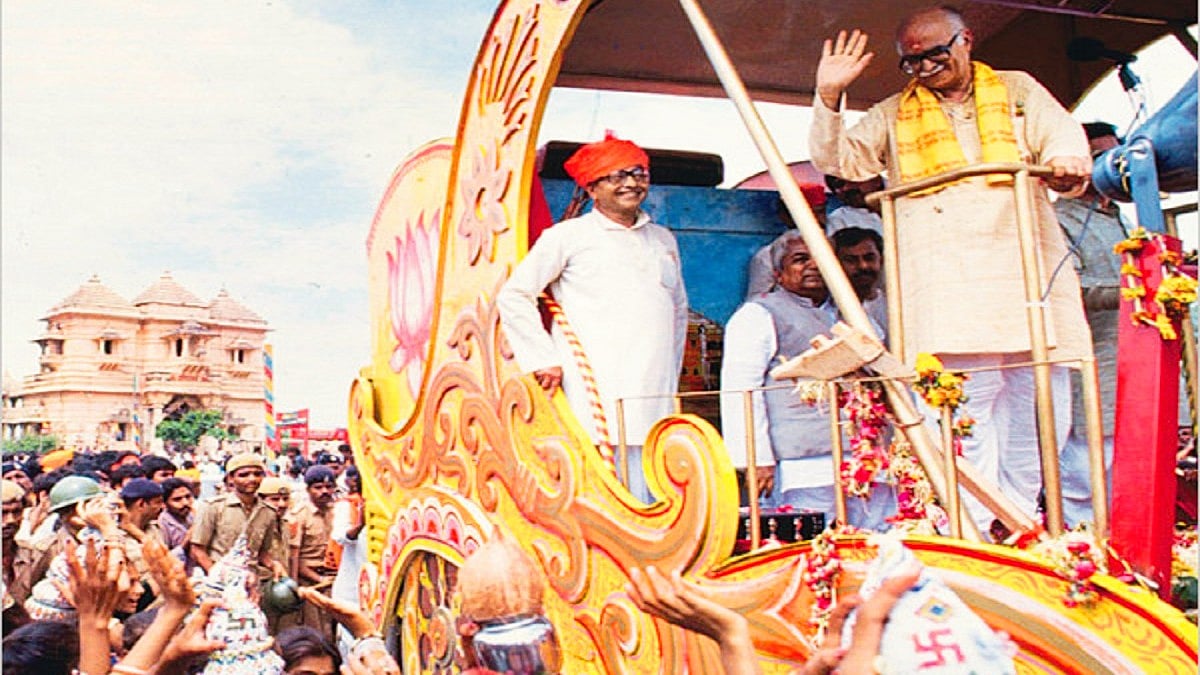
He announced he would begin his campaign against the mosque on Deendayal Upadhyaya’s birthday, 25 September, in Gujarat, and ride a ‘chariot’ (actually a truck) to Ayodhya on 30 October 1990.
Advani writes that he was astonished by the frenzied response his campaign received. ‘I had never realised that religiosity was so deep-rooted in the lives of the Indian people,’ he said, adding that it was the ‘first time he understood the truth of Swami Vivekananda’s statement that “religion is the soul of India and if you want to teach any subject to Indians, they understand it better in the language of religion”.’
At each stop along the way of his chariot yatra, Advani was talking about why the Babri Masjid had to be taken down, using the vocabulary and metaphors of religion, in basic speeches that he says were no more than five minutes long. The reduction can only be imagined; the consequence was predictable.
The scale of the violence unleashed by Advani’s decision to politicise a communal issue and mobilise on it was staggering in terms of both the number killed and the geographical spread. Over 3,400 Indians died in the violence triggered by Advani’s anti-Babri Masjid campaign, but it brought the BJP to the doorstep of power.
In the general elections held in mid-1991, the BJP won 20 per cent of the vote and 120 seats. In the first election held after the demolition, in 1996, the BJP rose to 161 seats. After 2002, the BJP cemented its position as the only party enthusiastic about, and willing to pursue, divisive politics, and it has been rewarded handsomely for this.
Views are personal. More of Aakar Patel’s writing may be read here
Join our official telegram channel (@nationalherald) and stay updated with the latest headlines