Opinion
BJP’s promised ‘Poriborton’ remains elusive in West Bengal
Three months after ousting Mamata Banerjee, BJP’s growing assertiveness and fading outrage over crime and violence are the only visible changes
Separate incidents of extreme violence in West Bengal in recent weeks have resulted in the death of a young man from Kerala who was lynched by a mob, the death of a man who intervened to protect his son from a mob, the death of a Trinamool Congress worker in police custody, and yet another death in a “police encounter”. This deeply disturbing and growing list of incidents in a state notorious for post-poll political violence points to the failure of the new BJP government to address the safety concerns of political rivals and ordinary citizens alike.
The state’s failure to intervene and stop violence has become so routine that the Bharatiya Janata Party has barely reacted to Communist Party of India (Marxist) state secretary Mohammad Salim’s description of the new ruling dispensation as the “Bharatiya Goonda Party”. Salim made the remark following the death of Sheikh Mohammad Mafik, who intervened when his son, Abdul Hafiz, was allegedly assaulted by a large group of BJP workers. Hafiz, a volunteer with the Cockroach Janata Party, had joined the “School Theek Karo” campaign and visited the local village school as part of an audit. According to CPI(M) leaders and Ashutosh Ranka, who visited the village, local BJP leaders cautioned Hafiz and allegedly abused him, calling him “Pakistani”, “Atankvadi” (terrorist) and other names.
The account of the violence is corroborated by eyewitnesses and Hafiz’s mother, Hasina Bibi, a thin and frail woman who wants her son to continue fighting for the rights of the village people. “A world-class school in my father’s name” is the only compensation Abdul Hafiz wants from the West Bengal government, rather than the routine cash compensation and promise of a precarious government job.
Even as Ranka and his team were speaking to the family, chief minister Adhikari and the police were hard at work on social media, seeking to minimise the violence. Blood pressure, fever, illness and minor injuries were cited as possible causes of death. The state government also announced a Criminal Investigation Department probe into the death in police custody of Birju Koet at Halishahar in North 24-Parganas on 8 August. Koet had been arrested after police allegedly received complaints of corruption and abuse of power against him. The chief minister sought to contain the fallout by visiting the deceased’s family and acknowledging that the death had occurred inside a police station.
At the same time, multiple cases of rape and rape-murder involving women and girls have been reported across the state, along with the unexplained death of a nurse on 12 August while on duty at Nilratan Sircar Medical College and Hospital. These incidents have not stirred the state’s famously sensitive public to the same extent, partly because the BJP government has cracked down on street protests. Public criticism of the government, demonstrations, expressions of outrage and demands for accountability are also less vocal and forceful than they were under Mamata Banerjee.
A state known for its relatively safe public spaces also saw a young man tied to a lamppost and brutally beaten by a mob in South 24-Parganas. Sandip Naik, from Mangalapuram in Kerala, was targeted after he lost his way and, unable to speak Bengali, could not explain to locals in Sankijahan what he was doing there. Xenophobic locals grew suspicious of him, accused him of theft and molesting a pregnant woman, and brutally assaulted him for being an outsider. Police learnt of the incident through social media after videos of the assault went viral.
An FIR has been lodged, investigations are underway, but the final outcome is still unknown, because public and political attention have wandered away. Even Opposition leaders who initially reacted by describing the incident as ““extremely shocking” and clubbed the death as part of the malaise of “hatred and violence” in BJP governed states,have not pursued the case. The death of a suspect, Prabhash Mondal, in police custody following an “encounter” after he attempted to flee having snatched a revolver from the police, for his involvement in a gang rape and murder of a 12-year-old girl in Baruipur, in South 24-Parganas, was briefly titillating but is now forgotten.
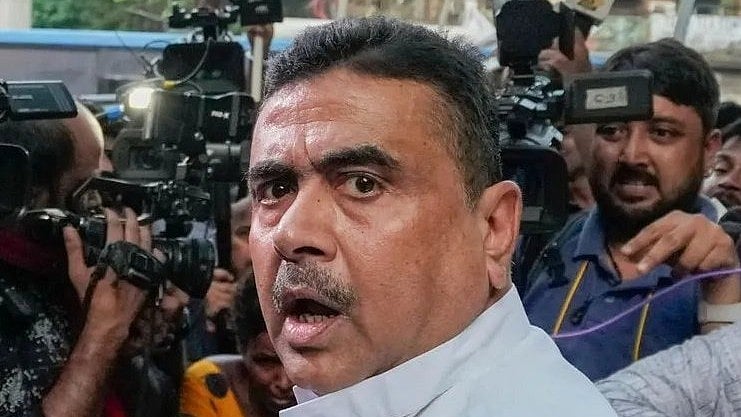
Suvendu Adhikari, abrasive at most times, wagged his fingers and declared in stentorian terms "More than 200 people have been identified in video footage; I will put all of them behind bars under the Goonda Act. The government will also recover the cost of the property damage caused.” There is a glaring gap though between Adhikari’s claim and reality – the Goonda Act to which he refers is not as yet the law of the land; it awaits presidential approval and gazette notification.
BJP’s state leadership has also normalised violence against anyone associated with the Trinamool Congress, from its local level workers to its leadership as legitimate “public anger” and not “revenge.” The party’s former state president and currently a minister in the Adhikari government, Dilip Ghosh, has descibed “egg attacks” on Trinamool Congress leaders as “egg therapy”. The party has been emboldened by the comment of a Supreme Court justice who taunted MP Mahua Moitra why being in politics she was afraid of eggs.
The connection between crime and politics and the invariably dubious performance of the police remains exactly the same as it was before the advent of the double engine sarkar and BJP’s spectacular election triumph on 4 May. Police have behaved just as before, underplaying the extent of violence and speedily push the crimes into the darkest, deepest pit, far from the public gaze. The speed with which the BJP as a party and the double engine government of Adhikari have succumbed to the practices of the past raises questions.
One explanation could be BJP state president Shamik Bhattacharya’s acknowledgement that the habits of corruption and abuse of power have been quickly acquired by BJP workers and office bearers, including local leaders. Bhattacharya was compelled to expel some 30 workers/office hearers of the party and suspend another 200-250 low level workers for extortion (tola baji), syndicate raj, mafia capture of mined minerals -- doing exactly what the Trinamool Congress did. Former state party president Dilip Ghosh too admitted “Many of our leaders have developed a taste for the honey of extortion. There is no reason to think this culture will disappear overnight. Those involved in political violence with BJP flags will be expelled.”
The BJP also admits BJP functionaries have developed “links with promoters”, in other words learnt the ropes of managing syndicates and extortion or tola baaji networks, established links with police officers, meaning learnt to abuse power and acquire immunity for tresspasses of the law by them and their associates.
Regime change, therefore, appears cosmetic. Walls are being painted lurid saffron, the visibility of fluttering Bhagwa Dhwajs has increased, and Calcutta University has hosted a seminar on “Commemorating August 1946 Calcutta Massacre”, where attendance was virtually made mandatory and governor R. Ravi delivered a perilously hate-filled speech that went largely unnoticed and unreported by the media.
Join our official telegram channel (@nationalherald) and stay updated with the latest headlines