Opinion
Is the Republic stronger or weaker than before?
From voting rights and protests to federalism and judicial evasion, Constitutional values are increasingly under strain
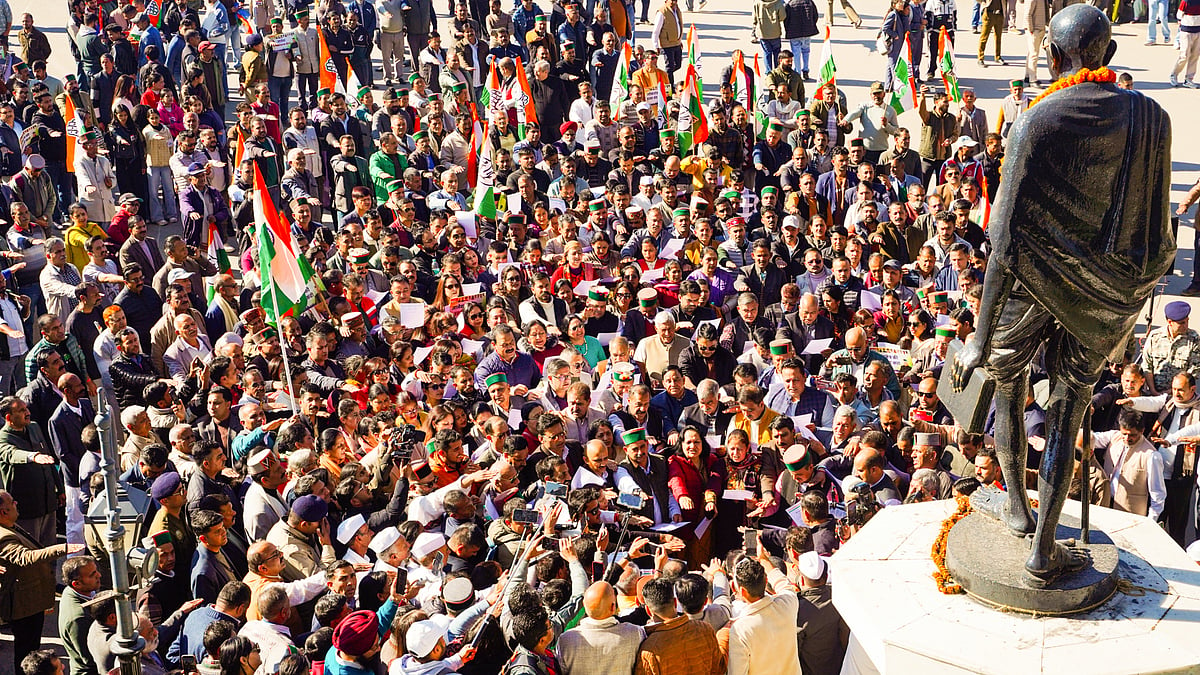
On Constitution Day, observed on 26 November to mark the adoption of the Constitution in 1949, another year saw the Preamble read aloud, reiterating that India is a secular, socialist and democratic Republic and pledging to secure for all its citizens ‘Justice, Liberty, Equality and Fraternity’.
Against the backdrop of defections by MPs and talk of a fresh delimitation Bill, official events applauded the ‘robust’ constitutional guardrails, while the Opposition protested the severe erosion of those very values. Very little of the constitutional spirit — secularism, equality and freedom — remains, they complained, as an autocratic government finds loopholes in the law to sabotage the Constitution.
A secular Republic on paper, in practice the country now resembles other ethnostates, a Hindu rashtra like the Islamic republics or the Jewish state of Israel. Citizens still enjoy the freedom to practise their religion, but Muslims find it increasingly difficult to stop and offer Friday prayers in parks and public spaces.
The state turns away when vigilante groups assault Muslims offering prayers in an airport or a mall. Muslims praying inside a home were arrested by the police in Uttar Pradesh; Hindus, in contrast, are allowed a free run of the streets for religious events, and UP police actually shower rose petals from helicopters on kanwariyas in the month of Shravan.
Some of the systematic assaults on the Constitution, getting normalised by the day, are therefore worth pondering.
The right to vote
Universal adult franchise guaranteed to every citizen no longer exists. People have lost their right to vote simply because one government document spelt someone’s name as Mohammed while another document took the short cut to spelling it as Md.
The homeless, and generally the undocumented poor, theoretically still have the right to vote. Not in practice, though. The Special Intensive Revision (SIR) of electoral rolls has disenfranchised approximately 13 crore citizens. Some of their names may eventually be restored, but millions of voters are more than likely to lose the right, as voters in West Bengal have already discovered to their chagrin.
Deleted voters in West Bengal have been refused renewal of their passports. They have been denied domicile certificates, access to the public distribution system and benefits of welfare schemes. Students have faced difficulties in securing admission because their names did not appear on the error-ridden electoral rolls; farmers have been asked to prove their citizenship first before being allowed to buy fertiliser or land.
Driving licences have not been renewed, and people have been barred from purchasing motorcycles in border districts. Migrant workers, students, elderly persons, persons with disabilities, women with little or no literacy or education, and the poor have been purged as voters, never mind the mandate for universal suffrage in our Constitution. The mayhem continues under the watch of the Supreme Court.
Pay to protest
Protests have not ceased, but protesting even on social media now comes with a price. Arrests, detentions, police brutality, summonses to the police station, the pressure to sign peace bonds, and imprisonment without trial are becoming the norm. Protests have also been invisibilised in the media, especially TV channels.
Protesting farmers were stopped from entering Delhi and camping at the same Ramlila Maidan designated by Delhi Police as a protest site. Protesters would also need to pay to use the protest sites — Rs 100,000 or more per day.
Protests have not stopped, though. They have forced the government and Supreme Court to revise and rescind their decision on mining in the Aravallis. IAS officers have resigned over the decision to reduce, by an executive fiat, the statehood of Jammu and Kashmir.
Protests against the Ken-Betwa river interlinking, the Pathalgadi movement, the long marches to Mumbai by farmers, protests in Manipur against the state’s failures to contain violence and resolve the ST status issue, protests by tribals in Assam, protests against the Siang dam in Arunachal Pradesh, the ongoing Niyamgiri and Kondha anti-mining agitations, and protests against the Great Nicobar project are rarely reported or seen. Thousands of underpaid factory workers and gig workers protesting in NOIDA and in Manesar near Gurugram were violently dispersed, and many put in jail.
Police action in JNU, Jamia Millia and Aligarh Muslim University, to cite just three campuses, has had a chilling effect on other campuses. The right to assemble and protest peacefully exists on paper, but on the ground, it is increasingly difficult to do so.
Judicial evasion
The highest court in the country has increasingly been ‘deciding cases by not deciding’, as constitutional expert Gautam Bhatia puts it. The evasion entrenches the status quo, which often benefits the executive. By refusing to grant a stay on contentious issues, the court has allowed the government to have its way.
Aadhaar was first challenged in 2012. It took six years for the court to finally hear the case. The challenge to the law that confers complete control over the appointment of election commissioners on the government has been pending since 2023. The court has not had time to hear it. The constitutional challenge to the 2019 UAPA amendments, including the power to designate individuals as terrorists, remains a contested subject. The state has invoked UAPA — designed to combat terrorism — against critics and dissenters.
The court evaded hearing the challenge to the abrogation of Article 370 for more than four years after the events of 5 August 2019. Multiple habeas corpus applications following 5 August 2019 became infructuous, with the victims complaining that they were effectively under house arrest and the state claiming they were not because there were no written orders.
Earlier this month, Ladakhi educationist-activist Sonam Wangchuk was ‘advised’ to stay at home, prevented from going out, but told that there was no written order to keep him confined to his house.
The decision striking down the electoral bonds scheme came after six years, by which time extensive money had been collected and two general elections had taken place. The court also heard the challenge to the SIR of electoral rolls in Bihar for 10 straight months, allowing the SIR and the subsequent election to be held even as it heard the challenge.
Federalism weakened
Jammu and Kashmir was under President’s Rule and its elected Assembly in suspended animation when Parliament reduced the state to a Union Territory in August 2019. The Supreme Court upheld the decision in 2023 in a contentious judgment in which it emphasised that elections be held and statehood be restored; despite assurances by the government before the Supreme Court, statehood has not been restored yet.
Elections were held, but not before a state-mandated delimitation of constituencies, which cannot be legally challenged. The government is now seeking similar rights to delimitation in the entire country, which would allow gerrymandering on a scale never seen before.
In the absence of any Constitutional mandate for the Central government to consult states before taking decisions affecting them, federalism and states have weakened. Unlike before 2017, states cannot change GST rates for most goods and services. They depend upon the Centre for devolution of taxes and cannot stop the Centre from collecting cess and surcharges which are not shared with them.
Central schemes come with strings attached, often requiring Opposition-ruled states to conform to colour codes, carry images of the prime minister and name schemes after him. Tamil Nadu frequently cited the withholding of education-related funds under Samagra Shiksha because of its refusal to adopt aspects of the National Education Policy and the three-language formula.
The role of governors as political players in Opposition-ruled states and obstructing legislation passed by elected state Assemblies has become a pressing concern. Unelected governors are often frustrating the legislative will, and the President is often sitting over Bills referred for opinion and consent.
The use of Central agencies against political rivals has increased. Another recurring concern is increasing Central interference and encroachment in areas Constitutionally assigned to states, particularly education, health, agriculture, policing and local governance — all part of the State List but increasingly shaped by Centrally designed schemes, regulations and standards.
Earlier this month, the government of India denied entry to over 100 international invitees to the second Bharat Summit in Hyderabad. They had all been cleared by the ministry of external affairs, which would not have given the clearance without taking the ministry of home affairs (MHA) and the Intelligence Bureau into confidence. Yet the visas were denied and, in some cases, those issued were withdrawn.
Days before Constitution Day, Saurav Das, one of the co-founders of the Cockroach Janta Party, was refused permission to travel to the UK to deliver a talk at Oxford University.
None of this speaks well of a mature and stable Republic.