Opinion
From pellet guns to propaganda: What the Chauhaan teaser leaves out
The film calls pellet guns 'limited force'. The record from Kashmir tells a starkly different story, writes Aakar Patel
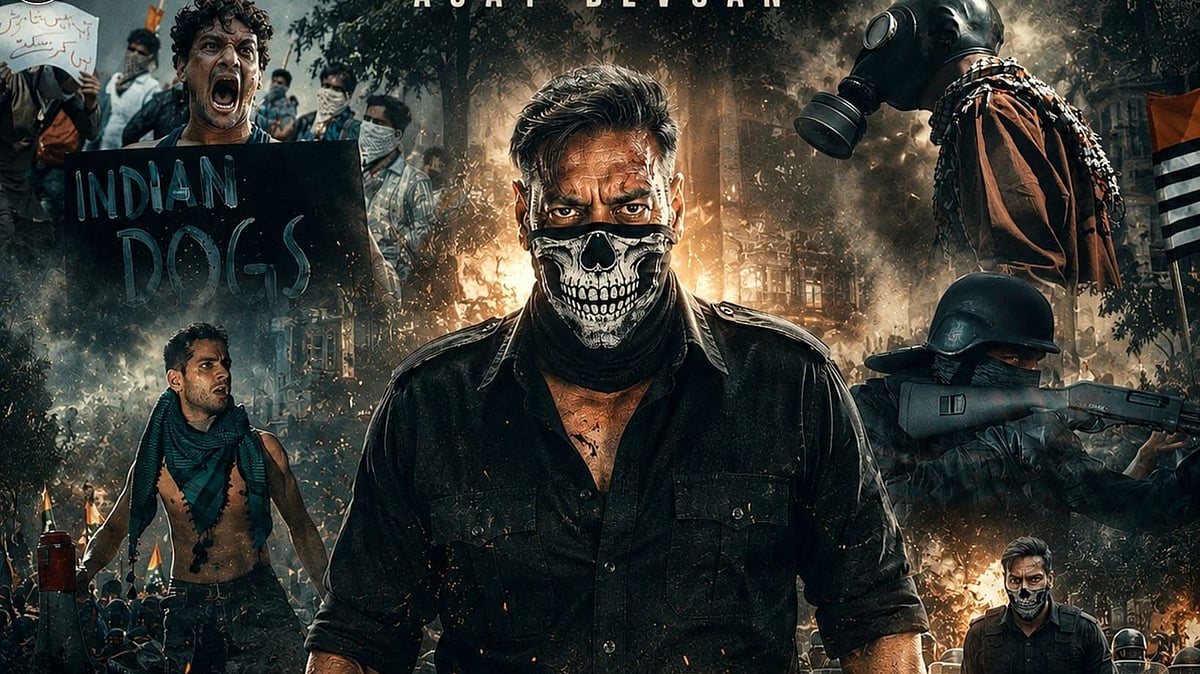
The teaser for Chauhaan — the latest in a line of films selling majoritarian propaganda — is out. It opens in the sort of place the Indian government prefers its stories set: a street in Pulwama, stones in the air, security forces in formation.
The voiceover calls tear gas ineffective because protective masks are easily accessible online. Water cannons are dismissed as temporary solutions. What is required, the film insinuates, is something harsher: 12-gauge shotguns firing birdshot into crowds.
We should pause here.
Narrative-building for majoritarianism in India now runs on the confidence that such claims are never checked. So let us check.
In 2017, Amnesty International India documented 88 people whose eyesight was damaged by shotguns fired by the Jammu & Kashmir Police and the Central Reserve Police Force between 2014 and 2017. Some recovered; many did not.
A single cartridge scatters between 360 and 600 metal pellets, with no way to govern where they land. The injuries caused by pellet guns are indiscriminate by design: shotgun barrels are not rifled, and there is no control over their projectiles.
That is evident from the fact that 14 of the 88 people we spoke to were not protesters but women hit inside their own homes. Security personnel themselves have been treated for injuries caused by weapons fired by their colleagues, so dangerous is their use.
And then there was Insha Mushtaq, a 14-year-old girl who, on the evening of 11 July 2016, opened a window in her village in Kashmir to look at the street. She never saw the street — or anything else — again. She was left completely blind. Her doctors called it the worst case they had ever seen.
The state's official data says 6,221 people were injured between July 2016 and February 2017, with 782 sustaining eye injuries.
The United Nations human rights office called the pellet shotgun "one of the most dangerous weapons used in Kashmir" and recommended its removal from India's arsenal for crowd control. When the Indian government was asked why it fired into the faces of children, it declined to answer, citing national security.
Clearly, "limited damage" is not a description the evidence can bear.
The Chauhaan teaser's complaint that limited force produces no results is equally untrue because, in Kashmir, there has never been restraint by the government or any shortage of force. The region's condition today reflects what more than three decades of force have wrought.
A government that answers one violation with another, graver violation does not earn trust; it forfeits it.
Protesters take to the streets because the doors of Parliament have been shut to them. And this is not just in Kashmir.
The Indian government's Pre-Legislative Consultation Policy adopted in 2014 requires all draft laws to be opened for public consultation for 30 days. Yet, according to PRS Legislative Research, of the 301 Bills introduced since 2014, 227 underwent no public consultation at all. Of the 74 that were published, at least 40 fell short of the prescribed 30-day consultation period.
The 'mother of democracy' will not discuss family matters with the family.
There is further evidence that we are a parliamentary democracy only in name. The share of Bills referred to standing committees has fallen from 71 per cent before 2014 to below 20 per cent since.
In December 2025, the government was asked whether it monitored implementation of the consultation policy. It replied that it had never evaluated the policy and kept no record of who complied with it.
Increasingly, the government's most problematic directives do not arrive as laws but as rules and advisories drafted by the executive without legislative scrutiny, let alone public consultation.
The state needs reminding that a country cannot keep calling itself a democracy while hollowing out the word one law, one rule and one advisory at a time.
In the process, the government has assembled a working dictionary: the dissenter is 'anti-national', the activist an 'urban Naxal', the protester an 'andolanjeevi', the reporter a 'presstitute', and the boy at a funeral a 'stone-pelter'.
Once these words seep into the public consciousness through propaganda, the state's actions no longer require a defence.
A film teaser that recasts a maiming weapon as an example of heroic restraint is not breaking with that dictionary. It is reading fluently from it, in a medium built to manufacture assent.
To look at a girl who was blinded simply for looking out of a window and call it "limited damage" is not strength. Quite the opposite.
When the Amnesty report was published, I went with my colleague Raghu to meet the then head of Kashmir Police, S.P. Vaid, who is quite active on X these days.
The police headquarters in Srinagar — and the ethnicity of the officials manning it — was revealing, though I will write about that another time.
Vaid was hospitable as he accepted a copy of our report. He listened as we presented our findings on the damage caused by police firing pellet shotguns at protesters. He did not dispute the findings, but he could not see why the weapon should be discontinued.
"It is a weapon that is not used for crowd control anywhere else in India," I said to him. "It should be," he replied.
Views are personal. More of Aakar Patel’s writing here
Join our official telegram channel (@nationalherald) and stay updated with the latest headlines