Opinion
‘Third World’ or not, that is the question
The question about India’s ‘Third World’ status has expectedly pitted those aligned with the right-wing against civil libertarians
US President Donald Trump’s 27 November announcement on Truth Social that he’ll suspend migration from ‘Third World countries’ — made after an Afghan national shot at two National Guard soldiers (one of whom later died) in Washington the previous day — has triggered speculation on whether India too is on Trump’s radar besides a raging debate on whether India fits that description.
India has a lot at stake: it consistently secures the maximum number of the coveted H-1B visas and has recently overtaken China to become the largest source of international students in the US.
The US Citizenship and Immigration Services estimates that over 72 per cent of the 380,000 H-1B visas issued in 2023 went to Indians, largely for jobs in STEM fields that fetch them an average yearly salary of $118,000. Trump’s policy amending H-1B rules has, however, already affected India.
The National Foundation for American Policy disclosed that the top seven India-based IT companies got only 4,573 H-1B applications approved for new employment in FY25, which is 37 per cent fewer than in FY24 and a 70 per cent drop since 2015.
According to the Institute of International Education’s ‘Open Doors 2024 Report’, more than 331,000 Indian students — compared to around 277,000 from China — enrolled at American universities for the academic year 2023–24, accounting for nearly a third (29.4 per cent) of the 1.1 million international students in the US.
While its 2025 report shows a significant drop in new international student enrolments for the Fall 2025 semester, the number of Indian students has continued to rise, with over 360,000 enrolled in FY25.
Many Indian students and H-1B holders eventually settle in the US. According to the Department of Homeland Security, of the 11 million illegal immigrants in the US in 2022, as many as 220,000 were Indian. Meanwhile, the US immigration and customs enforcement identified nearly 18,000 undocumented Indian nationals among the 1.5 million individuals marked for deportation.
The question about India’s ‘Third World’ status has expectedly pitted those aligned with the right-wing BJP government against civil libertarians. Here’s a reality check.
The 2025 World Press Freedom Index ranked India 151 out of 180 countries — below Nepal, Sri Lanka and Bangladesh — placing it in the ‘very serious’ category. The ranking is a reflection of concentrated media ownership, the use of sedition and defamation laws and intimidation of journalists, with most mainstream outlets blatantly partisan in their reportage.
India’s largest English-language broadsheet, the Times of India, raised the question, ‘Is India a third world country?’ and — without offering any reasons — responded ‘certainly not’.
The Times of India wrote that the term ‘Third World’, which came into vogue during the Cold War, is now ‘lazily used to refer to poor or underdeveloped countries, which India has ceased to be’. It didn’t explain how.
The article went on to highlight the varied classifications for India: ‘lower-middle’ by the World Bank, ‘medium’ by the UN Human Development Report and ‘emerging market and developing’ by the International Monetary Fund.
Social media was flooded with similar praise (read: denial), extolling the BJP government for making India the world’s fourth-largest economy in 2025, surpassing Japan with a $4.2 trillion GDP, and for its unexpected surge in GDP growth.
The National Statistical Office (NSO) reported a six-quarter high of 8.2 per cent in July–September, up from 7.8 per cent in April–June. BJP supporters crowed about PM Modi’s repeated assertions that India’s economy will reach $5 trillion in the next three years and $7 trillion by 2030, ‘driven by reforms and resilience’.
Even if their voices are barely heard in traditional media and overwhelmed on social media, not everyone buys this sunny narrative. Just days before the ministry of statistics put out the unlikely GDP growth figure of 8.2 per cent for Q2 of FY26, the IMF, in its annual staff report for 2025, retained a ‘C’ grade for India’s national account statistics, suggesting that the GDP data provided to the Fund had ‘some shortcomings that somewhat hamper surveillance’.
So critics draw our attention to the sanctity of our current macroeconomic data, and assert that the Modi government’s ‘obsession’ with GDP growth is perhaps more accurately described as an obsession with projecting growth by whatever means possible — ‘fixing’ the methodology, fudging data and other such adroit deceptions.
Economists less inclined to peddle the government’s story on GDP growth have also argued that for a truer picture, we must look at GDP per capita, which exposes the skew in income distribution and living standards. India, with an estimated GDP per capita of $2,820, is currently ranked by the IMF at 136, behind countries like Ghana, Mongolia, Angola, Bhutan, Iran, Djibouti, Indonesia, Namibia and Ukraine.
The top 1 per cent in India hold about 40 per cent of national wealth and the bottom 50 per cent a measly 6.4 per cent.
For most Indians, wage growth has lagged far behind soaring executive salaries, with CEOs taking home 50 per cent more in 2024 than they did in 2019. The ‘Hurun India Rich List 2025’ estimates the family wealth of Mumbai-based Mukesh Ambani — Asia’s richest man — at roughly 8 per cent of India’s GDP.
Another source puts the combined wealth of all 284 Indian billionaires at around $1.2 trillion, which is about a third of the country’s GDP.
Civil libertarian critics of the Modi government also draw our attention to a bunch of other indicators:
In the 2025 World Population Review of ‘Third World’ countries, for example, India, with an HDI (Human Development Index) reading of 0.685, is classified as a ‘developing economy’ and a ‘lower middle-income country’ with a poverty line of $4.2 per day. In HDI terms, India is ranked 130 out of 193 countries — behind Iran, Iraq, Gabon, Sri Lanka, Albania and Cuba.
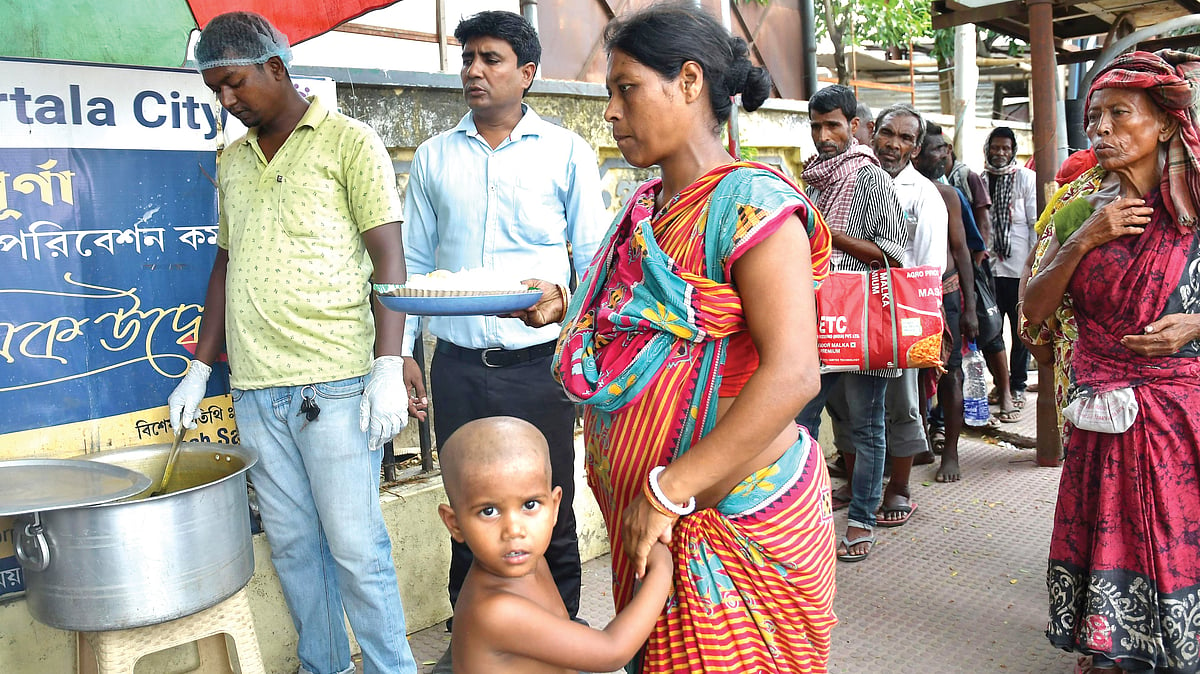
The 2024 UNDP Global Multidimensional Poverty Index identifies India as home to the largest number of people living in multidimensional poverty — 234 million, or nearly a fourth of the world’s 1.1 billion poor.
The Global Hunger Index 2025 classifies India’s condition as ‘serious’. At 102 of 123 countries, India is ranked below Pakistan (94), Bangladesh (88) and Sri Lanka (66). Approximately 806 million — that’s 55 per cent of India’s population of 1.46 billion — are currently covered under the National Food Security Act for highly subsidised foodgrains.
Education is another challenge, with India spending just 4.6 per cent of GDP — well below the 6 per cent target suggested by the 2020 National Education Policy and even less than Kyrgyzstan, Senegal and Burkina Faso. Latest data show over 1.17 million children are out of school across India, raising the question: how is the country to fulfil its objective of becoming a global technology hub when 19.1 per cent of its adult population is illiterate?
Bragging about his government’s unprecedented achievements for society and the economy, Modi once remarked, “I am looking forward to the day when Americans will be in queue for an Indian visa.” It was his external affairs ministry that informed Parliament in 2023 that a record 1.38 million Indians renounced their citizenship between 2014 — the year Modi took office — and June 2023.
But what do these grim ratings matter if you can manufacture a chorus that all is hunky-dory?
Sarosh Bana is executive editor of Business India. More of his writing can be read here
Join our official telegram channel (@nationalherald) and stay updated with the latest headlines