Opinion
How Trump and the mighty US were humbled
The Iran war might end quite abruptly because public opinion in the US will likely pressure Donald Trump to do a volte-face
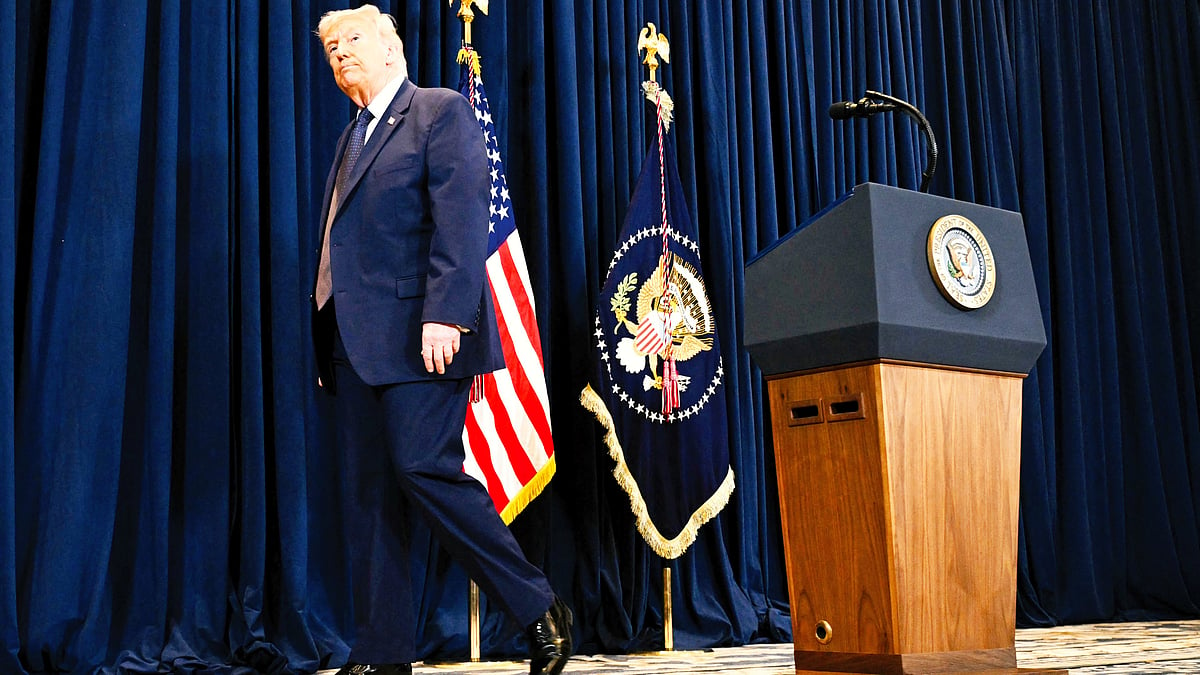
In capitals around the world there is talk of a prolonged war between Iran and US–Israel and the collateral damage this will inflict on Sunni Arab nations in the Persian Gulf. Most of these nations have protested claiming neutrality, but many host US military bases on their soil and at least some were covertly in favour of the US action.
The war wasn’t showing any outward signs of abating at the time of writing, but it might end quite abruptly — before the end of March, if not earlier. This is because the world — the US included — has been plunged into acute energy-supply shortages and public opinion will likely pressure US president Donald Trump to do a volte-face.
Trump is scheduled to visit China from 31 March, and it is most unlikely that such a summit will take place while the war, where Washington and Beijing are awkwardly on opposite sides, is still on.
Crude oil prices have rocketed to levels not seen since the Russian invasion of Ukraine four years ago, and unless the war ends and supplies resume through the Strait of Hormuz, the world could be in for the biggest oil shock ever.
Gas prices, too, have risen to a four-year high, with a force majeure shutdown announced by the world’s sixth largest producer—Qatar. Even releases from the IEA’s (International Energy Agency) emergency stockpile won’t help beyond a limited period. The world’s daily demand is an estimated 104 million barrels a day.
On 10 March, Trump’s social media post claimed the US mission was ‘very far ahead of schedule’ and ‘very complete, pretty much’. At a public event, he was heard saying “we are ahead of our initial timeline by a lot… we have taken out the leadership twice and maybe three times”.
These are signs he is preparing the ground for a face-saving exit.
****
Trump had demanded an ‘unconditional surrender’ by Iran, but that hasn’t happened. So, he might waive the elimination of Khamenei Sr. and hit on Iran’s defensive shield to claim ‘mission accomplished’.
In a televised address to the nation on 21 June 2025 (the day of the US strikes on Fordow, Natanz and Isfahan), Trump had claimed that “Iran’s key nuclear enrichment facilities have been completely and totally obliterated”.
However, earlier this month (on 9 March), International Atomic Energy Agency (IAEA) head Rafael Grossi was quoted by Reuters as saying, “What we believe is that Isfahan had until our last inspection a bit more than 200 kg, maybe a little bit more than that, of 60 per cent (enriched) uranium.” This stock is believed to be in tunnels that survived the strikes, and if enriched further, can yield sufficient explosive material for 10 nuclear weapons.
The war has surely depleted Iran’s arsenal of missiles but it’s not spent yet. Also, Russian drone expertise, gained from its war with Ukraine, has been made available to Iran.
The despatch of US Navy aircraft carriers to the Strait of Hormuz was more gunboat diplomacy than a forerunner to an all-out assault on Iran.
On 26 February, Oman’s foreign minister Badr Albusaidi, who was mediating talks between US and Iranian officials in Geneva, declared the two sides had made ‘significant progress’. Experts from the two sides were supposed to meet in Vienna the following week to take the discussion forward.
For Israel’s trigger-happy Prime Minister Benjamin Netanyahu — who has clung to power in the face of corruption charges at home and a warrant of arrest from the International Criminal Court (ICC) for war crimes in Gaza — a US-Iran rapprochement is bad news.
Trump — who has nurtured ambitions to make a deal with Tehran that he can take credit for — betrayed the ongoing dialogue, reportedly because he didn’t want Israel to take singular credit for the termination of Iran’s supreme leader. He even crowed that he will decide Iran’s new leadership.
Trump is now frustrated that even this strike has not produced a ‘capitulation’ of the Islamic regime. Not even after considerably greater US expenditure since last year to whip up a people’s rebellion in Iran.
Liberal Iranians, understandably livid with the suppression, are easy prey to such inducements. But the January uprising, partly fanned by the CIA, failed — and the crackdown by a ruthless Islamic establishment has claimed the lives of thousands.
Iran is a divided nation. Large sections of the country fervently wish for an ouster of the ruling Mullahs. But Mojtaba Khamenei, the new supreme leader, could initially benefit from a sympathy factor — his mother, wife and a son also died in the deadly attack to kill his father.
So, a regime change may not immediately be on the cards.
****
Meanwhile, fuel prices are soaring, and Americans are feeling the pinch of the rising cost of food and other essentials. Trump faces midterm elections in November. Around 60 per cent of Americans disapprove of the ongoing war; that number may balloon as the body bags of servicemen return to the US.
The war and the concomitant crude oil crisis have meant that US sanctions on the purchase of Russian oil are lifting, an embarrassing sideshow of which was the announcement that India was now “allowed” to resume purchases of Russian oil.
Trump was upbeat about a phone call with Russia president Vladimir Putin, who signalled his country’s willingness to provide oil and gas to Europe. It will be a coup for the Kremlin if Europe is compelled to resume business with Russia.
Onto the continuing strategic blunders of the Modi government, his presence in Tel Aviv 24 hours before Israel’s attack on Iran was diplomatic hara-kiri. Modi’s naked bias and his silence on the assassination of Khamenei has sunk India to a new low in the eyes of the developing world.
Contrast this with India’s deft manoeuvres under P.V. Narasimha Rao to upgrade diplomatic relations with Israel in 1992, after which India was seen as a neutral party both Israelis and Palestinians could turn to.
Modi’s lunge towards Netanyahu has wrecked India’s standing in the Global South. Under the current government, India has consistently been on the wrong side of UN General Assembly votes on Israel, and will find itself in a minority on the West Asia issue at the BRICS summit India is scheduled to host later this year.
Ashis Ray was formerly editor-at-large of CNN. He is the author of The Trial that Shook Britain. More of his writing can be found here
Join our official telegram channel (@nationalherald) and stay updated with the latest headlines