Opinion
What the British understood about protest that Modi doesn’t
As the Modi govt blocks protests over the Election Commission, Champaran shows how govts can respond to peaceful dissent
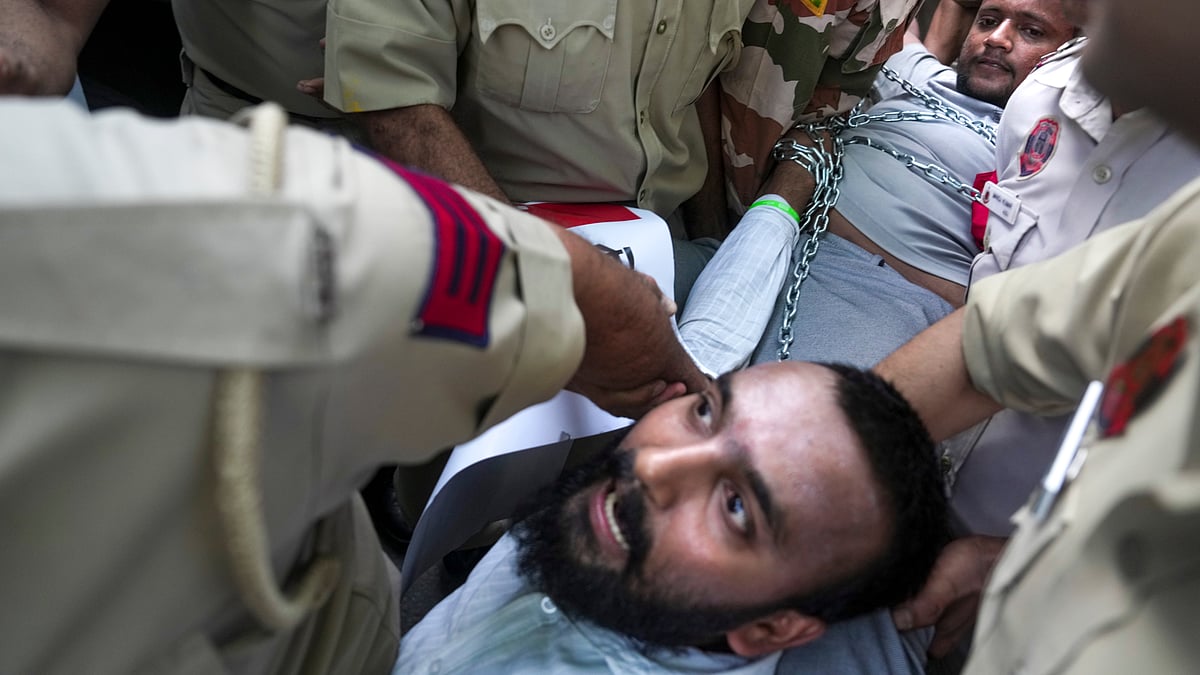
While Gandhi Jayanti is still fresh on our minds and the right to peaceful assembly is in the news again, let’s look at a few things that may be relevant.
The Modi government is stopping protesters from gathering as I write, because it wants to shield the chief election commissioner from accountability. His misconduct is not disputed: the facts are before us, but the government has adopted what we Indians say is a ‘jo karna hai kar lo’ posture. Is it sustainable? We will get to that, but first, a detour.
Gandhi’s opening protest in India was in 1917, when he was 47. He learned that the tenant farmers of Champaran were bound by law to plant indigo on 15 per cent of their land, whether they wanted to or not, under a system called tinkathia.
Gandhi decided to go on a fact-finding mission to Champaran and was ordered by the British magistrate to leave, which Gandhi decided not to do. He writes in his autobiography about what happened next: 'A sort of friendliness sprang up between the officials — Collector, Magistrate, Police Superintendent — and myself. I might have legally resisted the notices served on me. Instead I accepted them all, and my conduct towards the officials was correct. They thus saw that I did not want to offend them personally, but that I wanted to offer civil resistance to their orders.
'In this way they were put at ease, and instead of harassing me they gladly availed themselves of my and my co-workers’ co-operation in regulating the crowds. But it was a visible demonstration to them of the fact that their authority was shaken. The people had for the moment lost all fear of punishment and yielded obedience to the power of love which their new friends exercised.'
The British quickly assessed the situation as not winnable. Gandhi writes: 'Before I could appear before the Court to receive the sentence, the Magistrate sent a written message that the Lieutenant Governor had ordered the case against me to be withdrawn, and the Collector wrote to me saying that I was at liberty to conduct the proposed inquiry, and that I might count on whatever help I needed from the officials. None of us was prepared for this prompt and happy issue. Crowds of peasants came to make their statements, and they were followed by an army of companions who filled the compound and garden to overflowing.'
It should be noted that the British government then moved with empathy. Gandhi writes: 'The ever growing number of ryots coming to make their statements increased the planters’ wrath, and they moved heaven and earth to put an end to my inquiry. But Sir Edward Gait, the Lieutenant Governor, asked me to see him, expressed his willingness to appoint an inquiry and invited me to be a member of the Committee. The Committee voted in favour of the farmers, and recommended that the planters should refund a portion of the exactions made by them which the Committee had found to be unlawful, and that the tinkathia system should be abolished by law.
'The tinkathia system which had been in existence for about a century was thus abolished, and with it the planters’ raj came to an end.'
This is how government must work: it must concede the right to peaceful assembly and protest, and it must undo injustice.
Let us return to the present day. The Modi government was forced to concede the principle of accountability when it fired Dharmendra Pradhan over the botched functioning of the exam system. This concession came after it became clear that the government’s posture, including the prime minister’s Instagram videos, was not acceptable to the protesters.
The government is now resisting the firing of the chief election commissioner. He is of great importance to the BJP, as we have observed not only with this mess of the SIR but also with his conduct towards Opposition parties.
The furious back-pedalling on the SIR shows that the government has become alarmed and wants to be seen making minor concessions so that the anger dissipates. A tweak in the process here, a new form filled there.
Alas, this has not worked because citizens have seen how egregious the whole electoral roll scandal is. The problem for the government is that once a large enough section of the citizenry has taken to the streets, the state has to fold.
This happened with the farmers, it happened on the issue of the NRC, and it happened with Dharmendra Pradhan. It will happen again, because there is no real alternative.
Gyanesh Kumar has another two-and-a-half years left in office, until January 2029, and it is hard to see the government being able to hold on to him, however precious he may be to Modi, until then. If the protesters remain mobilised, the government will be compelled to do the right thing ultimately and concede again the principle of accountability.
It seems absurd to say this, but it is appropriate: the Modi government must learn from the conduct of the British raj with Gandhi at Champaran. Accept the right to peaceful assembly; reverse the injustice done to crores of voters; punish the man responsible.
Views are personal. More of Aakar Patel’s writing here
Join our official telegram channel (@nationalherald) and stay updated with the latest headlines